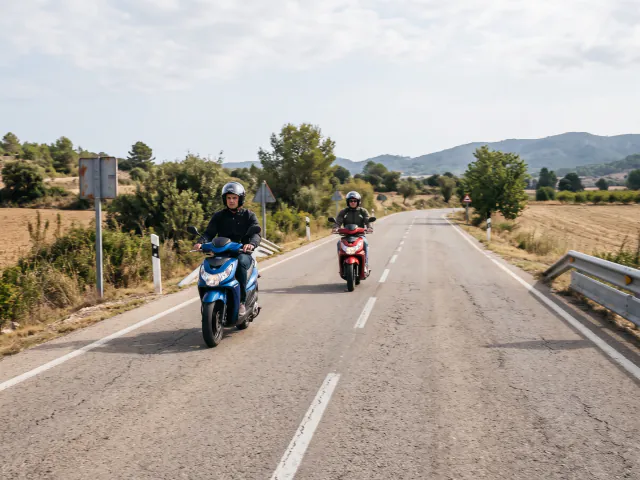
Overtaking cyclists, pedestrians and PMVs: 1.5 m on any road and 20 km/h less
Now.1.5 m or a complete lane change on any road and, outside built-up areas, at least 20 km/h below the limit.
Before. The Regulations asked for 1.5 m only outside built-up areas and, in built-up areas, a “proportionate” margin. With cycles and mopeds, the Law already required 1.5 m on any road (and a complete lane change since March 21, 2022).
See detailsHide details
When overtaking pedestrians, animals, animal-drawn vehicles, mopeds, PMVs and cyclists:
You leave 1.5 m or change lanes completely, on any road.
Outside built-up areas, you travel at least 20 km/h below the limit of the road before and during the overtaking.
A group of cyclists counts as a single unit.
The overtaken motorcycle is no longer on the list: with it, sufficient separation is enough.
Rule: RD 518/2026
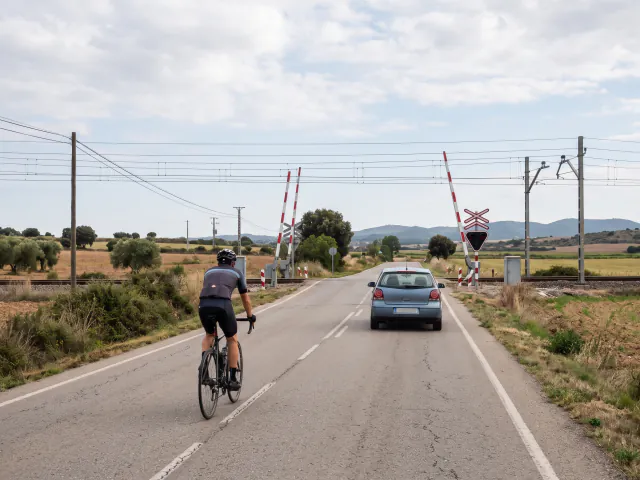
No overtaking at pedestrian crossings, intersections with cycle paths and level crossings
Now. Overtaking is prohibited at pedestrian crossings, intersections with cycle paths and level crossings, with no exceptions.
Before. A two-wheeled vehicle could be overtaken at a level crossing, and any vehicle at a pedestrian crossing at very low speed.
See detailsHide details
The exceptions that allowed overtaking in these places disappear. At a pedestrian crossing, at an intersection with a cycle path or at a level crossing, you overtake no one.
Rule: RD 518/2026
Passing an immobilized vehicle: 1.5 m and 20 km/h less
Now. You leave 1.5 m on any road and travel 20 km/h below the limit.
Before. Outside built-up areas, 1.5 m had to be left when overtaking an immobilized or assistance vehicle (since 2021), with no speed reduction set; in a section where overtaking was prohibited, it could be passed by occupying the opposite lane after checking that there was no danger.
See detailsHide details
When passing a vehicle immobilized by a breakdown, accident, assistance, road works or officers:
You leave 1.5 m, even if you have to enter the opposite lane.
You travel 20 km/h below the limit of the road.
Rule: RD 518/2026
Emergency lane in tailbacks
Now. On motorways and dual carriageways, with a tailback at walking pace or stopped, an emergency lane is opened.
Before. The Regulations did not regulate the emergency lane.
See detailsHide details
When traffic on a motorway or dual carriageway moves at walking pace or is stopped:
With two lanes, the gap is left in the middle.
With three or more, between the left lane and the adjacent one.
Rule: RD 518/2026
Snow on motorways and dual carriageways: no overtaking and keep right
Now. With snow, overtaking is prohibited and you drive in the right lane.
See detailsHide details
With snow on a motorway or dual carriageway:
Overtaking is prohibited.
You drive in the right lane; with three or more lanes, also in the adjacent one.
The left lanes are left free.
Rule: RD 518/2026
In town, 5 m behind the bicycle
Now. In urban areas, motor vehicles leave 5 m from the cyclist ahead in the same lane.
See detailsHide details
In an urban area, if you follow a cyclist in the same lane, you leave at least 5 m. The bicycle preferably rides in the center of the lane (art. 153.4 of the General Traffic Regulations).
Rule: RD 518/2026
Right of way of cyclists and pedestrians; single platform
Now. The cyclist has the right of way over any vehicle, and the definitions of single platform and vulnerable road users are added.
Before. The cyclist had the right of way only over motor vehicles in those cases.
See detailsHide details
The cyclist has the right of way over any vehicle, not only motor vehicles, in the cases of article 64.2.
The pedestrian has the right of way at crossings, on sidewalks and in pedestrian areas, and when getting on or off the bus at the stop.
Single platform: the pedestrian has the right of way on the whole roadway.
Vulnerable road users are defined.
Rule: RD 518/2026
Pedestrians: left shoulder and a luminous item at night
Now. Without a pedestrian area, the pedestrian walks on the left shoulder and, at night on an interurban road, with a luminous or reflective item.
Before. There was the “right-hand sidewalk” rule and exceptions for walking on the shoulder with a bulky object, a cart or a wheelchair. Outside built-up areas pedestrians already walked on the left; in built-up areas they could walk on the right or on the left.
See detailsHide details
The “right-hand sidewalk” rule and the exceptions for a bulky object, a cart and a wheelchair on the shoulder disappear.
Without a pedestrian area, you walk on the left shoulder.
At night on interurban roads, with a luminous or reflective item visible from 150 m.
Skates are regulated by the city council.
Rule: RD 518/2026
Bicycle: helmet with no exceptions on interurban roads and passengers up to 22 kg
Now. Helmet compulsory on interurban roads with no exceptions and passengers who are minors weighing up to 22 kg.
Before. The helmet had exceptions (slopes, heat and medical reasons) and the bicycle could carry passengers “up to 7 years old”.
See detailsHide details
Bicycle helmet:
Compulsory on interurban roads, with no exceptions.
On any road for under-16s.
In town, for those who work riding a bicycle (for example, delivery workers).
Passenger: the bicycle may carry minors weighing up to 22 kg who can sit unaided, in an approved additional seat.
Rule: RD 518/2026
Restrictions for environmental reasons
Now. A road can also be restricted for environmental reasons. Failing to respect a low-emission zone or a pollution protocol is serious: €200, with no loss of points.
Before. The Traffic Law already allowed traffic to be restricted for environmental reasons (art. 18), and since 2022 failing to respect a low-emission zone (ZBE) is a serious offense; the Regulations did not include it.
See detailsHide details
The authorities may restrict traffic for environmental reasons, as well as for safety or traffic flow: low-emission zones (ZBE), residential priority zones or other roads (arts. 37.1 and 157 of the General Traffic Regulations).
Failing to respect the restrictions of a ZBE or of a protocol for pollution episodes is a serious offense (art. 76.z3 of the Traffic Law): €200, with no loss of points.
Art. 37.6 of the Regulations classifies driving without authorization on a restricted road as very serious, including for environmental reasons, but refers to a letter of the Law (77.l) that deals with the authorization of the vehicle. The Law prevails.
Rule: RD 450/2026
Electric scooters (PMVs): registration, insurance and new rules
Now. They need a certificate, registration, label and insurance, and from October 1, 2026 there is a minimum age, a helmet and prohibited roads.
See detailsHide details
To be ridden, the PMV (electric scooter) needs:
Compulsory insurance, from January 2, 2026.
Certificate, registration with the DGT and label, from January 30, 2026.
From October 1, 2026, in addition:
A minimum age of 15 years to ride one.
Helmet compulsory.
Lights on (during the day, from October 1, 2027).
You may ride on the cycle paths and bike lanes of motorways, dual carriageways, roads passing through a town (travesías), interurban roads and urban tunnels. Outside them, the PMV remains prohibited on those roads, as it has been since 2021.
Rule: RD 52/2026; Ley 5/2025; RD 518/2026
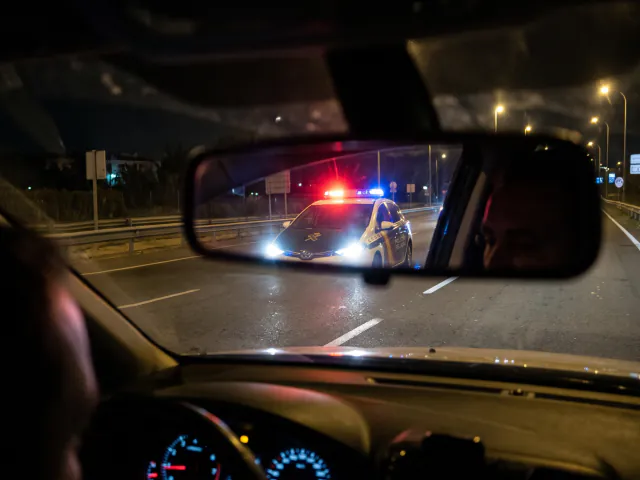
Police behind you: red light facing forward
Now. The flashing light facing forward is red.
Before. The police vehicle behind you asked you to stop with a red or yellow flashing light facing forward.
See detailsHide details
When a police vehicle positions itself behind you and turns on the red flashing light facing forward, it orders you to stop:
You stop on the right, in front of the police car.
You stay inside the vehicle until you are told otherwise.
Rule: RD 465/2025
Order of precedence of signsClarification
Now. The second step is temporary signage, which includes temporary delineation and delimiting devices.
Before. The second step of the order of precedence mentioned “fixed delineation signs”.
See detailsHide details
The order of the five types of signs is the same as in 2003:
Traffic officers.
Temporary signage (includes temporary delineation and delimiting devices).
Traffic lights.
Vertical signs.
Road markings.
Among signs of the same type, the most restrictive one prevails. The underlying rule does not change, but its wording does: an old question that mentions “fixed delineation” may now be wrong.
Rule: RD 465/2025
Road works signs in yellow and temporary signs in orange
Now. At road works, the list is extended to all warning signs, R-1, R-100 to R-120 (except R-101) and R-504, and temporary signage for other causes is orange.
Before. At road works, the P-18 and a list of signs (among them R-300 to R-306, R-500 to R-503, lane signs and direction signs) already had a yellow background, and road markings were yellow.
See detailsHide details
2025 Catalog of Traffic Signs (sections 2.5 and 2.6):
At road works, yellow background on warning signs, R-1, R-5, R-100 to R-120 (except R-101), R-200 to R-205, R-300 to R-306 and R-500 to R-504.
Lane signs at road works are also yellow, with black symbols.
Temporary signage for other causes (not road works) is orange.
Signs that do not apply are covered with a black sticker.
Rule: RD 465/2025
S-28: stay and play zone at 10 km/h
Now. The S-28 is “stay and play zone”, at 10 km/h.
Before. The S-28 was “residential street”, at 20 km/h.
See detailsHide details
In the zone marked with the S-28:
The maximum speed is 10 km/h.
The pedestrian has the right of way.
Parking is allowed only where indicated by signs.
Rule: RD 465/2025
R-305: it only prohibits overtaking by entering the opposite lane
Now. The R-305 prohibits overtaking motor vehicles when the maneuver requires entering the opposite lane; without entering it, the sign does not prohibit it, whatever the vehicle.
Before. The R-305 prohibited overtaking any motor vehicle, even without entering the opposite lane; only two-wheeled motorcycles could be overtaken without entering it.
See detailsHide details
The R-305 (no overtaking) no longer prohibits overtaking without entering the opposite lane, which is why the exception for two-wheeled motorcycles disappears. If to overtake you have to enter the opposite lane, you must not overtake any motor vehicle.
The R-306 (trucks over 3,500 kg) does prohibit overtaking any motor vehicle, motorcycles included, even without entering the opposite lane.
Rule: RD 465/2025
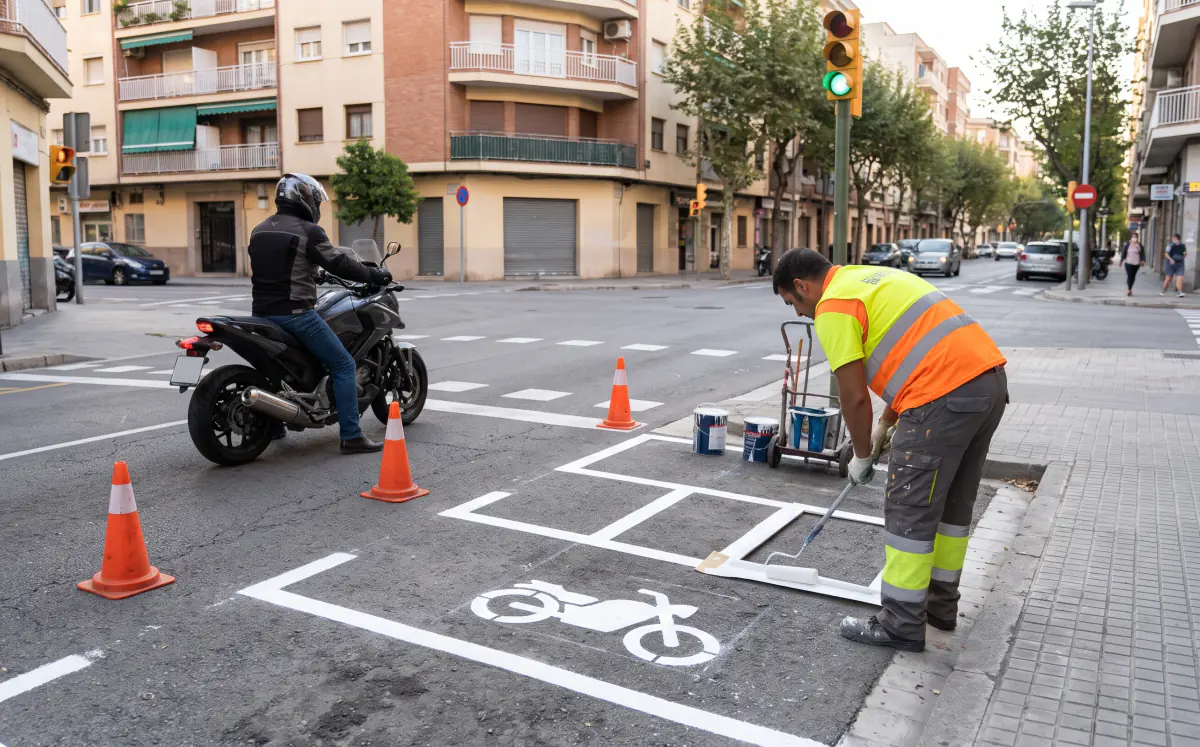
New road markings
Now. New markings appear for motorcycles and bicycles in front of traffic lights, dragon’s teeth and the speed bump.
See detailsHide details
2025 Catalog of Traffic Signs (section 5.2, road markings):
Motorcycle and bicycle advance zones (avanza-motos and avanza-bici): two lines 4 m apart before a traffic light; with the light red, only the vehicles drawn may occupy that space.
Dragon’s teeth (M-8.1).
Speed bump (M-4.5).
The yellow curb markings (solid, broken and zigzag) and the yellow box junction are not new: they already existed.
Rule: RD 465/2025
Other signs that change
Now. The R-412 allows snow tires, there is a new panel for overtaking cycles, and some signs disappear.
Before. The R-412 only mentioned chains, the S-940 had a 100 km/h row, and the S-30 and R-308a/b existed.
See detailsHide details
R-412: chains or snow tires.
S-940: without the 100 km/h row.
S-891: new panel of 1.5 m when overtaking a cycle.
The S-30 (30 zone) and the R-308a/b disappear.
Rule: RD 465/2025
Changes specific to Permit A1/A2
NEW
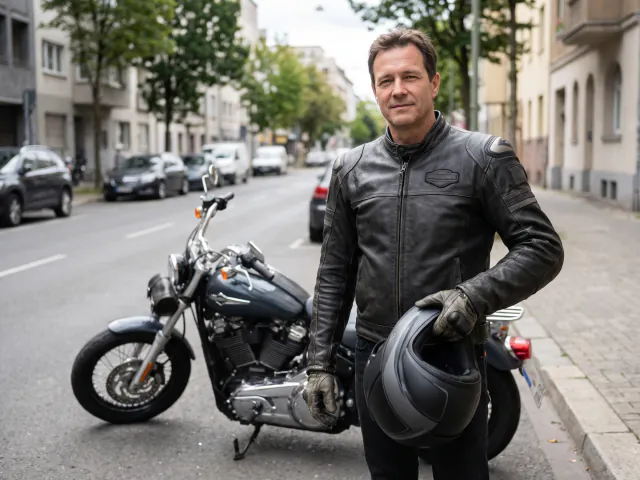
Motorcycle: R22 approved helmet
Now. The helmet must be approved under UNECE Regulation R22 and properly fastened, on all types of roads. A helmet that is only certified is no longer valid.
Before. The helmet had to be approved or certified under the legislation in force.
See detailsHide details
Riders and passengers of motorcycles, motorcycles with a sidecar, three-wheeled vehicles, quadricycles and quads wear a helmet approved under R22, properly fastened, on all types of roads (art. 118.1.a of the General Traffic Regulations).
On the moped, the certified helmet is valid until September 30, 2027 (first transitional provision of RD 518/2026; see “Coming soon”).
Rule: RD 518/2026
Helmet with no medical exemption
Now. The exemption disappears: the helmet is compulsory for everyone, even with a medical certificate.
Before. With a certificate of exemption for serious medical reasons, signed by a physician and stating its period of validity, you could ride a motorcycle or moped without a helmet.
See detailsHide details
RD 518/2026 repeals paragraph 3 of art. 119 of the General Traffic Regulations, which exempted anyone with a medical certificate from wearing a helmet. The medical certificate remains valid for the seatbelt (art. 119.1.b), not for the helmet.
Rule: RD 518/2026
Motorcycles on the shoulder in tailbacks
Now. On signposted sections (vertical sign and road markings), motorcycles may use the right shoulder when the traffic in the lanes is stopped by congestion: at 30 km/h at most and in single file.
See detailsHide details
The extraordinary use of the shoulder by motorcycles (art. 36.3 of the General Traffic Regulations) is only valid:
on sections agreed between the authority responsible for the road and the DGT, signposted with a vertical sign and road markings;
when the traffic in the lanes is stopped by congestion;
at 30 km/h at most and in single file, taking extreme care.
The motorcyclist must not put at risk those who are required to use the shoulder (cyclists, mopeds…) and must leave it if necessary. It does not apply to mopeds.
Rule: RD 518/2026
The motorcycle carries a vest
Now. The motorcycle carries a high-visibility reflective vest in its equipment, and the motorcyclist puts it on if getting out and occupying the roadway or shoulder of an interurban road.
Before. The reflective vest was in the equipment of passenger cars, buses, trucks, dual-purpose vehicles and combined vehicles, not in that of the motorcycle, and the obligation to put it on when getting out did not include motorcyclists.
See detailsHide details
Equipment: motorcycles carry a high-visibility reflective vest (annex XII.3 of the General Vehicle Regulations).
Use: the driver of a motorcycle puts it on when leaving it and occupying the roadway or shoulder of an interurban road (art. 118.4 of the General Traffic Regulations), like the driver of a passenger car.
The moped does not have that equipment; anyone who rides for work, on a motorcycle or on a moped, always wears one (see “Vest always if you ride for work”).
Rule: RD 518/2026
Helmet intercom, allowed
Now. Earphones remain prohibited, but the motorcyclist may use a wireless device, certified or approved, built into the helmet, only for intercom or navigation.
Before. Driving with headphones or earphones connected to sound devices was prohibited. The phone, only if used hands-free and without headphones or earphones.
See detailsHide details
Art. 18.2 of the General Traffic Regulations prohibits driving with audio headphones, earphones or other devices that reduce attention. As an exception, drivers of motorcycles and mopeds may use a device that is:
wireless and certified or approved;
built into the helmet;
used only for intercom or navigation, and provided that it does not affect safety.
Earphones for listening to music, or the phone in the hand, remain prohibited.
Rule: RD 518/2026
Gloves on interurban roads and closed footwear
Now. The rider and passenger wear protective gloves on interurban roads and closed footwear covering the whole foot on any road.
Before. Only the helmet was compulsory. No gloves or footwear.
See detailsHide details
For motorcycles, mopeds, three-wheeled vehicles, quadricycles and quads (art. 118.1.b and c of the General Traffic Regulations):
Protective gloves on interurban roads. Until an order sets their specifications, those in use now are valid.
Closed footwear covering the whole foot, on all types of roads: no flip-flops or sandals.
If the vehicle has a self-protection structure and seatbelts and this is stated on its roadworthiness test (ITV) card or on the moped’s technical specifications certificate, its occupants wear no helmet, gloves or that footwear, and fasten the seatbelt.
Rule: RD 518/2026
Vest always if you ride for work
Now. Anyone who rides a motorcycle, moped, bicycle or PMV for work wears a high-visibility reflective veston all types of roads.
Before. Anyone riding for work on a motorcycle, moped, bicycle or scooter was not required to wear a vest.
See detailsHide details
Art. 118.4 of the General Traffic Regulations requires drivers who carry out their professional activity riding motorcycles, mopeds, three-wheeled vehicles, quadricycles, quads, bicycles and other cycles or personal mobility vehicles to wear a high-visibility reflective vest that meets the requirements for personal protective equipment, on urban and interurban roads: for example, a delivery rider or a courier.
Rule: RD 518/2026
Motorcycle signs: also three-wheeled vehicles treated as motorcycles
Now. R-103, R-104, R-404 and R-405 also include three-wheeled vehicles treated as motorcycles.
Before. R-103 and R-404 made an exception for “motorcycles without a sidecar”, and R-104 and R-405 referred only to motorcycles.
See detailsHide details
R-103 (entry prohibited to motor vehicles, except two-wheeled motorcycles): it does not prohibit entry to two-wheeled motorcycles or to three-wheeled vehicles treated as motorcycles.
R-104 (entry prohibited to motorcycles): it prohibits entry to motorcycles and to three-wheeled vehicles treated as motorcycles.
R-404 (mandatory roadway for automobiles, except two-wheeled motorcycles): vehicles treated as motorcycles are also outside the obligation.
R-405 (mandatory roadway for two-wheeled motorcycles): it also applies to vehicles treated as motorcycles.
Rule: RD 465/2025
Other changes
They change things for you, but are not part of the exam.
Course to move from A2 to A
Now. Still at least 9 h, but over two or more days, with 2 h on a closed circuit and 4 on open roads.
Before. Under Order INT/2323/2011: 9 h, with 4 h on a closed circuit and 2 on open roads, and a practice motorcycle of more than 175 kg.
See detailsHide details
At least 9 hours, spread over two or more days.
2 h on a closed circuit and 4 h on open roads, 2 of them on a conventional road.
Theory in person or in a virtual classroom.
The practice motorcycle goes from “more than 175 kg” to 595 cc and 50 kW.
Rule: Orden INT/210/2025
Coming soon
Already approved, but not yet in force.
SOON
Uncertified PMVs: they can no longer be ridden
Now. From January 22, 2027, those uncertified PMVs can no longer be ridden.
Before. PMVs without a certificate sold before January 22, 2024 are registered with only make, model and serial number.
See detailsHide details
Until January 22, 2027, a PMV sold before January 22, 2024 without a certificate can be registered with only make, model and serial number. From that date, it can no longer be ridden.
Rule: RD 52/2026, disposición transitoria 1.ª
SOON
PMV: lights on during the day too
Now. From October 1, 2027, the PMV is ridden with its lights on during the day as well.
Before. Until October 1, 2027, PMV lights are not compulsory during the day.
See detailsHide details
Article 155.5 of the annex to the Regulations requires PMV lights to be on day and night from October 1, 2027.