
Maneuvers
In this topic:
- How any maneuver is prepared, signaled and carried out, and which signals you use with the lights or with your arm.
- Where you position yourself to turn, how you join traffic and when you may make a U-turn or reverse.
- How to overtake, where it is prohibited and what changed on 1 October 2026 when overtaking cyclists, mopeds, personal mobility vehicles (PMV) and pedestrians.
- Where you may stop and park, and what to do with the car when you leave it.
A maneuver is any change in the position of your vehicle on the roadway: pulling out of a parking space, changing lanes, turning, turning around, overtaking or stopping. Each one cuts across the path of other users, so all of them are a potential danger and the General Traffic Regulations regulate them one by one. In the exam it is one of the topics with the most questions, above all on overtaking and on stopping and parking.
1. What a maneuver is and how it is carried out
Driving in a straight line in your lane is not a maneuver. Neither is following the line of a curve: you do not change your position on the roadway, you just follow the road. What are maneuvers: joining traffic, moving sideways or changing lanes, changing direction (turning), making a U-turn, reversing, overtaking, stopping and parking.
Before any of them, the Regulations require you to make sure that you can do it without danger and to signal it to others. This gives the MSM rule, which you should always repeat in the same order:
- Mirror (observe). Look in the mirrors and, if needed, turn your head to cover the blind spot. You need to know what is behind, to the sides and ahead. The mirrors are checked regularly while you drive, not only before maneuvering: that way you always know what is around you.
- Signal. Signal the maneuver far enough in advance, so that others see it before it starts.
- Maneuver. Carry it out progressively and in the least space and time possible.
If, when observing, you see that the maneuver is not safe, do not make it: refrain and wait. Signaling gives you no right; it only warns.
When you reach an intersection, the maneuver begins before the intersection. In the approach phase, first check the traffic that is approaching, decide in advance whether you are going to continue straight or turn, take the right lane and position, and, once positioned, adjust your speed to the turn or the crossing.
Watch out in the exam: “taking a curve” is the typical answer to “which of these is not a maneuver?”. Even so, good technique is to brake before entering the curve and accelerate gently when leaving it.
2. How maneuvers are signaled
Signaling maneuvers is mandatory, whether or not there is traffic. As a general rule they are signaled with the vehicle's light signals (indicators, brake lights, reversing light) and, failing that, with your arm.
Arm signals only count if others can see them and they are made as the Regulations say. And if they contradict the lights, the arm prevails: it overrides any optical indication that contradicts it. For example, a driver with the right indicator on who sticks out an arm horizontally with the palm facing down is telling you that they are going left.
You must signal with optical signals any maneuver that involves moving sideways or backward, and also your intention to immobilize the vehicle or to brake considerably. It is signaled far enough in advance and, if done with lights, the signal is kept until the maneuver ends.
| What you are going to do | With the lights | With your arm |
|---|---|---|
| Move or turn left | Left indicator | Left arm extended horizontally, with the palm facing down |
| Move or turn right | Right indicator | Left arm bent upward, with the palm open |
| Reverse | Reversing light | Arm extended horizontally, with the palm facing backward |
| Brake hard or immobilize the vehicle | Brake lights, switched on repeatedly (pressing and releasing) | Arm moved up and down, with short, quick movements |
| Stop or park | Also the indicator on the side you are going to pull over to | As when braking |
In a lateral movement only the movement is signaled. As soon as the vehicle has taken its new path, you switch the indicator off: when you finish changing lanes, when you are integrated into the lane you are joining or when you finish moving over to overtake.
If you are immobilized on a motorway or dual carriageway, or where visibility is poor, also switch on the hazard lights and, if needed, the position lights.
Sound signals (horn). They are exceptional and never shrill or without reason. You may use them only to avoid a possible accident (above all on narrow roads with many curves), to warn the vehicle ahead outside built-up areas that you are going to overtake it and to make your presence known in the cases the Regulations allow. Instead you may use flashes: switching the low beam, the high beam or both alternately on and off intermittently, at very short intervals and without dazzling. Flashes are also valid in built-up areas; the horn to warn of an overtaking is not.
3. Joining traffic
You join traffic when you leave a stop or a parking space, a gas station or a service area, a garage or private property, or an acceleration lane. In all cases:
- First, make sure that you can do it without danger, taking into account the position, path and speed of the others. If you cannot see well, you may follow another person's directions.
- Always yield to those already driving, whether they come from the right or from the left.
- Signal the maneuver with the indicator (or with your arm) and keep it on until you are integrated into the lane.
If you enter a public road from an exclusively private road, do so at a speed that allows you to stop immediately, yielding to those driving on the road in either direction.
Acceleration lane. It serves to gain speed before entering the roadway. Check at the start of the lane whether you can join without danger and, if you cannot, stop there, at the start, not at the end. Then accelerate to reach the end of the lane at a speed suited to that of the road. Entering a dual carriageway slowly is as dangerous as entering without looking: you force those coming to brake.
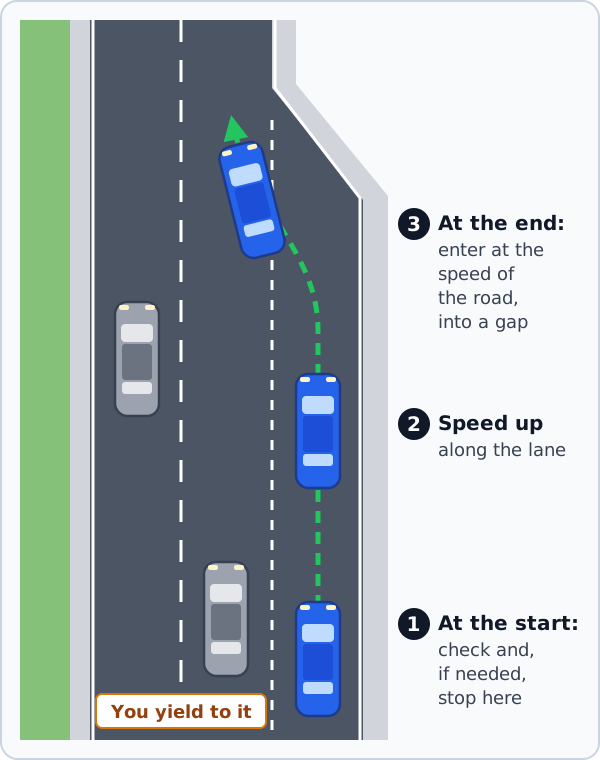
Figure 1. In the acceleration lane you look and, if needed, stop at the start; then you accelerate and enter at the end, at the speed of the road.
Driving faster in the acceleration lane than the cars on the roadway is not overtaking.
The others have obligations too. Make it as easy as possible for others to join, above all a bus pulling out of a signed stop. In built-up areas it is mandatory: move sideways if you can or reduce your speed, even to a stop if necessary, so that the bus can pull out of the stop. The bus driver is still obliged to signal and to take extreme precautions.
4. Lateral movements and lane changes
When changing lanes, whoever is already driving in the lane you are going to has the right of way. Turning on the indicator does not give you the right of way: you have to wait for a gap in which you enter without forcing anyone to brake or swerve. The movement is made gradually, with the indicator on from before you start until you finish.
When traffic is very dense and vehicles fill the whole width of the roadway, each lane goes at the speed set by the vehicle ahead. Then:
- One lane moving faster than another is not overtaking, even if you are on the right.
- Do not change lanes to overtake or for anything other than getting ready to turn, leave the roadway or take a direction.
Moving faster in a reserved lane (bus, acceleration, deceleration) than in the normal ones, or the other way around, is not overtaking either.
Road markings that limit lane changes (2025 Catalog of traffic signs and road markings):
- Solid line: do not cross it or drive on it. If it separates two lanes in the same direction, wait until it becomes a broken line to change.
- Solid line next to a broken line: only the one on your side counts. If it is the broken one, you may cross.
- Hatched markings (oblique stripes framed by a solid line): you do not enter that area, not even to turn or to leave the road.
- End-of-lane arrow: your lane is ending; you must leave it in the direction it indicates, yielding to those driving in the lane you are moving to. If the line between the two lanes is still solid, wait until it is broken.
5. Changes of direction: turning
To turn right or left, to take another roadway or to leave the road:
- Signal it far enough in advance to those behind you.
- Check that the speed and distance of those approaching, above all in the opposite direction, allow you to do it without danger. If not, refrain.
- Turning left without enough visibility is prohibited: if you cannot see what is coming, you do not turn.
Where you position yourself (unless the road is arranged or signed for it to be done another way):
| Turn | Roadway | Position |
|---|---|---|
| To the right | Any | As close as possible to the right edge |
| To the left | One-way | As close as possible to the left edge |
| To the left | Two-way with a center marking | Next to the line separating the directions, without entering the opposite direction |
| To the left | Two-way without markings | Next to the center of the roadway, without entering the opposite half |
| To the left | Two-way with three lanes separated by broken lines | In the center lane |
You position yourself with the necessary advance and make the turn in the least space and time possible. When you stay close to the center to turn left, those behind you may continue on your right: traffic does not stop for you.
When turning left at an intersection, leave the center of the intersection on your left, unless it is arranged or signed for it to be left on the right. If the road has an arrangement for turning (a turning bay, known as a raqueta, or a central waiting lane), you must use it, even if there is no sign saying so.
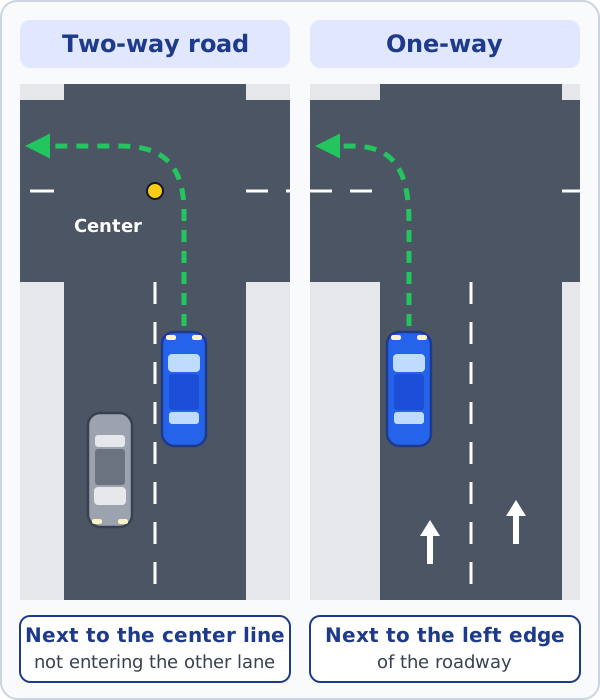
Figure 2. To turn left you stay close to the center line on a two-way road and to the left edge on a one-way road. On a two-way road, you pass the center of the intersection and leave it on your left.
If, because of the size of the vehicle, you cannot turn exactly this way, take extreme precautions. Bicycles and two-wheeled mopeds, on interurban roads and without a special lane for turning left, position themselves on the right, off the roadway if possible, and turn from there.
Leaving a motorway or dual carriageway. Signal in advance, position yourself in good time in the lane closest to the exit and enter the deceleration lane as soon as possible. Speed is reduced in that lane, not on the main roadway.
6. U-turns
Making a U-turn is turning around to travel in the opposite direction. To do it:
- Choose a suitable place, where you occupy the road for the shortest time possible.
- Signal it in advance (left indicator) and reduce your speed.
- Make sure that you do not endanger or obstruct anyone. If you are not sure, refrain.
- If, while you wait to turn, you are stopping those behind you, leave the roadway on your right, if possible, and wait there until you can do it.
It is prohibited to make a U-turn:
- Where you cannot check that it is safe (for example, on a change of gradient or a curve without visibility).
- At level crossings.
- In tunnels, underpasses and sections with the tunnel sign (S-5).
- On motorways and dual carriageways, except in the places provided for it.
- On all sections where overtaking is prohibited, unless a sign expressly authorizes it.
That last rule explains many questions: since overtaking is prohibited at pedestrian crossings, at intersections and near a level crossing, making a U-turn there is also prohibited. The no left turn sign includes the U-turn; the no change of direction sign prohibits it expressly.
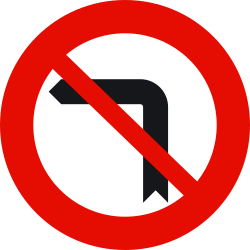
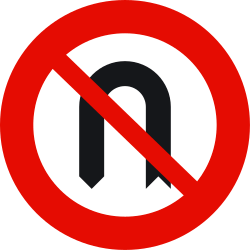
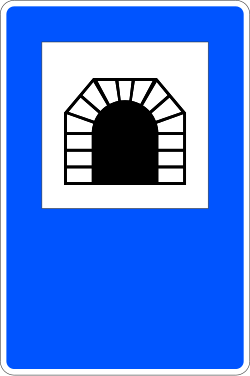
At a roundabout you may make a U-turn: you enter, go around it leaving the center on your left, as the arrows indicate, and exit the way you came.
Not complying with these rules is a serious offense that costs 3 points.
Watch out in the exam: the Regulations give only stopping, parking and joining traffic as examples of “complementary” reversing. That is why, in the questions, reversing to complete a U-turn that cannot be done in one go is given as not allowed as a general rule: look for a place where you can turn around in a single go.
7. Reversing
Driving backward is prohibited except in two cases, and always with the minimum indispensable distance:
- When you cannot move forward or change direction or make a U-turn. For example, in a dead-end street where there is no room to turn around. If you can turn or make a U-turn, you must not reverse out.
- As a complementary maneuver to a stop, a parking maneuver or joining traffic. Then, 15 meters at most and without entering an intersection.
The 15-meter limit and the prohibition on entering the intersection apply to complementary reversing. When you have no other way out, the limit is the minimum indispensable distance, even if it exceeds 15 meters or you have to enter an intersection.
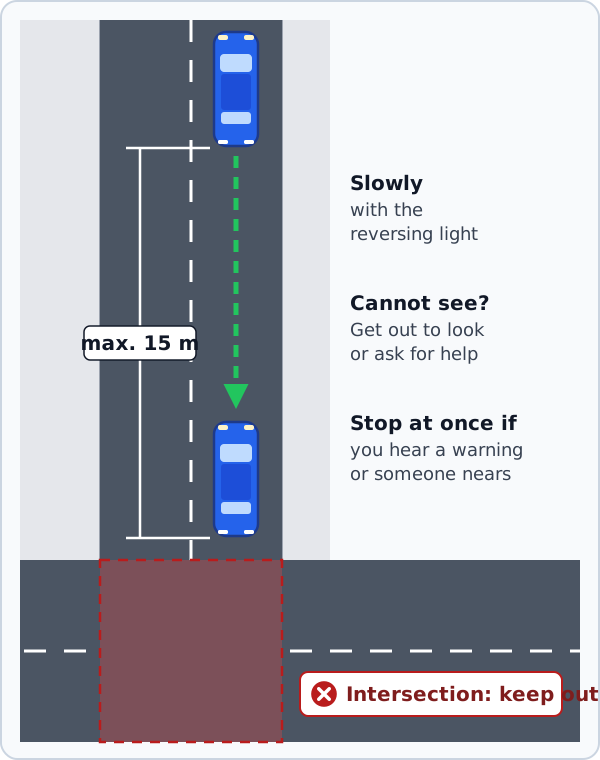
Figure 3. As a complementary maneuver, reversing does not exceed 15 meters or enter the intersection.
On motorways and dual carriageways reversing is always prohibited, also to go back to an exit you have missed. It costs 4 points. And if, by reversing, you end up driving in the opposite direction to the established one, the offense is very serious.
How it is done:
- Slowly, after signaling it with the reversing light or, if you do not have one or it does not work, with your arm extended horizontally and the palm facing backward.
- First, make sure that there is no danger because of the visibility, the space and the time you need. If you cannot see, get out to look or follow another person's directions.
- With maximum caution: stop immediately if you hear warnings or see a person, an animal or another vehicle approaching, and give up if necessary.
- If traffic does not let you do it safely, wait.
8. Overtaking
Overtaking is the most complex maneuver and the one with the most risk: you spend a while in a place that is not yours, sometimes in the lane of oncoming traffic.
8.1 Which side you overtake on
As a general rule, on the left. On the right only in these cases:
- When the vehicle ahead clearly indicates that it is going to turn left or stop on that side, and there is enough space. Do it with maximum caution.
- A tram that is going in the center of a two-way road, if there is space.
- In built-up areas, on roadways with at least two lanes in the same direction delimited by markings, after making sure that there is no danger.
Outside those cases you do not overtake on the right. On a motorway or dual carriageway outside built-up areas, the vehicle ahead staying in the left lane does not allow you to overtake it on the right: you wait, even if that lane is free. Inside built-up areas the exception of two lanes delimited by markings applies, if you can do it without danger. This does not allow you to choose a lane freely on a motorway or dual carriageway.
These are not overtaking: one lane going faster than another in dense traffic, moving faster in an acceleration, deceleration or reserved lane, or cyclists in the same group passing one another.
8.2 Before overtaking
- Signal in advance (left indicator).
- Check that in the lane you are going to use there is enough free space so as not to endanger or disturb oncoming traffic, taking into account your speed and theirs. If there is not, you do not overtake.
- Check that the vehicle ahead has not signaled that it is going to move to the same side. If it has, it has the right of way. If after a reasonable time it does not move, you may overtake it, warning it first with the horn or with flashes.
- Check that no vehicle behind has already started to overtake you. If the one behind only has its indicator on and has not moved yet, you may start.
- Make sure that you will have room to return to your lane when you finish.
- While you prepare, keep the safety distance from the vehicle ahead. Tailgating it does not shorten the overtaking and takes away your visibility. It is advisable to leave at least 2 seconds, and better 3 outside built-up areas.
- In a tunnel, if you are not going to overtake, leave at least 100 meters or 4 seconds from the vehicle ahead (150 meters or 6 seconds if your vehicle exceeds 3,500 kg).
To warn the vehicle ahead: outside built-up areas, with the horn or with flashes; in built-up areas, only with flashes.
Several vehicles at once. You may overtake several only if you are totally sure that, if someone appears coming the other way, you will be able to return to the right without endangering any of those overtaken. On a three-lane two-way roadway separated by broken lines, you may use the center lane only if oncoming traffic has not already occupied it to overtake.
8.3 During and after
- Drive at a speed clearly higher than that of the vehicle overtaken, without exceeding the limit of the road: since 2022 the limit may not be exceeded to overtake. If a car with a trailer is going at its maximum on a dual carriageway, you may overtake it without exceeding 120 km/h.
- Leave a sufficient lateral distance to do it safely: the faster you go and the narrower the road, the more space you need.
- If in the middle of the maneuver you see that you will not be able to finish it without risk, abort: reduce speed quickly, return to your lane and warn those behind.
- When you finish, return to your lane as soon as you can and gradually, without forcing anyone to change their path or speed, and signaling it (right indicator). A good reference is to return when you see the whole of the overtaken vehicle in the interior rearview mirror: if you move in earlier, you force it to brake.
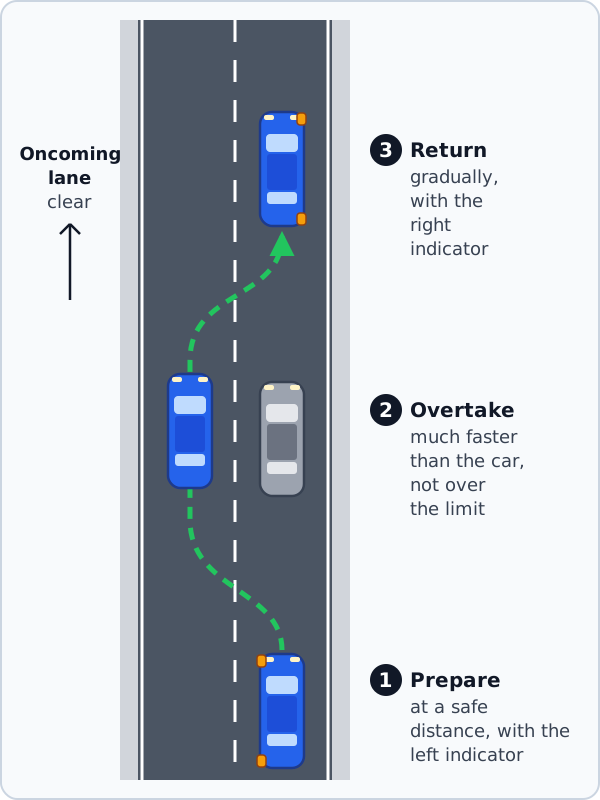
Figure 4. The three phases of overtaking: prepare at a safe distance, pass quickly with the opposite lane clear and return to the right without cutting in on the overtaken vehicle. Not to scale.
If the roadway has at least two lanes in your direction, you may stay in the lane you used to overtake if you are going to overtake again right away, as long as you do not unduly disturb those coming up faster behind you. If you are not going to overtake any more, or someone faster is coming behind, return to the right.
8.4 Overtaking cyclists, mopeds, PMV, pedestrians and animals
Since 1 October 2026 (Royal Decree 518/2026), when overtaking pedestrians, animals, animal-drawn vehicles, mopeds, personal mobility vehicles (PMV), cyclists or groups of cyclists:
- Leave a lateral distance of at least 1.5 meters, on any road, inside or outside built-up areas.
- Occupy part or all of the adjacent or the opposite lane. If the roadway has more than one lane in each direction, a complete lane change is mandatory.
- Outside built-up areas, reduce your speed so that it is at least 20 km/h below the limit of the road, before you start and throughout the maneuver. On a 90 km/h road, you drive at 70 km/h at most.
- A group of cyclists counts as a single unit: you overtake all of it, in one go.
- It is prohibited to overtake in a way that endangers or hinders those coming from the opposite direction, even if they are on the shoulder (for example, cyclists in the opposite direction).
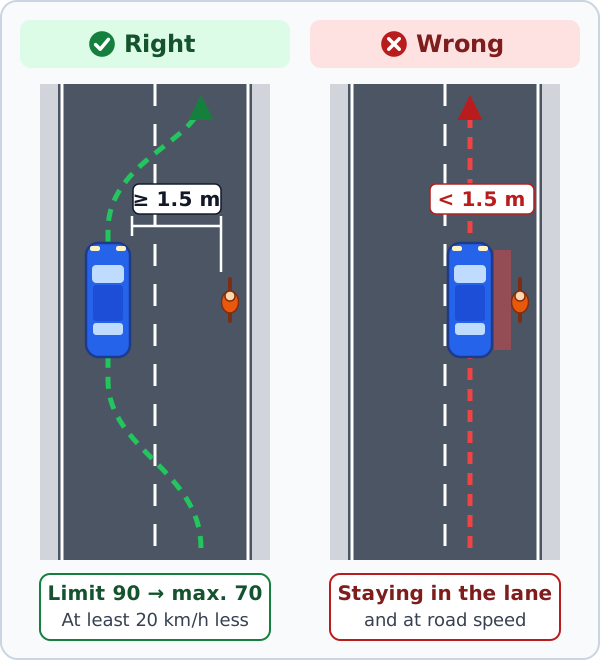
Figure 5. To overtake a cyclist outside built-up areas, change lanes, leave at least 1.5 meters and go 20 km/h below the limit of the road.
With a solid line. On a section where overtaking is prohibited, you may overtake cyclists and other cycles, mopeds, PMV, pedestrians, animals, animal-drawn vehicles and special agricultural vehicles, even if you have to occupy the opposite direction, when they are going so slowly that you can pass them without risk and after making sure that no one is coming. That is, to leave the meter and a half you may cross the solid line; what you must not do is pass at less than 1.5 meters to avoid crossing it. A slow truck, on the other hand, is not on that list: if there is a solid line and it is moving, you do not overtake it.
Overtaking while endangering or hindering cyclists, or without leaving 1.5 meters, costs 6 points.
And a motorcycle? The Regulations' list no longer includes motorcycles (it used to say “two-wheeled vehicles”). You must leave it a sufficient lateral distance, as for any vehicle; it is advisable that it not be less than 1.5 meters, because the blast of air destabilizes it. For their part, a motorcyclist who overtakes outside built-up areas must leave at least 1.5 meters from the vehicle overtaken.
Watch out in the exam: the 1.5 meters is no longer “only outside built-up areas”. It applies on any road; what applies only outside built-up areas is reducing speed by 20 km/h. Some old questions still say the opposite (see “What has changed in the rules”).
8.5 If you are being overtaken
- When you see that the vehicle behind wants to overtake you, it is mandatory to keep to the right edge of the roadway. If you are going to turn or stop on the left, you keep to the left, without hindering oncoming traffic.
- It is prohibited to increase your speed or make maneuvers that prevent or hinder the overtaking.
- If, once it has started, a danger arises (for you, for the overtaking vehicle or for oncoming traffic), reduce your speed so that it ends as soon as possible. If the other driver aborts by braking, you are not obliged to brake if doing so creates danger, but you are obliged to make it easy for them to return to their lane.
- A car does not have to give any signal to say “you may overtake”. Heavy vehicles, large ones and those with their own speed limit must help: slow down or move aside onto the shoulder if it is passable when, because of the road or the traffic, they cannot be overtaken easily. And if they cannot keep fully to the right but they can be overtaken safely, they indicate it with the arm extended, moving it from back to front (back of the hand facing backward) or with the right indicator.
Leave room so that you can be overtaken. Outside built-up areas, on a road with a single lane in your direction, if you are behind another vehicle and are not going to overtake it, leave enough space ahead so that the one following you can overtake you safely. Vehicles of more than 3,500 kg of maximum authorized mass and those more than 10 meters long must leave at least 50 meters. It is not needed in built-up areas, where overtaking is prohibited, where there is more than one lane in your direction or with saturated traffic.
Slow vehicles. Animal-drawn vehicles, special vehicles of up to 3,500 kg, mopeds, cycles (except bicycles) and vehicles of persons with reduced mobility must not overtake another vehicle if they go side by side for more than 15 seconds or more than 200 meters. A bicycle may overtake, for example on the shoulder, an animal-drawn vehicle.
8.6 Where overtaking is prohibited
| Where | Exception |
|---|---|
| Curves and changes of gradient with reduced visibility, and in general where you cannot see enough to overtake or abort | If the two directions are clearly separated and you do not enter the opposite one |
| Behind a vehicle that is overtaking, if its size blocks your view of the road ahead | None |
| A vehicle that is already overtaking another, if you have to enter the opposite direction | None |
| Signed pedestrian crossings, intersections with cycle paths and level crossings, and their vicinity | None since 1-10-2026 |
| Intersections and their vicinity | At roundabouts; when the overtaking has to be done on the right; if your road has signed priority; overtaking two-wheeled vehicles |
| Tunnels, underpasses and sections with the S-5 sign with a single lane in your direction | With two or more lanes in your direction, yes |
| Sections with a no overtaking sign or with a solid line | The slow users in 8.4 |
In fog or heavy rain the same visibility rule applies: if you cannot see enough, you do not overtake; if you can see, you may, taking extreme precautions.
On a road with one lane in each direction, you must not overtake a vehicle and the one that is overtaking it at the same time: you would have to enter the opposite direction. You also must not overtake by entering an additional lane opened with cones for the other direction.
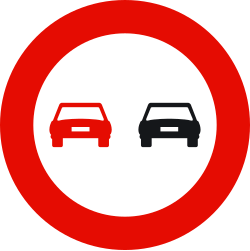
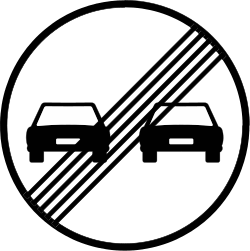
The no overtaking sign (R-305) does not allow any motor vehicle to overtake if, to do so, you have to enter the opposite direction. Since the 2025 Catalog there is no longer an exception for two-wheeled motorcycles: what counts is whether you enter the other direction. Overtaking with danger to oncoming traffic or where visibility is poor costs 4 points.
8.7 Immobilized vehicles and obstacles
If a vehicle is immobilized occupying your lane (because of a breakdown, an accident, an emergency or assistance service, road works or a traffic checkpoint), when passing it leave at least 1.5 meters, even if you have to occupy the opposite direction, and reduce your speed so that it is at least 20 km/h below the limit of the road. If overtaking is prohibited on the section, you may pass it anyway after making sure that there is no danger, unless it is stopped by the traffic itself (a queue). The same applies to any obstacle that forces you to occupy the opposite direction.
9. Stopping and parking
Stopping is immobilizing the vehicle for less than 2 minutes without the driver leaving it. Parking is everything else: more time, or getting out of the car.
9.1 Where and how
- Outside built-up areas (interurban road): off the roadway, on the right and leaving the passable part of the shoulder free. You must not stop or park on the passable shoulder, not even to look at the scenery, nor on the left on a two-way road. Only if an emergency does not allow you to do it that way may you stay on the roadway or the shoulder, signaling the vehicle.
- On motorways and dual carriageways stopping is prohibited, except in the designated areas (service and rest areas).
- In built-up areas (urban road and travesía, a road passing through a town): if you do it on the roadway or on the shoulder, as close as possible to the right edge. On one-way streets you may also do it on the left.
- The vehicle is placed parallel to the edge of the roadway. Any other position (perpendicular or angled) only when the road or the circumstances advise it or the markings indicate it. Use the space so that others fit.
- Stop and park so that you do not obstruct traffic or create risk, and so that the vehicle cannot move on its own.
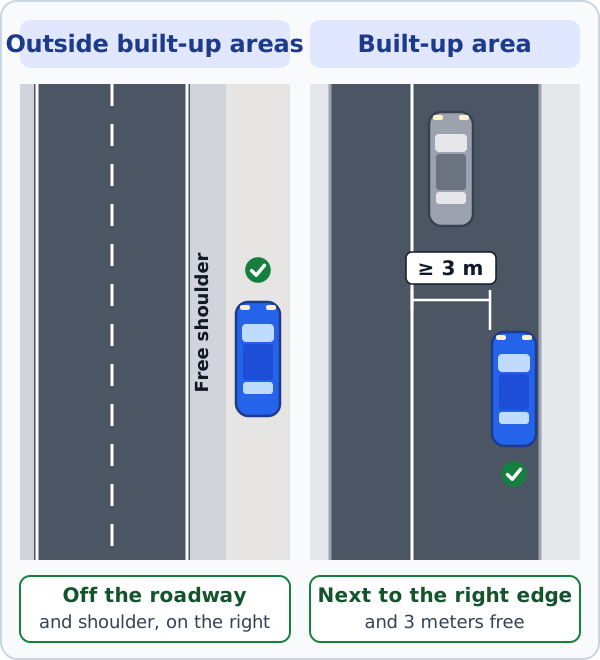
Figure 6. Outside built-up areas, off the roadway and the shoulder; in built-up areas, next to the right edge and leaving at least 3 meters free.
If you leave the driver's seat:
- Stop the engine and disconnect the starting system. If you move away, take precautions so that no one uses the vehicle without permission (keys, doors).
- Leave the parking brake on.
- With a manual gearbox, leave first gear engaged on an uphill slope and reverse on a downhill slope; with an automatic gearbox, the park position.
- Vehicles of more than 3,500 kg, buses and combined vehicles, on a noticeable slope, are also secured with chocks (never with stones) or by resting a wheel against the curb.
Doors. It is prohibited to open them before the vehicle is completely stopped and to open them or get out without checking that there is no danger to anyone, above all to cyclists. As a general rule, you get in and out on the side closest to the edge of the road.
9.2 Where it is prohibited
| Stopping prohibited (and therefore parking too) | Only parking prohibited |
|---|---|
| Curves and changes of gradient with reduced visibility and their vicinity | Limited parking zones (blue zone) without the badge or after the time has expired |
| Tunnels, underpasses and sections with the S-5 sign | Loading and unloading zones |
| Level crossings, cyclist crossings and pedestrian crossings | Sidewalks, promenades and pedestrian areas |
| Reserved lanes (bus, bicycles) and urban public transport stopping areas | In front of a signed driveway entrance |
| Intersections and their vicinity if you make it harder for others to turn (on interurban roads, also if you create danger through lack of visibility) | Double parking |
| On the tram rails or so close that you obstruct it | |
| Where you block a sign from someone it applies to | |
| Motorways and dual carriageways, outside the designated areas | |
| Zones signed for the exclusive use of persons with disabilities |
Note the difference: in front of a driveway entrance you may stop, but not park. On a curve or a change of gradient it is only prohibited if visibility is reduced.
Double parking. Double parking is prohibited and, without a driver, it also seriously obstructs. Stopping in double file is not among the Regulations' prohibitions: it may be done exceptionally and briefly, for example to unload when there is no room nearby. A stop lasts less than two minutes and you must not leave the vehicle; nor may it create risk, obstruct traffic or breach another prohibition, a sign or the municipal ordinance.
Seriously obstructing. These are serious offenses, among others: leaving less than 3 meters free up to the opposite edge or up to a solid line (or not letting others pass), preventing another parked vehicle from leaving, blocking a signed driveway entrance or a lowered curb crossing, stopping on medians, traffic islands or separators, preventing an authorized turn, occupying a loading and unloading zone during its hours, a bus stop or a space for emergency services, and parking in the middle of the roadway.
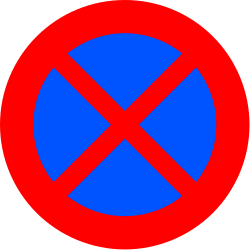
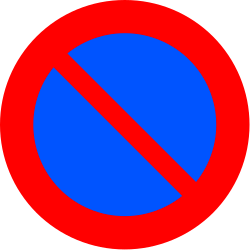
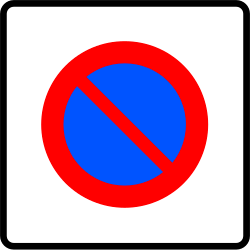
Yellow markings on the curb: broken, parking prohibited; solid, stopping and parking prohibited; zigzag, parking prohibited because the place is reserved (bus stop, loading and unloading).
Blue zone. In a limited parking zone you must leave the ticket or badge with the start time visible. Without it, or once the time has expired, parking is prohibited. The city council may order the removal by tow truck or the immobilization with a wheel clamp when there is no ticket or three times the paid time is exceeded. The tow truck also removes a vehicle that creates danger or seriously obstructs.
Service vehicles (assistance tow trucks, emergency vehicles): they may stop where their work requires, for the time strictly necessary, without creating a new danger or obstructing traffic.
10. Broken-down vehicles: do not tow them with your car
If your car breaks down or has an accident, signal it and get it off the roadway as soon as possible. If it can continue but needs assistance, leave the lanes as soon as possible and go along the right shoulder to the first exit.
To remove or move it, only an assistance vehicle (tow truck) registered with the DGT is valid. You must not tow a broken-down vehicle with your passenger car, neither on a motorway or dual carriageway nor on any other road.
Watch out in the exam: some questions still accept the rule from before July 2021: towing with another vehicle, exceptionally, only to the nearest place where it could be immobilized and never on a motorway or dual carriageway. Today that exception does not exist.
What has changed in the rules
- 1 October 2026 (Royal Decree 518/2026). Separation of 1.5 meters when overtaking pedestrians, animals, animal-drawn vehicles, mopeds, PMV and cyclists on any road (the Regulations previously required it only outside built-up areas), with a complete lane change if there is more than one lane in each direction, and 20 km/h less outside built-up areas (previously not required). Motorcycles are no longer on that list. The paragraph that asked for a “lateral margin proportional to the speed and to the width and characteristics of the roadway” is removed; the general rule is now “sufficient lateral distance”. Overtaking at pedestrian crossings and level crossings is now prohibited without exceptions: previously you could overtake at a pedestrian crossing at very low speed and overtake a two-wheeled vehicle at a level crossing. Passing an immobilized vehicle requires 1.5 meters and 20 km/h less.
- 1 July 2025 (Royal Decree 465/2025). New Catalog of traffic signs and road markings, which is where the solid line next to a broken line, the hatched markings, the end-of-lane arrow and the yellow markings are read today. The no overtaking sign (R-305) loses the exception for two-wheeled motorcycles, and the R-304 is renamed “no change of direction”.
- 21 March 2022 (Law 18/2021). It is no longer possible to exceed the limit by 20 km/h to overtake on a conventional road.
- 1 July 2021 (Royal Decree 159/2021). The exception that allowed towing a broken-down vehicle with another vehicle “to the nearest place where it could be immobilized” (never on a motorway or dual carriageway) disappears. Since then only an assistance vehicle may remove it.
If a question accepts one of the old rules, it predates these changes.
Numbers you need to know
| What | Number | Nuance |
|---|---|---|
| Complementary reversing | 15 meters at most | Without entering an intersection. If there is no other way out, the minimum indispensable |
| Separation when overtaking cyclists, mopeds, PMV, pedestrians and animals | At least 1.5 meters | On any road; with more than one lane in each direction, complete lane change |
| Speed when overtaking them outside built-up areas | 20 km/h below the limit, at least | On a 90 km/h road, 70 at most |
| Passing an immobilized vehicle | 1.5 meters and 20 km/h less | Even if you occupy the opposite direction |
| Motorcycle overtaking outside built-up areas | 1.5 meters | From the vehicle overtaken |
| Space ahead so that you can be overtaken | 50 meters | More than 3,500 kg or more than 10 m, outside built-up areas, one lane in each direction |
| Slow vehicles side by side | 15 seconds or 200 meters | They must not overtake if they exceed them (bicycles may) |
| Tunnel with no intention to overtake | 100 meters or 4 seconds | More than 3,500 kg: 150 meters or 6 seconds |
| Stopping | Less than 2 minutes | Without the driver leaving the vehicle |
| Free space when stopping or parking | 3 meters | Less is a serious obstruction |
| Blue zone | Three times the time paid | Without a ticket or beyond that time, tow truck or wheel clamp |
| Points | 6 / 4 / 4 / 3 | Cyclists or without 1.5 m / overtaking with danger or without visibility / reversing on a motorway or dual carriageway / improper U-turn |
Summary
- Before any maneuver: observe, signal in advance and maneuver. If it is not safe, refrain; signaling does not give you the right of way.
- Maneuvers are signaled with lights or, failing that, with the arm; if they contradict each other, the arm prevails.
- When joining traffic you always yield; in the acceleration lane you look at the start and enter at the end, at the speed of the road.
- To turn left you stay close to the center line (two-way) or to the left edge (one-way) and leave the center of the intersection on your left. Without visibility, you do not turn.
- Do not make a U-turn where overtaking is prohibited, at level crossings, in tunnels or on motorways and dual carriageways (except in designated places).
- Reverse only if you cannot move forward or turn around, or to stop, park or join traffic (15 m, without entering an intersection). Never on a motorway or dual carriageway.
- You overtake on the left, at a clearly higher speed without exceeding the limit, and you return to the right as soon as you can, gradually.
- Cyclists, mopeds, PMV, pedestrians and animals: at least 1.5 meters on any road, the whole lane if there are two in each direction and 20 km/h less outside built-up areas.
- Overtaking is prohibited at pedestrian crossings, level crossings and intersections with cycle paths, without exceptions.
- If you are being overtaken, you keep to the right and do not accelerate.
- Outside built-up areas you stop and park off the roadway and the passable shoulder; in built-up areas, next to the right edge (or the left on one-way streets).
- A broken-down vehicle is removed only by an assistance tow truck.
Check your understanding
1. A driver has the right indicator on and sticks out the left arm horizontally with the palm facing down. What are they going to do?
Answer
Move to the left. The arm signal overrides any light indication that contradicts it.
2. You are on a two-way street with a center line and you want to turn left. Where do you position yourself?
Answer
Next to the center line, without entering the opposite lane, and you turn leaving the center of the intersection on your left. If the street were one-way, you would stay close to the left edge.
3. You reverse out of a parking space. How far may you go like this?
Answer
15 meters at most, and without entering an intersection. Always the minimum indispensable distance.
4. In a city, you overtake a cyclist on a street with one lane in each direction. What separation do you leave? Do you have to reduce your speed by 20 km/h?
Answer
At least 1.5 meters, occupying part or all of the opposite lane: it applies on any road. Going 20 km/h below the limit is mandatory only outside built-up areas.
5. May you make a U-turn right after a pedestrian crossing?
Answer
No. Making a U-turn is prohibited where overtaking is prohibited, and overtaking is prohibited at pedestrian crossings and in their vicinity.
6. On a road, may you stop on the shoulder to take a photo of the scenery?
Answer
No. Outside built-up areas you stop off the roadway and leaving the passable part of the shoulder free. Look for a rest area or a wide spot off the road.
Frequently asked questions about Maneuvers
Definition of a Driving Maneuver
Priority When Parking a Service Vehicle
Stopping and Parking Rules for Authorized Service Vehicles
Can you drive in the left lane after overtaking?
Safety Distance to Allow Overtaking
Maximum Time for Parallel Overtaking
Left Turn on One-Way Streets
Recommended Safety Distance Outside Built-Up Areas
Exceptions to Safety Distance for Overtaking
Safety Distance for 3000kg Truck on Motorway
Topic test
727 questions available for this topic.