
Safety and economic driving
In this topic:
- What active and passive safety are, which systems of the car belong to each one and which assistance systems new cars have.
- When the seatbelt is mandatory, who is exempt from 1 October 2026, how it is worn and how the headrest and the distance to the airbag are adjusted.
- How you sit, how you hold the steering wheel and what defensive driving is.
- How to drive to use less fuel: gears, revs, speed, load and stops.
- What pollutes in a car, what the Regulations say about noise and fumes, and what the environmental labels mean.
A safe car is safe because of what it has and because of how you drive it. What it has prevents the accident or reduces the harm. How you drive it decides whether you use more or less fuel, whether you pollute more or less and whether the safety system ever needs to act. In the exam this topic has many short, direct questions: the seatbelt and its exemptions, the airbag, the headrest, gears and revs, and efficient driving.
1. Active safety and passive safety
1.1 The difference
- Active safety: what helps avoid the accident, before it happens.
- Passive safety: what reduces the harm once the accident has started.
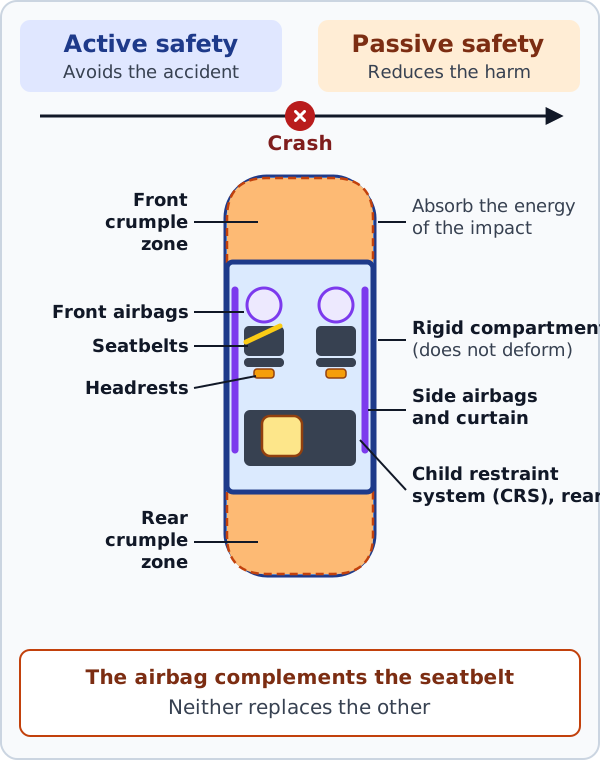
Figure 1. Before the crash, active safety acts; from the crash on, passive safety. The airbag and the seatbelt work together.
| Active safety | Passive safety | |
|---|---|---|
| When it acts | Before the accident | During and after the impact |
| What for | To avoid it | To reduce injuries |
| Examples | Brakes, ABS, ESP, steering, tires, lighting, driver assistance systems | Seatbelt, airbag, headrest, bodywork with crumple zones, safety glass, child restraint systems |
Watch out in the exam: the steering system is active safety, not passive or mixed. Power steering reduces the effort you make to turn the steering wheel, and with it fatigue.
1.2 Active safety: the car's aids
The ones asked about most are these:
- Brakes and ABS. They prevent the wheels from locking when you brake hard and let you keep turning the steering wheel. How they are used is in the topic Adherence, Tires and Brakes.
- ESP (stability control). It brakes wheels individually to correct a skid.
- Traction control. It prevents the drive wheels from spinning when you accelerate.
- Tires in good condition and at their pressure. They are the only thing that touches the ground. A tire pressure monitoring system (TPMS) warns you when a tire loses air.
- Lighting. Seeing and being seen.
Driver aids do not give you permission to leave the driving to technology. A car with all the systems can have an accident if these systems are misused or if you overtrust them, and the driver is still the one responsible and in control.
1.3 Driver assistance systems (ADAS)
They are called ADAS (advanced driver assistance systems). Regulation (EU) 2019/2144 requires several of them to be fitted in new vehicles. Since 6 July 2022 no new models are type-approved without them, and since 6 July 2024 no new vehicles are registered without them. These are the most important ones in a new passenger car.
| System | What it does |
|---|---|
| Tire pressure monitoring (TPMS) | It warns you if any tire loses pressure. |
| Advanced emergency braking (AEB) | If there is a risk of a rear-end collision, it warns you; if you do not react, it brakes the car. |
| Emergency lane keeping (LKA) | It helps you not to leave your lane when that is about to happen. |
| Intelligent speed assistance (ISA) | It informs you of the limit and warns you if you exceed it. You can switch off its speed control function. |
| Driver drowsiness and attention warning (DDR-DAD) | It detects that you are getting tired and advises you to stop. |
| Emergency stop signal | The brake lights flash rapidly when you brake hard, to warn the driver behind. |
| Reversing detection | It warns of people and objects behind the car when you reverse. |
| Event data recorder (EDR) | It is the “black box”: it stores data from the moment of the crash. |
Others are not mandatory, but they also appear in the exam:
- Blind spot information system (BSIS). It warns with visual or sound signals of a vehicle or a pedestrian that you cannot see. In the exam: it only warns, it does not take control of the car, and the driver keeps all the responsibility.
- Advanced driver distraction warning (DDR-ADR). A camera in the passenger compartment watches where you are looking and warns you if you get distracted.
- Night vision assistant. With thermal or infrared cameras, it highlights on the screen pedestrians or animals that you cannot see yet.
- Rear camera. It switches on when you engage reverse.
- Start-Stop. It switches off the engine when it is idling and starts it again when you operate the pedals.
1.4 Passive safety: what protects in the crash
- Bodywork and chassis. They have crumple zones at the front and the rear, which deform and absorb the energy of the impact, and a rigid passenger compartment that protects the space of the occupants. A strong body does not replace the seatbelt or the airbag.
- Front part. It is designed to reduce the injuries of a pedestrian who is hit by the car: that is why it is not advisable to modify it (for example, with rigid bull bars).
- Safety glass. It breaks without forming large splinters, to avoid wounds.
- Seatbelt, airbag and headrest. The following sections.
- Child restraint systems. Section 2.3.
The airbag is not just one: besides the front ones, many cars have side, curtain and knee airbags. The systems are finely tuned and do not deploy because of a light knock when parking.
2. The seatbelt
2.1 When and how
The driver and the occupants must wear an approved seatbelt, fastened, both on urban and interurban roads. It is the most important passive safety element. The obligation applies to every vehicle that has one fitted: passenger car, van or truck (for example, a 3,500 kg truck), and to all occupants.
If you do not wear it, or you wear it wrongly, it is a serious offense: a fine of 200 euros and 4 points.
How to wear it correctly (figure 2):
- The shoulder strap goes over the collarbone and the chest, between the shoulder and the neck. Never across the neck or behind your back.
- The lap strap goes over the hips, not over the stomach. If it goes over the stomach and you slide under the seatbelt, the submarining effect occurs.
- It must be snug against the body. If you wear it loose, your body travels a longer distance before it is stopped and hits the steering wheel.
- No clips or pressure regulators: they cancel its effectiveness.
- Do not sit on poorly secured covers, towels or cushions that are loose: they make you slide under the seatbelt. If because of your height you need a booster to see well, it must be well fixed to the seat.
After fastening it, check that it fits snugly to your body.
2.2 Exemptions (from 1 October 2026)
You may travel without a seatbelt only in these cases (art. 119 of the General Traffic Regulations):
| Who | When |
|---|---|
| Drivers | When reversing or parking, inside or outside built-up areas |
| People with an exemption certificate for serious medical reasons or disability | All roads; you must show the certificate if a law enforcement officer asks for it |
| Drivers and passengers of vehicles on an emergency call (ambulance, police, firefighters) | Only in built-up areas; never on motorways, dual carriageways or conventional roads |
| Passengers of a medical ambulance who attend to the patient en route | All roads, on an emergency call |
Watch out in the exam: taxi drivers, delivery drivers and driving instructors in the city are no longer exempt. Until 30 September 2026 they were, and that is why the old answer is still around. Today they also wear it in built-up areas, like any driver: they are exempt only when reversing or parking.
2.3 Children
Children 135 cm tall or less must travel with an approved child restraint system (CRS), suited to their height and weight and installed according to the manufacturer's instructions. They travel in the rear seats. In the front they may travel only in three cases: if the car has no rear seats, if all of them are occupied by other children or if not all the CRSs fit. A rear-facing CRS may go in the front only with the passenger airbag deactivated.
The taxi exception: in the city it may carry children under 135 cm without a CRS if they are in a rear seat. More detail (types of seat, bus) in the topic Transport of People and Goods.
3. Airbag and headrest
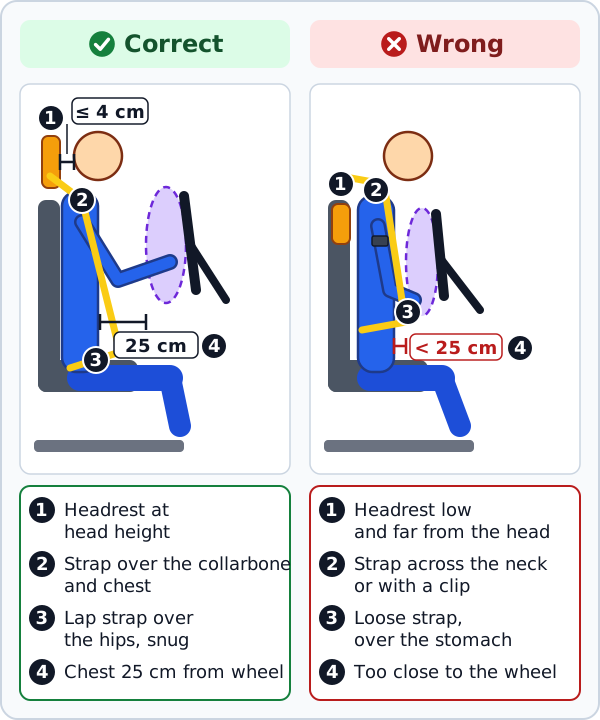
Figure 2. Seatbelt over the collarbone and the hips, head 4 cm at most from the headrest and about 25 cm from you to the airbag. Not to scale.
The airbag is a bag that inflates by itself in a strong crash. Its purpose is to prevent the occupants from hitting hard parts of the car. It is a complementary element: the airbag does not replace the seatbelt and is effective only if you are wearing it fastened. Misuse of these systems can even increase the risk.
- Sit about 25 centimeters from the steering wheel, between your chest and the steering wheel. Too close, and the airbag hits you when it opens.
- Do not put anything in the area where it deploys (mounts, the GPS navigator): it can prevent it from working and it would be thrown out like a projectile.
The headrest protects the neck from whiplash in a rear-end collision. It is not there for comfort. It must be at head height and as close to the head as possible, no more than 4 cm away. The driver's must be adjustable, and the rear ones must also be adjusted to the height of whoever sits there.
Watch out in the exam: 25 cm is the distance to the steering wheel (because of the airbag) and 4 cm the distance to the head (because of the headrest). Do not mix them up.
4. Helmet and other protective elements
Drivers and occupants of vehicles are required to use the seatbelt, the helmet and the other protective elements under the conditions set by the Regulations. The helmet, unlike the seatbelt, no longer has a medical exemption. This is what article 118 requires:
| Who | What they wear |
|---|---|
| Motorcycle, three-wheeled vehicle, quadricycle, moped and quad (driver and passenger) | Approved helmet (UNECE Regulation R22), properly fastened, on all types of roads; closed footwear covering the whole foot, on all types of roads; gloves on interurban roads. On the moped a certified helmet is still valid (see below) |
| Those same vehicles with a self-protection structure and seatbelts (according to the ITV) | They do not need a helmet, gloves or closed footwear, but do need the seatbelt, on all types of roads |
| Bicycle | Helmet on interurban roads and, for children under 16, on all roads |
| Personal mobility vehicle (PMV) | Helmet |
Watch out in the exam: the passenger of a quadricycle without a self-protection structure must wear a helmet always, just like the driver.
For mopeds, the approved helmet will be mandatory from 1 October 2027; until then the certified one is valid. The medical exemption for the helmet no longer exists (since 1 October 2026). The complete rules for each vehicle are in Types of Vehicles and Other Users.
5. The driving position
A good position improves control and delays fatigue. The posture of the body (back supported and upright, arms and legs slightly bent) is in Driver's Physical State. Here, what is missing.
Order to get ready. First adjust the seat (distance to the controls and height) and the headrest; then the mirrors; and last, the seatbelt. Adjusting the mirrors before the seatbelt lets you move freely to set them properly.
- Distance. The seat adjustment levers are for adjusting the distance to the controls. With the seat too close, movements are more forced and driving is less safe. Driving very close to the controls is not safer.
- Height. Just enough to see the roadway over the steering wheel.
- Cushions and covers. If the seat does not adjust enough in height, you may use a well-fixed cushion. A loose one is dangerous: it makes you slide under the seatbelt.
- The steering wheel. It is held with both hands, gently but firmly, without tensing up. The recommended position is a quarter to three: hands at the nine and three o'clock positions (like the hands of a clock at 9:15). Do not hold it by the spokes, do not cross your arms over it when turning and do not drive with one hand only unless you need it to operate another control.
- Wide curves. The steering wheel turns are short and progressive.
- The controls. They are divided into foot controls (the pedals: accelerator, brake and clutch) and hand controls. The clutch is operated with the left foot.
The GPS navigator. Place it at a height that lets you see it without taking your eyes off the driving, outside the airbag area and with the cables tidied so they do not get in the way of the controls. Do not handle it while driving: it is a distraction (3 points).
6. Defensive driving
It is an attitude: avoiding the accident even if others make mistakes. It rests on three principles:
- Vision. It is not enough to look at the car in front: look far ahead, to the sides and check the mirrors regularly.
- Anticipation. With what you see, imagine what the others are going to do and the hazards of the road, and decide in time.
- Space management. Leave the space you need to brake or swerve.
The safety distance is part of the third. The Regulations require leaving a free space that lets you stop, in case the vehicle ahead brakes suddenly, without hitting it; in built-up areas and outside them, also when a truck is ahead. More detail in Speed and in Adherence, Tires and Brakes. In a tunnel with one lane in each direction, 100 meters (or 4 seconds).
More habits:
- Attitude. Always be alert and ready to react. Adapting your speed and increasing the safety distance reduces the probability of facing a dangerous situation.
- Someone is tailgating you. Increase the distance to the vehicle ahead yourself whenever you can, so you can brake gently.
- You are the last in a stopped line. Watch those approaching in the rearview mirrors.
- Plan the trip. It is a defensive attitude. Avoid, as far as possible, roads with road works or dangerous sections.
- Make it easy to be understood. Make your maneuvers in a way that the others understand them.
- Driver and vehicle in perfect condition are the starting conditions for driving safely.
- Curves. Braking and shifting down are done before entering. Once inside, accelerate smoothly and gradually. The force that changes your speed (accelerating or braking) in a curve is the tangential one; the one that changes your direction is the centripetal one.
- Crosswind. Hold the steering wheel firmly but without rigidity and correct gently toward the side the wind is coming from.
7. Efficient driving
Efficient driving is driving to use less fuel and pollute less, without losing time. It is advice and a technique, not an obligation of the Regulations. Its advantages, according to the exam: lower consumption, less wear and less maintenance, less noise, more comfort, less stress and less risk of an accident. It is similar to defensive driving, and that is why the two complement each other.
Consumption is influenced by the way you drive, speed, load, aerodynamics, tire pressure, maintenance, the type of engine and the conditions of the road. Signage does not influence consumption directly.
7.1 Starting and setting off
- Start the engine without pressing the accelerator.
- Gasoline engine: start driving immediately, gently. Waiting stationary does not warm up the engine sooner and uses fuel. Do not rev the engine while stationary either.
- Diesel engine: wait a few seconds before setting off, so that the oil reaches all the parts.
- First gear is the one that transmits the most force and the one that uses the most fuel: use it only to start off and shift out of it early.
7.2 The gears
Each gear trades force for speed. First and second transmit more force to the wheels and let you go slowly; the highest gear transmits less force and lets you go faster with the engine at lower revs. That is why the rule is to use high gears with the engine at low revs.
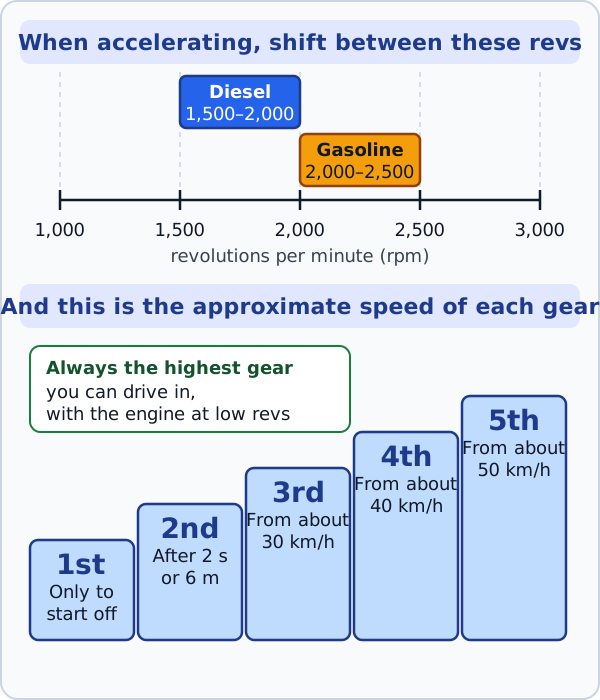
Figure 3. Shift when accelerating between 2,000 and 2,500 rpm (gasoline) or between 1,500 and 2,000 rpm (diesel). The speeds for each gear are approximate.
- When accelerating: shift to the highest gear possible between 2,000 and 2,500 rpm in a gasoline engine and between 1,500 and 2,000 rpm in a diesel one. Shift to a higher gear as soon as possible.
- When decelerating: lift your foot off the accelerator and let the car roll by inertia, with the gear engaged (engine braking). Brake with the pedal gently, without going through all the gears, and shift down as late as possible.
- Do not go down a slope in neutral. The engine does not brake and you have to use the brake more, with the risk of it overheating, and you can lose control. Neutral is the position in which no gear is engaged.
7.3 Speed and anticipation
- Drive at a uniform speed, without sudden accelerations or hard braking. It is what saves the most consumption and emissions.
- The higher the speed, the higher the consumption. From about 60 km/h the main resistance the car overcomes is that of the air.
- Aggressive driving can use up to 50% more fuel.
- Increase the safety distance and look far ahead: that way you anticipate and brake less.
- Avoid sudden accelerations or starts at high revs: they use more fuel and emit more carbon monoxide.
7.4 What uses extra (and how to avoid it)
| What | Effect | What you do |
|---|---|---|
| Open windows | They worsen aerodynamics; they increase consumption, especially at high speed | Drive with them closed and ventilate with the car's devices |
| Roof rack | It increases air resistance, even if it is empty | It may stay fitted, but you use more fuel; if you do not use it, take it off |
| Load | More weight, more consumption; a poor distribution too | Do not overload; carry the load in the trunk, not outside |
| Low tire pressure | More rolling resistance, more consumption and more risk | Check it with the pressure gauge |
| Air conditioning | It is one of the pieces of equipment that uses the most | Use it sensibly, not out of habit |
| Poor maintenance | Dirty filters, low levels and worn spark plugs shoot up consumption and pollution | Maintenance up to date |
| Headwind | More resistance | A tailwind helps reduce consumption |
| Idling | The engine uses fuel without moving | Switch it off if you are going to stop for more than 60 seconds |
Stops. If you expect to be stopped for more than 60 seconds (a traffic jam, for example), switch off the engine. In a brief stop, such as a red traffic light, it is not advisable to switch it off: it is uneconomical. Start-Stop does it for you.
Trips and roads. Consumption rises noticeably on urban roads: many stops, accelerations and low gears. Close to 30% of car trips in Spain are under 3 km. With the same age and performance, a diesel engine uses less fuel than a gasoline one.
The type approval of a car measures three official consumption figures: urban, extra-urban and combined. “Anticipated real consumption” does not exist.
8. Pollution, noise and environmental labels
8.1 Two types of pollution
A motor vehicle produces chemical and noise pollution.
- Chemical: the exhaust gases. Carbon dioxide (CO₂) is the main cause of the greenhouse effect (the rise in the planet's temperature) and is emitted in proportion to the fuel you use. Carbon monoxide (CO) is toxic.
- Noise: the noise. It depends on the technical characteristics of the vehicle and on how it is driven.
8.2 What the Regulations say
According to article 7 of the General Traffic Regulations:
- Vehicles that emit electromagnetic disturbances, noise above the limit or gases and fumes above the permitted values must not be driven.
- Traffic officers may immobilize a vehicle that exceeds the levels of gases, fumes or noise.
- All drivers are required to cooperate in the tests to detect these deficiencies.
- It is prohibited to drive with an open exhaust, with no silencer, or with a damaged silencer or resonators.
- A vehicle with fumes that reduce the visibility of others or that are harmful must not be driven either.
Other tips to avoid polluting: do not fill the tank to the brim when refueling (it can spill), and avoid washing the car on the public road: do it in a car wash.
8.3 The environmental labels
The General Vehicle Regulations (annex II) classify each vehicle by its polluting potential as 0 emissions, ECO, C, B and A. There is a label for the first four; A has no label. The criteria in figure 4 are those for passenger cars and vans.
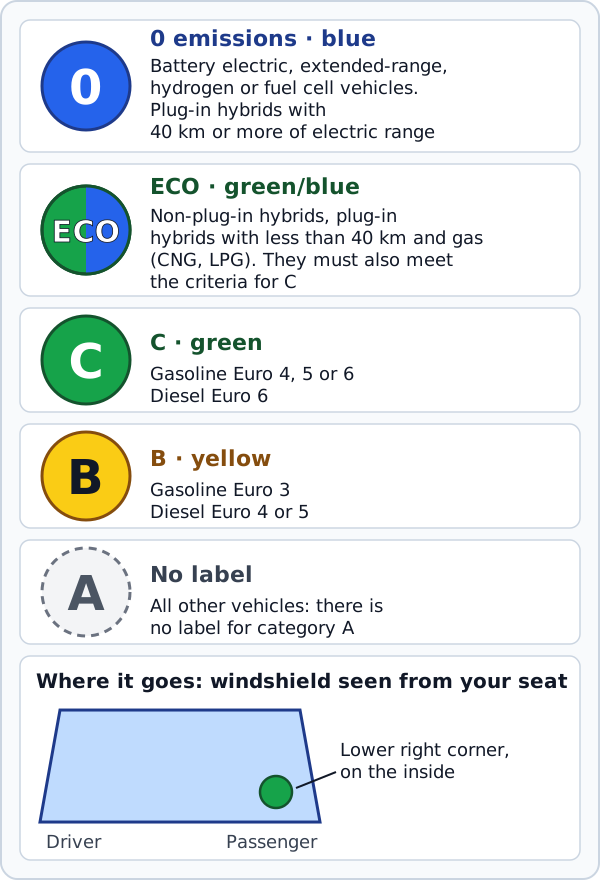
Figure 4. The four labels, their criteria and where they are stuck. A vehicle that meets none of them has no label (category A).
A battery electric vehicle (BEV) or a plug-in hybrid with at least 40 km of electric range has the 0 emissions label (blue). A non-plug-in hybrid has the ECO, if it also meets the criteria for C. “0 emissions” is the name of the classification, not a guarantee that the vehicle does not pollute at all.
Where it goes. If the vehicle has a windshield, the label is stuck in the lower right corner, on the inside. The Regulations let the competent authority establish whether it is mandatory to carry it.
What it is for. The authorities may restrict, totally or partially, entry and driving in low-emission zones, in residential priority zones or on any other road under their authority, according to environmental criteria (art. 157 of the General Traffic Regulations, new since 1 October 2026). In a pollution episode, for example, they may limit speed, prohibit parking or prohibit vehicles with a certain environmental classification from being driven.
- Not respecting the restrictions of a low-emission zone or of a pollution protocol is a serious offense (200 euros, Traffic Law art. 76.z3).
- Art. 37.6 of the General Traffic Regulations also classifies as very serious driving without the corresponding authorization on a restricted road, also for environmental reasons, and refers to art. 77.l of the Traffic Law.
Do not confuse the two cases: an environmental restriction does not by itself make every offense in a low-emission zone very serious.
9. Equipment and duties before starting and when leaving the car
Mandatory equipment of a passenger car: one high-visibility reflective vest, the connected V-16 warning light and a spare wheel or an alternative system. A fire extinguisher is not needed in a private passenger car. Dual-purpose vehicles also carry the vest.
- The vest must be in a place you can reach without getting out of the car. You put it on before getting out if you are going to step on the roadway or the shoulder of an interurban road. Passengers do not have to put it on.
- An immobilized vehicle is signaled with the connected V-16: triangles are no longer valid (since 1 January 2026).
Refueling. Switch off the engine and all electrical systems and do not use your phone.
When leaving the car. If you walk away: stop the engine, disconnect the starting system, take precautions so that nobody uses it without authorization and leave the parking brake applied. Before opening the door or getting out, check that there is no danger to anyone, especially a cyclist.
Compulsory insurance (third-party liability). It does not cover the damage suffered by the responsible driver.
What has changed in the rules
- 1 October 2026 (Royal Decree 518/2026). The seatbelt exemptions of taxi drivers, delivery drivers and driving instructors in the city disappear. Only reversing or parking, the medical certificate and emergency services in built-up areas remain. The helmet no longer has a medical exemption and must be approved (the moped one, from 1 October 2027). The new article 157 covers environmental restrictions in low-emission zones and residential priority zones.
- 6 June 2026 (Royal Decree 450/2026). Driving without the corresponding authorization on a restricted road, also for environmental reasons, is a very serious offense (General Traffic Regulations art. 37.6). Not respecting the restrictions of a low-emission zone is still serious.
- 1 January 2026. The connected V-16 replaces the triangles.
Numbers you need to know
| What | Number | Nuance |
|---|---|---|
| Height that requires a CRS | 135 cm or less | In the rear seats, with exceptions |
| Not wearing the seatbelt | 200 euros and 4 points | Serious offense |
| Distance from chest to steering wheel | 25 cm | Because of the airbag |
| Headrest to the head | As close as possible, no more than 4 cm | It must be adjustable |
| Hands on the steering wheel | A quarter to three (nine and three o'clock) | Both hands |
| Gear change, gasoline engine | 2,000–2,500 rpm | When accelerating |
| Gear change, diesel engine | 1,500–2,000 rpm | When accelerating |
| Switching off the engine | If you expect to stop for more than 60 seconds | At a brief traffic light, no |
| Aggressive driving | Up to 50% more consumption | |
| Air resistance | Main one from about 60 km/h | |
| Environmental label | Lower right corner of the windshield | Inside |
| Electric or PHEV with 40 km or more of range | 0 emissions label | Blue |
| Low-emission zones | Art. 157 | Environmental restrictions |
Summary
- Active safety avoids the accident; passive safety reduces the harm. Steering is active.
- The seatbelt is mandatory on urban and interurban roads. From 1 October 2026 only these remain exempt: reversing or parking, the medical certificate and emergency services in built-up areas.
- The airbag complements the seatbelt and does not replace it. Sit 25 cm from the steering wheel.
- The headrest goes at head height and no more than 4 cm away.
- The assistance systems help; the driver keeps the responsibility and the control.
- Defensive driving is based on vision, anticipation and space management.
- Efficient driving asks for uniform speed, high gears and low revs, shifting between 2,000 and 2,500 rpm (gasoline) or 1,500 and 2,000 rpm (diesel) and switching off the engine if you are going to stop for more than 60 seconds.
- Open windows, a roof rack, excess load and tires with low pressure increase consumption.
- A car pollutes chemically and with noise; it must not be driven if it exceeds the limits and all drivers must cooperate in the tests.
- The environmental labels are 0 emissions, ECO, C and B; A has no label. It is stuck in the lower right corner of the windshield.
Check your understanding
1. You are going to park in reverse on a street in your city and you do not put on your seatbelt. Is it an offense?
Answer
No. When reversing or parking, the driver does not have to wear it. As soon as you drive, in the city too, you must wear it fastened.
2. Is a taxi driver on duty in the city exempt from the seatbelt?
Answer
No, since 1 October 2026. That exemption disappeared, like the one for delivery drivers and driving instructors. In built-up areas only vehicles on an emergency call remain exempt.
3. How far must your head be from the headrest and your chest from the steering wheel?
Answer
Head: as close as possible, no more than 4 cm. Chest: about 25 cm from the steering wheel, because of the airbag.
4. You are driving a car with a diesel engine and accelerating. Between which revs do you change gear, and what do you do when starting?
Answer
Between 1,500 and 2,000 rpm (in gasoline, between 2,000 and 2,500). You start without pressing the accelerator and wait a few seconds before setting off; in gasoline, you set off right away.
5. You have to wait in a long traffic jam. What do you do with the engine? And at a red traffic light?
Answer
If you expect to stop for more than 60 seconds, you switch it off. At a red traffic light, a brief stop, it is not advisable: you use more fuel.
6. A plug-in hybrid car with 25 km of electric range: which label does it have? And where is it stuck?
Answer
ECO, because it does not reach 40 km. It is stuck in the lower right corner of the windshield, on the inside.
Frequently asked questions about Safety and Economic Driving
Vehicle Circulation Prohibition
Eco-Driving Habits to Reduce Pollution
Which vehicles get the DGT ZERO Emissions label?
Eco-Driving
Lower Fuel Consumption
Correct Placement of GPS Navigation Device While Driving
Luggage Placement for Fuel Economy
How much does aggressive driving increase fuel consumption?
Pillars of Defensive Driving
How to Start the Engine to Save Fuel
Topic test
439 questions available for this topic.