
Traffic signs
In this topic:
- Which sign takes precedence when two contradict each other and which orders from traffic officers you always obey.
- What traffic lights, flags, cones and delineation mean.
- How to recognize a vertical sign by its shape and color, and the most frequently asked warning, regulatory and information signs.
- What road markings say, above all the yellow ones and the solid line next to a broken one.
- What changed with the 2025 Catalog.
Signs are the language of the road: they warn, inform or give orders. This topic is the complete overview and one of those with the most questions. What another topic covers in detail (right of way, speed, road works, lighting, lane markings) is summarized here and cross-referenced. Since 1 July 2025 a new Catalog of signs is in force (Royal Decree 465/2025): you will see it marked as “2025 Catalog”.
1. What a sign requires of you
- All road users, pedestrians included, obey mandatory and prohibitory signs and adapt their behavior to the rest.
- You obey the sign even if it contradicts a general rule (for example, a speed limit lower than the general one).
- If it orders you to stop, you do not resume until you have done what it requires: a STOP sign orders you to stop and yield even if you see nobody.
- On a dynamic toll or electronic toll road you carry the technical device that allows you to use it.
- You obey the traffic lights and vertical signs on your right, above the roadway or above your lane; if there are none and you are going straight ahead or to the left, those on your left. If the indications on the right and on the left differ, whoever is going straight ahead or to the left obeys only those on the left.
- Every sign applies to the whole width of the roadway that its intended users can use. Only road markings limit it to one lane: a sign or marking painted in a delimited lane affects only its vehicles.
- They carry retroreflective material. The texts are in Castilian Spanish and also in the co-official language of the region. A clarification goes on a supplementary panel below.
- They are installed by the authority responsible for the road. Except for a justified reason, nobody may remove, hide, move or modify signs, or add panels or notices that could confuse: it is a very serious offense.
2. Order of precedence
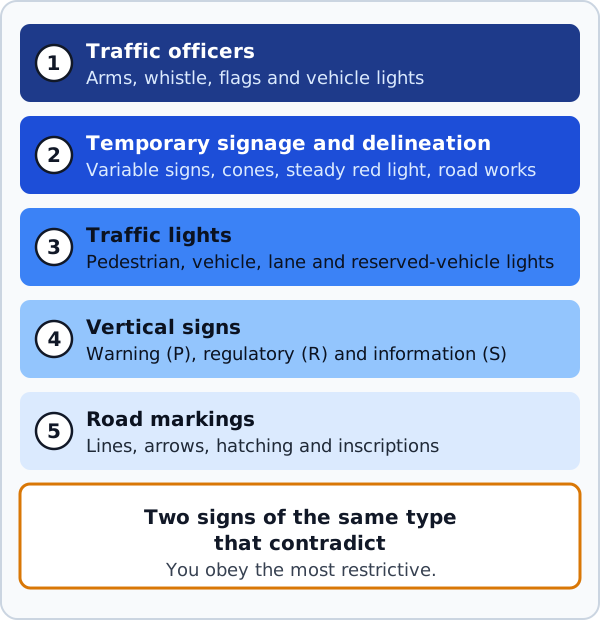
Figure 1. Order of precedence among signs (General Traffic Regulations art. 133). Within the same step, the most restrictive one.
Examples: the officer takes precedence over a green traffic light and over a STOP sign; the traffic light, over a vertical STOP sign and over a marking; temporary delineation (cones, steady red light, directional panel), over the traffic light; the vertical sign, over the marking (a vertical STOP sign over a painted yield line); between STOP and yield, the most restrictive (STOP).
Express exception: the green arrow of a lane control signal allows you to use the lane, but it does not exempt you from stopping at a red traffic light or from obeying another sign that requires you to stop or yield.
At a toll, the green arrow over a lane indicates that you may use it. It does not remove the obligation to stop at the booth or at a stop sign. If the lane works with ticket collection, you stop to take the ticket; if it is an electronic toll lane, you use the required technical device and comply with its signage.
Watch out in the exam: a question shows a toll with a green light and gives as correct “stop at the booth to take the ticket”. That is the answer for a manual entry lane with a ticket, not what any green light means.
3. Traffic officers
They are recognizable from a distance, with conspicuous clothing and retroreflective elements visible from 150 meters (the exam mentions the belt). Their orders are always obeyed.
| Signal | What you do |
|---|---|
| Raised arm | You stop: it obliges everyone approaching the officer, pedestrians included, except anyone who cannot brake safely or is already inside the intersection. You stop at the nearest stop line or, if there is none, before the officer; at an intersection, before entering |
| Arms horizontal | Those approaching from a direction that crosses the line of the arms stop. It remains in force even if the officer lowers the arms, until the position changes |
| Arm moving up and down | Those approaching from that side slow down |
| Swinging a red or yellow light | You stop if the light is directed at you |
| Whistle | Short and frequent blasts: stop. One long blast: resume |
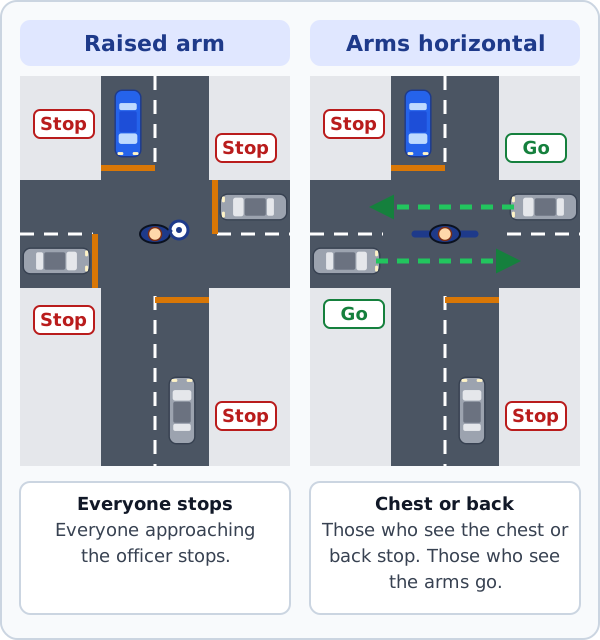
Figure 2. Raised arm: everyone stops. Arms horizontal: those who see the officer's chest or back stop; those who see the officer's arms go.
From a vehicle: red flag, roadway closed from the moment the vehicle passes (except escorted vehicles); green, open again; yellow, take extreme care; arm pointing down at an angle and fixed, stop on the right; flashing or blinking red light toward the front (police behind you): you stop on the right, in front of the police vehicle, and follow its instructions without getting out. Until 30 June 2025 it was “red or yellow”: a question with only a yellow light is the old rule.
Others: road works personnel, the personnel escorting special transports and the Military Police (in the absence of traffic officers) direct traffic with a paddle; if a worker shows you a STOP sign, you obey it even if you have the right of way. School patrols invite you to stop with a paddle. Civil Protection and sports organizers may close access if the authority enables them to.
4. Temporary signage and delineation
It modifies the normal regime of the road and ends when the sign itself says so or the cause disappears.
- Variable message signs: they inform, warn of dangers or give mandatory instructions; never more than two alternating messages. They do not give “guidance” messages.
- Delimiting devices (formerly “barrier devices”): they prohibit passage. Fixed or mobile (barrier, half-barrier); temporary directional panel (prohibits and gives the direction); cones and temporary edge beacons (you do not cross the line that joins them); steady red light (roadway closed); yellow lights, steady or flashing (you do not cross the line that joins them).
- Guidance devices (they do not prohibit): vertex marker (semi-cylindrical, separates two traffic streams), edge marker (edges), permanent directional panel (curve), horizontal beacon or reflector (“cat's eyes”, guides at night; the exam: “edge of the roadway or limits of road works”), vertical beacon, vertical panel (narrowing or obstacle) and cylindrical beacon (guide at merges and intersections). There are also snow poles and rumble strips.
- Luminous beacon on the roadway: green, orange or red light; you may drive over only the green one.
- Road restraint systems: barriers, parapets, protection for motorcyclists and attenuators; they mitigate, they do not prevent.
- Road works: same meaning as the normal sign. In road works, yellow background (P signs, R-1, R-5, R-100 to R-120 except R-101, R-200 to R-205, R-300 to R-306 and R-500 to R-504; P-18 exists only in yellow; new direction signs yellow with black letters; new markings yellow); for another cause, orange; those that do not apply are covered with black adhesive. They are delineated with light at night or in bad weather (see Visibility and Road Hazards).
The exam still uses names from before 2025 (“barrier devices”, “barrier reflectors”, “flat beacons”), and cylindrical beacons are no longer defined as a prohibition of passage.
5. Traffic lights
Four types: for pedestrians, circular, square (lane) and reserved for certain vehicles. There are no triangular traffic lights.
| Light | What it means |
|---|---|
| Pedestrian steady red | Do not start to cross |
| Pedestrian steady green | They may start |
| Pedestrian flashing green | Time is running out: anyone crossing finishes quickly |
| Steady red | You do not go past the traffic light or the stop line; if it is inside or on the other side of the intersection, you do not enter |
| Steady yellow | Like red, unless you cannot brake safely |
| Flashing yellow | You take extreme precaution and yield if necessary; it does not exempt you from other stop signs |
| Flashing red | Temporary prohibition of passage: level crossing, movable bridge, firefighter exit, low-flying aircraft |
| Steady green | Passage with priority (without entering if you would be blocked) |
| Black arrow over red or yellow | The light applies only to that direction |
| Green arrow | You may take that direction with any light; anyone in a lane for that direction must go ahead. With caution, yielding to the lane you are entering and without endangering any user (formerly, “pedestrians”) |
| Lane: red cross | Occupying the lane is prohibited: you leave it as soon as possible |
| Lane: green arrow pointing down | You may use the lane (see section 2) |
| Lane: white or yellow diagonal arrow | The lane is closing: merge into the one indicated |
Lane signals affect only those driving in that lane. At a level crossing with raised barriers and a flashing red traffic light, you wait until it goes out.
Reserved: the cycle silhouette is for cycles only (since the 2025 Catalog, no longer for mopeds). The white bar on black is for trams and scheduled buses (or only those in the reserved lane): horizontal, like red; vertical, straight ahead; diagonal, turn; flashing, like steady yellow. It does not affect a passenger car.
6. Vertical signs: common rules
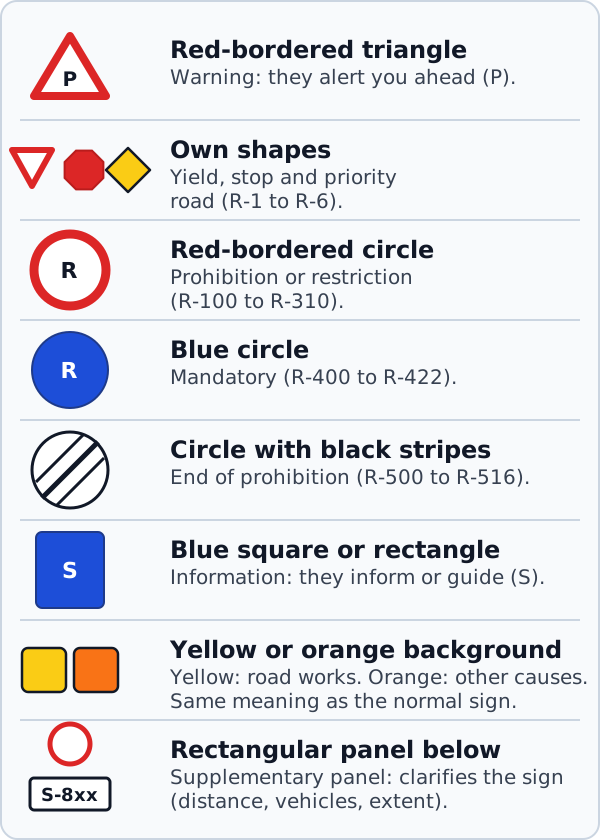
Figure 3. Shape and color give the class of sign. In road works, yellow; for another cause, orange.
Regulatory signs apply from where they are, unless a panel indicates another distance; no entry signs apply to those who see them head-on. Next to the built-up area sign (or on its post) they apply to the whole built-up area.
Supplementary panels: S-800 distance to the hazard; S-810 length of the section; S-820, S-821 and S-830 extent of the prohibition (arrow); S-840 under yield, distance to the STOP; S-850 to S-853 priority route (with R-3); S-870 only the exit ramp of the arrow; S-880 only trucks, trailers, buses, cycles or PMV (with “EXCEPT”, everyone but that); S-890 only with snow, rain or fog; S-891 (new) reminds you of 1.5 m when overtaking cycles or mopeds; S-892 (new) automatic enforcement. An R-301 on the same post as a warning sign applies until the hazard ends.
7. Warning signs (P)
Red-bordered triangle. With a yellow (road works) or orange background they mean the same.



| Sign | Meaning |
|---|---|
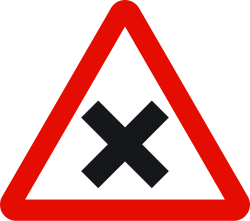
| P-1 (a to e) Priority intersection | You have the right of way; the other road yields |
| P-2 Intersection with priority from the right | General rule |
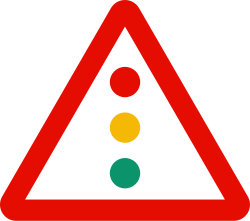
| P-3 Traffic lights | Intersection or section with traffic lights |
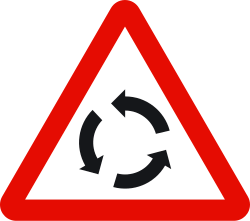
| P-4 Roundabout | Formerly “gyratory traffic” |
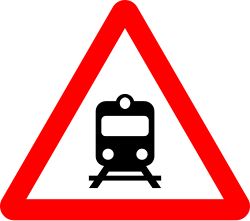
| P-5 Movable bridge; P-6 Tram crossing | The tram has the right of way |
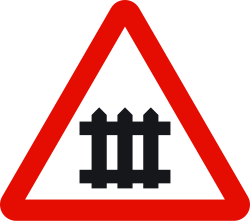
| P-7 / P-8 Level crossing with / without barriers | P-11: immediate location, without barriers |
| P-9 / P-10 (a, b, c) Approach beacons | 200, 150 and 100 m (3, 2 and 1 stripes); the 200 m one goes with P-5, P-7, P-8 or P-27 |
| P-12 Airport | Unexpected noise |
| P-13 / P-14 Curve / dangerous curves | P-14: a series, the first one toward the side of the drawing |
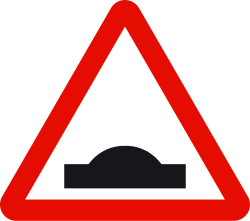
| P-15 Uneven road; P-15a Speed hump; P-15b Dip | |
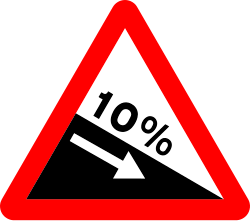
| P-16a Steep downhill; P-16b uphill | The figure is the percentage |
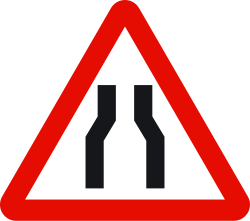
| P-17 (a, b) Roadway narrowing | Also if the shoulder is reduced; not if lanes are removed without changing the width of the others |
| P-18 Road works | Only in yellow |
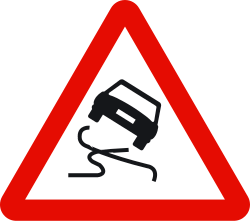
| P-19 Slippery road surface | |
| P-20a Pedestrian crossing (pedestrian on a zebra); P-20b Pedestrians; P-20c with cyclists | |
| P-21a Children; P-21b people with mobility difficulties | |
| P-22a Cyclist crossing; P-22b cyclists | |
| P-23 Domestic animals or livestock; P-24 wild animals | |
| P-25 Two-way traffic | |
| P-26 Falling rocks; P-28 loose gravel; P-29 crosswind; P-30 lateral drop | |
| P-27 Quay; P-32 Obstruction on the roadway | |
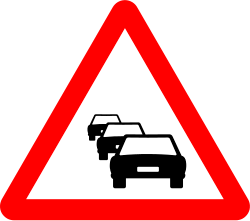
| P-31 Congestion; P-33 Reduced visibility | “Frequently” |
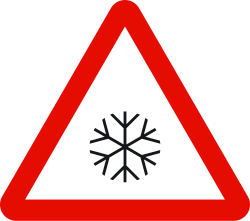
| P-34 Presence of ice or snow | Formerly “slippery road surface due to ice or snow”: in the winter season |
| P-35 Weaving | Between a merge and a split |
| P-50 Other dangers | Exclamation mark |
8. Regulatory signs (R)
Priority: R-1 yield, R-2 stop, R-3 priority road (over those who drive on another roadway or come from it), R-4 end, R-5 priority to oncoming traffic (you do not enter if you would force those coming to stop), R-6 priority over oncoming traffic. Details in Right of Way.

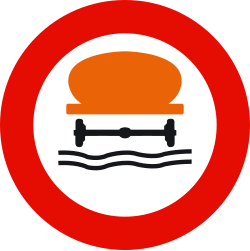
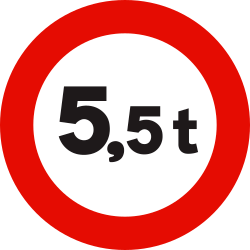
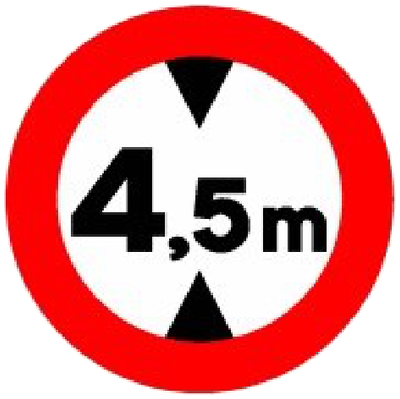
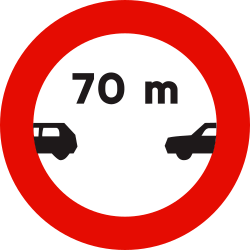
| Sign | Meaning |
|---|---|
| R-100 Closed to all vehicles | Everyone, both directions |
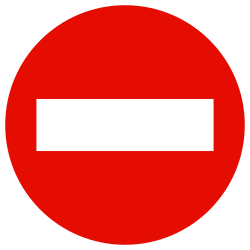
| R-101 No entry | Everyone, for those who see it head-on |
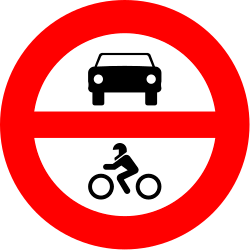
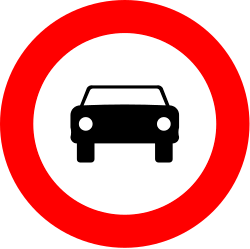
| R-102 No entry for motor vehicles | |
| R-103 …motor vehicles, except two-wheeled motorcycles | It does not prohibit two-wheeled motorcycles or equivalent tricycles; passenger cars and trucks may not enter |
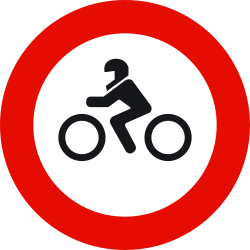
| R-104 No entry for motorcycles | And equivalent three-wheeled vehicles |
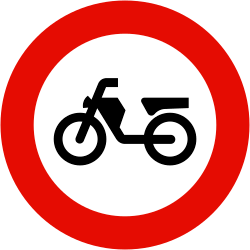
| R-105 No entry for mopeds | And vehicles for persons with reduced mobility |
| R-106 …goods vehicles | Trucks, tractor units and vans, whatever their mass |
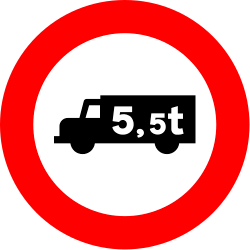
| R-107 …with an authorized mass greater than the one indicated | Even if they are empty (formerly “weight”) |
| R-108, R-109, R-110 Dangerous goods; explosive or flammable; water-polluting | R-110: more than 1,000 liters |
| R-111 Agricultural motor vehicles; R-112 with a trailer (except single-axle) | |
| R-114 Cycles; R-115 handcarts; R-116 pedestrians; R-117 saddle animals; R-118 PMV; R-119 cycles and PMV | |
| R-200 Prohibition of passing without stopping | Customs, toll, police; you do not resume until you comply |
| R-201 Mass limit; R-202 mass per axle; R-203 length; R-204 width; R-205 height | Load included |
| R-300 Minimum separation | Do not drive closer than the distance indicated, except to overtake |
| R-301 Maximum speed | |
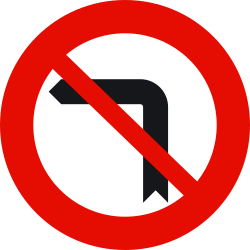
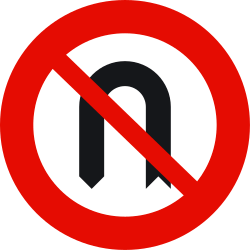
| R-302 / R-303 No right turn / No left turn | R-303 includes the U-turn |
| R-304 No change of direction | Formerly “no U-turn”; it does not prohibit turning left |
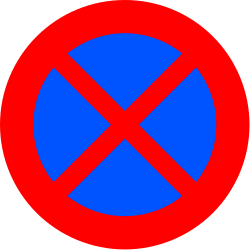
| R-307 No stopping or parking | On that side, up to the nearest intersection in the direction of travel |
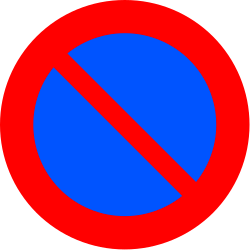
| R-308 No parking | It prohibits parking, not stopping. R-308e: driveway entrance |
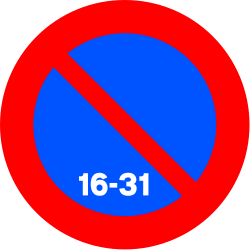
| R-308c / R-308d First / second fortnight | From 09:00 on the 1st to 09:00 on the 16th / from 09:00 on the 16th to 09:00 on the 1st; you may stop |
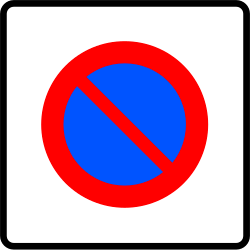
| R-309 Limited parking zone | You indicate the start time; it may be paid |
| R-310 Use of horn prohibited | Except to avoid an accident |
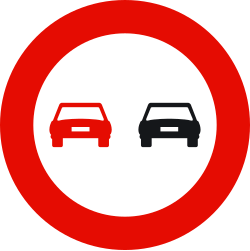
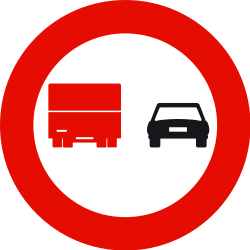
R-305 and R-306 (2025 Catalog). R-305 prohibits everyone from overtaking motor vehicles when it involves entering the opposite lane: there is no longer an exception for two-wheeled motorcycles; if you overtake without leaving your lane, it does not prohibit it. R-306 prohibits trucks of more than 3,500 kg from overtaking motor vehicles even if they do not enter the opposite lane; it does not affect a bus or a passenger car. They apply until “End of overtaking prohibition” (R-502, R-503 for trucks) or “End of prohibitions” (R-500). They add to the general rules (see Maneuvers).


| Sign (blue circle) | Meaning |
|---|---|
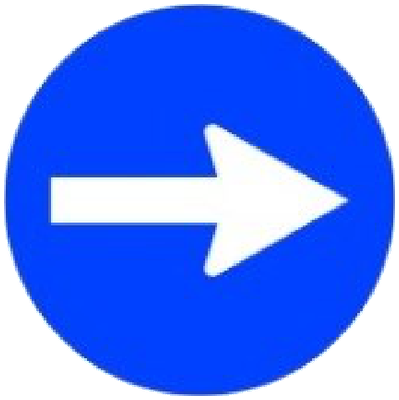
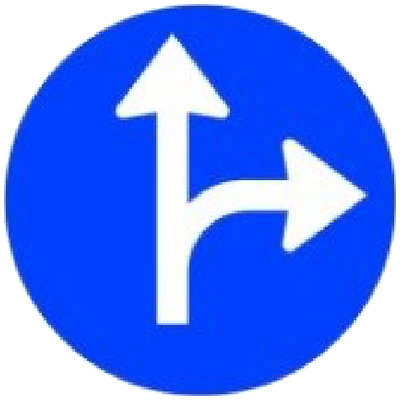
| R-400 Mandatory direction; R-401 Mandatory pass (side of the refuge or obstacle); R-403 Only permitted directions | R-400 with R-1: you follow the arrow and yield |
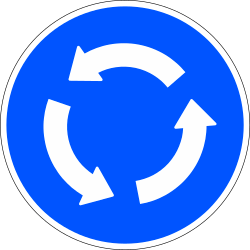
| R-402 Mandatory roundabout direction | Direction of the arrows, center of the roundabout on your left |
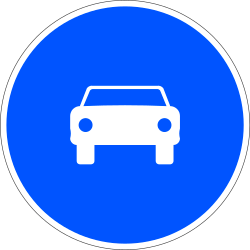
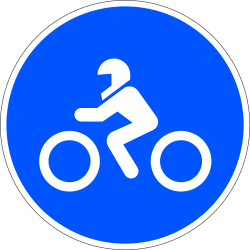
| R-404 Roadway for automobiles, except two-wheeled motorcycles; R-405 for two-wheeled motorcycles | Also equivalent tricycles |
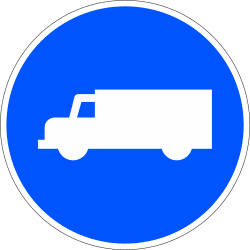
| R-406 Roadway for trucks, tractor units and vans | |
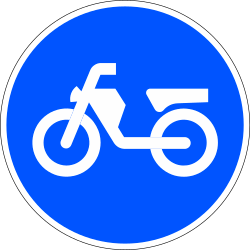
| R-407a / R-407b Road reserved for cycles / mopeds | Mandatory for them, prohibited for everyone else |
| R-410 Pedestrian path; R-422 Dismount and continue on foot | |
| R-411 Minimum speed | Drive at least at that speed |
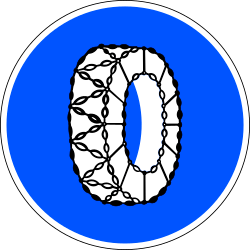
| R-412 Snow chains | Chains, other authorized anti-skid devices or snow tires (M+S with the mountain and snowflake symbol) |
| R-412b Winter tires | Mandatory |
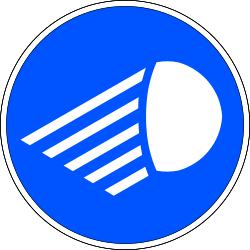
| R-413 Low beam headlights | Low beam even if visibility is good; ends with S-24 |
| R-414, R-415, R-416 Roadway for dangerous goods, water-polluting products or explosives | |
| R-417 Seatbelt (person wearing a seatbelt) | It reminds you of the obligation; the website has no image |
| R-418 Electronic toll mandatory | |
| R-500 End of prohibitions | The specific ones, including R-305 and R-306 |
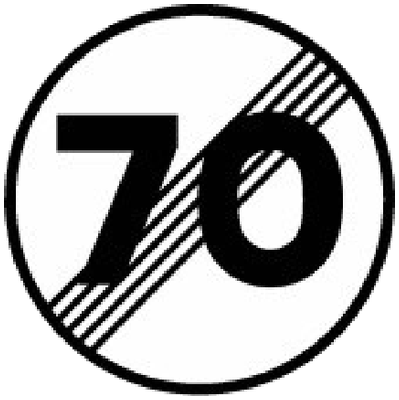
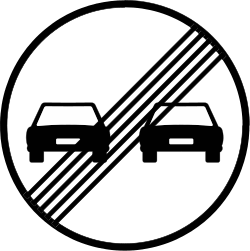
| R-501 End of speed limit; R-502 / R-503 End of overtaking prohibition (general / trucks); R-504 end of limited parking; R-506 end of minimum speed |
9. Information signs (S)
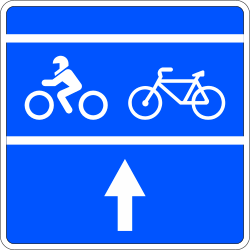
| Sign | Meaning |
|---|---|
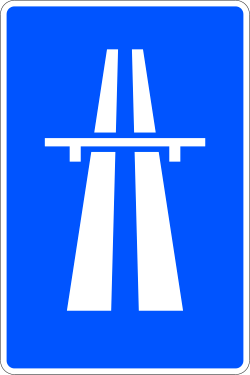
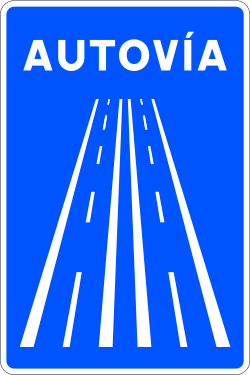
| S-1 Motorway, S-1a Dual carriageway, S-1b Multi-lane road, S-1c 2+1 (S-2… their end) | Start of the road and of its rules; the 2+1 reserves the center lane alternately for each direction |
| S-3 / S-4 Road reserved for motor vehicles; end | |
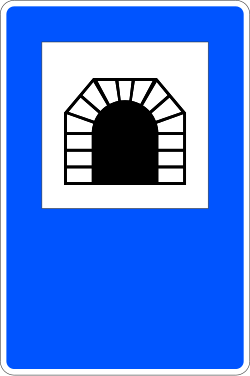
| S-5 Tunnel | S-6 “End of tunnel” no longer exists |
| S-7 Recommended maximum speed (S-8 end; S-9 range) | It does not prohibit; under a warning sign, it applies to that section |
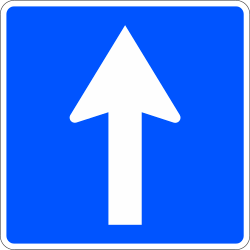
| S-11, S-11a, S-11b One-way roadway with one, two or three lanes | |
| S-15a Dead-end roadway (the T); S-15b, c, d advance signs | |
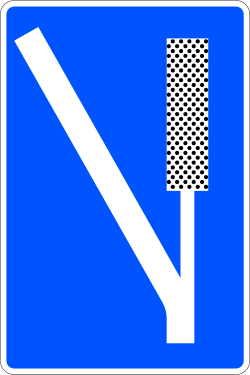
| S-16 Emergency braking zone | |
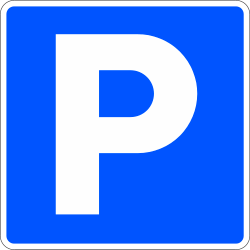
| S-17 Parking; S-18 taxis; S-19 buses | |
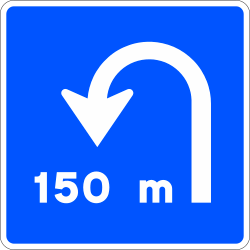
| S-22 U-turn at the same level; S-25 at a different level (exit) | |
| S-23 Hospital | Avoid noise |
| S-24 End of mandatory low beam headlights | |
| S-26a, b, c Approach to an exit | 300, 200 and 100 m, only motorway or dual carriageway |
| S-27 Roadside assistance | |
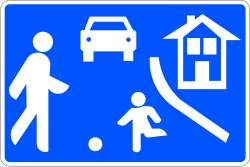
| S-28 / S-29 Stay and play zone; end | See below |
| S-30a Pedestrian zone (“30 zone”, S-30, no longer exists) | |
| S-32 Electronic toll | In addition to other means |
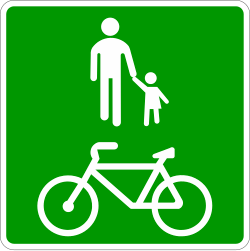
| S-33 Shared cycle and pedestrian path | Pedestrians, cycles and PMV |
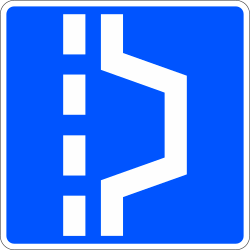
| S-34 Lay-by | To pull over in an emergency; S-34a, in tunnels with a telephone |
| S-35 to S-46 Roads for cycles, PMV and pedestrians; cyclist crossings | |
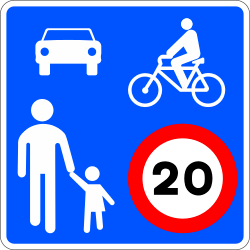
| S-47 / S-48 Shared space zone; end | 20 km/h, pedestrian priority, games not allowed |
| S-49 Motorcycle or bicycle advance zone | Waiting area before the traffic light for motorcycles, mopeds or cycles |
| S-50a to e Lanes according to the signed speed | Only at that speed or more; if possible, on the right; ends with R-506 or S-52. The website has no image |
| S-51a Reserved lane (bus, motorcycle, taxi…); S-51b HOV | |
| S-52 and S-52a to g End of lane | |
| S-53 Increase from one to two lanes (a: with the speed of each one) | |
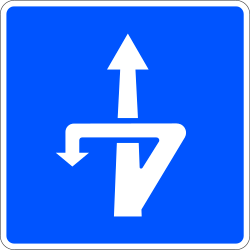
| S-60 to S-63 Splits; S-70 to S-73 Merges | |
| S-100 to S-129 Services | S-104 telephone (with S.O.S, permanent); S-123 rest area |
S-28 “Stay and play zone” (2025 Catalog), formerly “residential street” at 20 km/h: it always goes with an R-301 of 10 km/h; pedestrians have priority and use the whole zone (no pedestrian crossings); you park only where indicated; cycles and PMV, in both directions; games and sports are allowed.
Direction. Six classes: advance direction (S-200 roundabout, S-220… on a road, S-225 on a motorway; on motorways and dual carriageways, as a general rule at 500 m), direction (S-300, S-301), identification (S-400 European, S-410 motorway and dual carriageway, S-410a toll motorway), location (S-500 entering a built-up area, S-510 end of built-up area with the name crossed out, kilometer markers), confirmation (S-600) and specific use in built-up areas (S-700 to S-770).
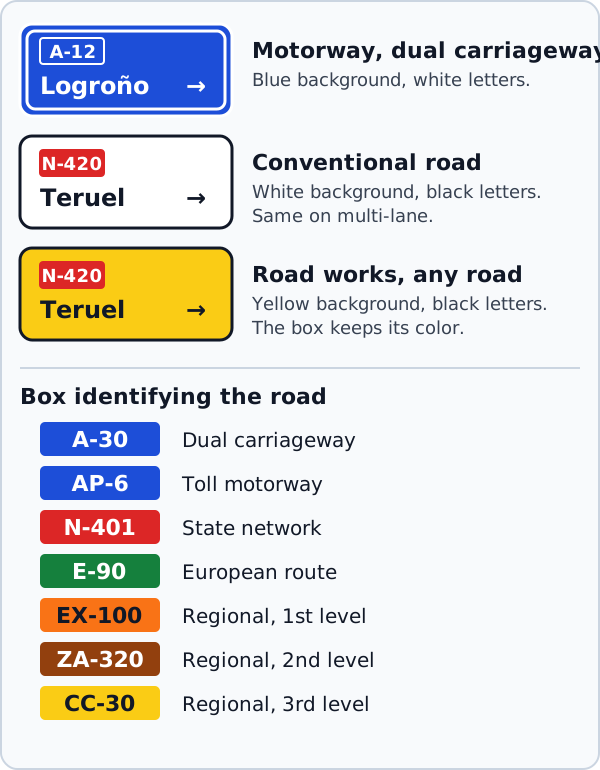
Figure 4. The color of the sign indicates the type of road; that of the box, the category of the road.
An inscription on a blue background in a roundabout advance sign leads to a motorway or dual carriageway. In built-up areas, street modules are green; those for travelers, yellow; sports, orange; monumental or natural, brown; motorways and dual carriageways, blue.
Others: S-940 (2025 Catalog): 30 in built-up areas with one lane per direction, 50 with two or more, 90 on conventional roads and 120 on motorways and dual carriageways (there is no longer a 100). S-960 to S-990, telephone, fire extinguisher and emergency exits. S-991 enforcement (speed, traffic light, STOP, separation; the S-991g, with helicopter or drone, has a yellow background); they do not change the limit. S-992 distance in chevrons (M-7.12); S-993 rear-end collisions on uphill sections.
10. Road markings
They regulate, warn and guide. They are white, except the yellow ones (stopping and parking, and the new markings in road works). Parking markings may be other colors: the exam accepts the blue one as limited parking (“blue zone”), which the 2025 Catalog no longer regulates in a section of its own.
Longitudinal (details in Use of Public Roads): the broken line is not driven over unless the width of the lanes requires it and it can be done safely, and it is crossed to turn or change lanes while yielding; the solid line is not crossed or driven over (if it separates directions, not on its left either; the edge one may be crossed in an emergency); the wider broken line is a special lane; double broken lines, reversible lane; shorter and closer dashes, advance warning of a solid line or of a dangerous section; M-1.13 (new), only a guide on mountain passes, it does not regulate overtaking; return arrow on the center line, solid line nearby: you abort the overtaking or finish it as soon as possible.
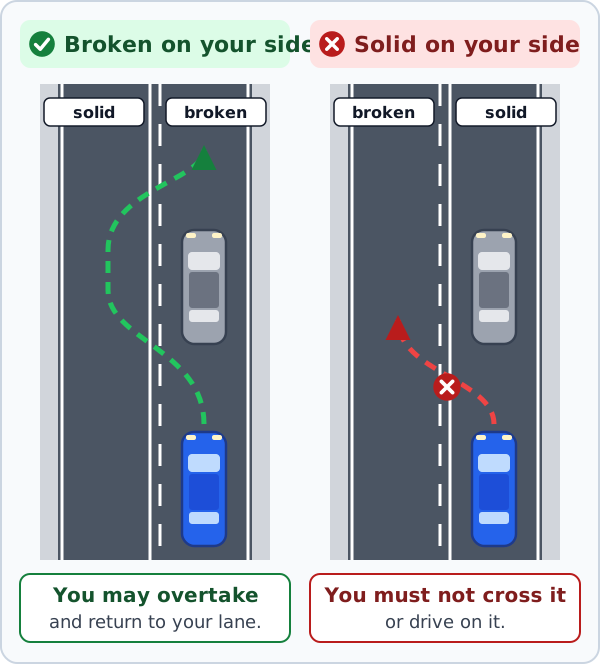
Figure 5. With a solid line next to a broken one, the one on your side applies. From the broken line you may overtake and return (or abort) by crossing the solid one.
Transverse: solid line for stopping (STOP, traffic light, officer, level crossing…; if you cannot see, you stop again where you can see; you stop at the line, not only at the “STOP” inscription); broken line, yield (also before the green or flashing amber arrow); pedestrian crossing, bands parallel to the center line (with a traffic light, two broken lines); cyclist crossing, two broken lines; speed hump (M-4.5, new), three triangles.
Arrows and horizontal signs: an arrow with “straight ahead” does not prevent changing lanes if the lines allow it; the end of lane arrow obliges you to leave it, yielding. Horizontal signs (STOP, yield —triangle with the apex toward you—, speed, reserved zones, “BUS”) have the same value as vertical ones and only for their lane. Hatched markings: nobody enters, except those who use the shoulder. M-7.5: P and N with a cross, level crossing nearby.
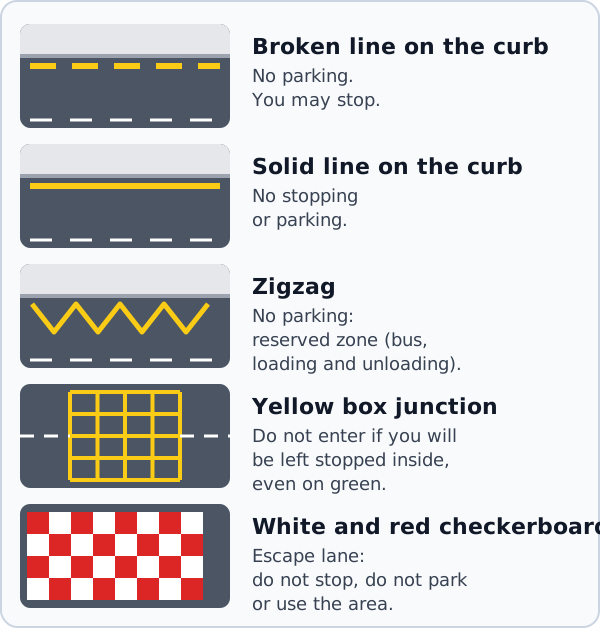
Figure 6. Markings that prohibit stopping, parking or entering.
- Broken yellow (M-7.7): parking prohibited; you may stop. Solid (M-7.8): neither stopping nor parking. They may be temporary (a sign says so).
- Zigzag (M-7.9): parking prohibited, reserved zone (bus, loading and unloading).
- Yellow box junction (M-7.10): you do not enter if you will end up stopped, even if you have a green light.
- White and red checkerboard (M-7.11): escape lane: do not stop, park or use it.
- Chevrons (M-7.12, new): distance reference, with S-992.
- Bicycle advance zone and motorcycle advance zone: between two stop lines 4 m apart; on red, only cycles, PMV, motorcycles and mopeds.
- Traffic calming (not mandatory): dragon's teeth (M-8.1), you are arriving at a road passing through a town or an urban road: slow down considerably; broken edge lines (M-8.2), pedestrian or cyclist crossing; warning checkerboard (M-8.3); guidance for motorcyclists (M-8.4).
11. Signs on vehicles
They are in Annex XI of the General Vehicle Regulations. V-1 priority vehicle (blue light for all: police, firefighters, civil protection and rescue and medical assistance; only them); V-2 rotating yellow light (road works, tractors and special vehicles at 40 km/h or less; tow trucks only if they obstruct); V-3 police on non-emergency duty; V-4 speed limit; V-5 slow vehicle (40 km/h); V-6 long vehicle (more than 12 m); V-9 public service; V-10 school transport (there are children: you slow down and stop if necessary); V-11 dangerous goods (orange plate); V-13 novice driver (less than one year); V-14 learning (“L”, blue for a driving school or red for a driving permit); V-15 reduced mobility; V-16 hazard warning (today, the connected V-16 warning light); V-19 ITV; V-20 overhanging load; V-21 and V-22 escort of a special vehicle or of cyclists.
What has changed in the rules
1 July 2025 (Royal Decree 465/2025), new Catalog: red police light (formerly red or yellow); cycle silhouette only for cycles; green arrow: “no user”; R-305 and R-306 without exception for motorcycles; R-103, R-104, R-404 and R-405 include equivalent tricycles; R-106, R-107 and R-406 include tractor units and vans (“mass”); R-412 admits snow tires; R-304 “no change of direction”; S-28 at 10 km/h; S-940 30, 50, 90, 120; road works in yellow and other causes in orange; delimiting devices instead of “barrier”; luminous beacons. Removed: S-6, S-30 and R-308a and R-308b (odd or even days), to be withdrawn within a year. New: S-891, S-892, S-991 to S-993, M-1.13, M-4.5, M-7.12, M-8.1 to M-8.4, motorcycle advance zone and bicycle advance zone. A question with a yellow police light, mopeds with a cycle traffic light, 20 km/h on a residential street or a removed sign is from the old rules.
Numbers you need to know
| What | Number |
|---|---|
| Visibility of the officer | 150 m |
| Level crossing beacons | 200, 150 and 100 m (3, 2 and 1 stripes) |
| Advance direction signs on motorways and dual carriageways | 500 m (built-up area, about 50) |
| S-26a, b, c | 300, 200 and 100 m |
| S-28 / S-47 | 10 km/h / 20 km/h |
| R-308c | 09:00 on the 1st to 09:00 on the 16th |
| R-110 and R-415 | More than 1,000 liters |
| R-306 | Trucks of more than 3,500 kg |
| Bicycle advance zone and motorcycle advance zone | 4 m between lines |
| Variable message sign | Two alternating messages at most |
| S-940 | 30 / 50 / 90 / 120 |
Summary
- Everyone obeys signs, even if they contradict a general rule; a stop is complied with completely.
- Order: officers, temporary signage and delineation, traffic lights, vertical signs, markings. Same type: the most restrictive.
- Officers always prevail: raised arm, everyone stops; arms horizontal, chest and back; red police light behind you, stop on the right in front of it.
- Steady yellow, like red unless you cannot brake; flashing, precaution; green arrow, with caution.
- Cycle traffic light, cycles only; white bar, trams and scheduled buses.
- Red-bordered triangle, warning; red-bordered circle, prohibition; blue circle, obligation; blue rectangle, information.
- R-305 and R-306 no longer exempt motorcycles; R-412 is complied with using snow tires; S-28 is at 10 km/h.
- Cones, steady red light and directional panel are not crossed; the luminous beacon only when green.
- With a solid and a broken line together, the one on your side applies.
- Broken yellow, no parking; solid, neither stopping nor parking; yellow box junction, do not enter if you will be left stopped.
- V-1 priority, V-10 school, V-13 novice, V-16 hazard warning.
Check your understanding
1. A police car behind you turns on a flashing red light toward the front. What do you do?
Answer
You stop on the right, in front of the police vehicle, and follow its instructions without getting out of your vehicle.
2. An officer has the arms horizontal. Do you stop if you arrive facing the officer's chest? And if you arrive from the side?
Answer
Head-on, you stop. From the side, toward the tip of the arm, you go. The signal applies until the position changes.
3. You are driving a moped and a traffic light shows the silhouette of a bicycle. Does it affect you?
Answer
No. Since 2025 it refers only to cycles.
4. With an R-305, are you allowed to overtake a motorcycle without entering the opposite lane?
Answer
Yes. The R-305 prohibits only when you enter the opposite direction, and it no longer distinguishes motorcycles. With an R-306, a truck of more than 3,500 kg could not, even without entering.
5. There is a solid line next to a broken one and the solid line is on your side. Do you overtake?
Answer
No: only the line on your side counts.
6. What is the maximum speed in a stay and play zone (S-28) and who has priority?
Answer
10 km/h; pedestrians have priority.
Do you know it already?