
Transport of people and goods
In this topic:
- How many people you can carry, how children are counted and why the maximum authorized mass is also a limit.
- Who must wear a seatbelt, which exceptions remain from 1 October 2026 and how children up to 135 cm travel.
- How to place the load, how far it may overhang on a passenger car and on a truck, and how it is signaled with the V-20.
- What to do if your load falls, how to load and unload on the road and what changes with a light trailer.
A badly loaded car brakes worse, becomes unstable and can release objects that turn into projectiles. A car with more people than allowed, or with children who are not properly restrained, turns hard braking into a serious accident. That is why the General Traffic Regulations govern who travels, where and with what restraint, and how the load is transported. In the exam these are very frequent questions, with specific figures.
1. Seats and occupants
The number of people traveling must not exceed the number of authorized seats. The seats are listed on the vehicle registration certificate and on the roadworthiness test (ITV) card. A passenger car with 5 seats, including the driver, carries at most 5 people: you and four more, whether adults or children.
Each person counts as one seat, whatever their age:
- A child from 2 to 12 years old takes up a full seat.
- A baby also counts: a baby must not be carried in someone's arms, but in a child restraint system (CRS), which takes up a seat.
Watch out in the exam: until September 2006 the Regulations did not count a child under 2 who traveled without taking up a seat, in the care of an adult other than the driver, and counted a child over 2 and under 12 as half a seat. Both rules have been repealed: today a child under 2 counts as a full seat.
That is why a 5-seat car cannot carry you, three adults and two children aged 3 and 6: that is six people. If all the children are 135 cm or shorter and each is in their own CRS, at most four children fit in addition to the driver.
There is a second limit: between passengers and luggage you must not exceed the maximum authorized mass (MAM) of the vehicle, the one shown on the ITV card. What you can load is, roughly, the difference between the MAM and the tare (the mass of the empty car). If that difference is 350 kg, you must not carry 550 kg of people and luggage, even if you do not fill all the seats. Driving with excess mass is prohibited because it is dangerous: the car brakes worse and becomes unstable.
Watch out in the exam: too many people and excess mass are two different offenses. A car can comply with the number of seats and still exceed the MAM.
An occupancy that increases the authorized seats by 50% (not counting the driver) is a very serious offense and traffic officers immobilize the vehicle for as long as the cause lasts. Buses on urban and interurban routes are exempt.
Where people go
It is prohibited to carry people outside the place intended and fitted for them: seats, not the trunk or the roof. There is an exception for goods vehicles: people may travel in the place reserved for the load only under the conditions set by the specific regulations, with authorization and safe conditions. If the vehicle carries both people and load at the same time (a family passenger car, a dual-purpose vehicle), it must have protection suited to the load, as required by vehicle legislation, so that the load does not get in the way of the occupants or injure them if it is thrown about.
The driver is responsible for the position of the passengers. You must keep your freedom of movement and your field of vision, make sure that you and the other occupants are in a suitable position, and make sure that objects or animals are placed so that they do not interfere with you.
To get into and out of the vehicle, as a general rule the side closest to the edge of the road is used, and only with the vehicle stopped. It is prohibited to drive with the doors open, to open them before the vehicle has come to a complete stop, or to open them without making sure there is no danger to others, especially to cyclists coming from behind. That is why it is advisable to activate the child safety locks on the doors: they prevent a child from opening them while the car is moving.
Collective passenger transport
On buses and other public service vehicles, the driver starts and stops smoothly and as close as possible to the right edge, and avoids distractions. Passengers are prohibited from:
- Distracting the driver while the vehicle is moving.
- Getting on or off anywhere other than the doors intended for it.
- Boarding when it has been announced that the vehicle is full: you must wait for the next service.
- Needlessly obstructing the way.
- Carrying animals, unless there is a place intended for them (the guide dog of a blind person is the exception, under the person's responsibility).
- Carrying dangerous materials or objects beyond what their specific regulations allow.
School transport and the transport of minors have their own regulations for seats and safety conditions.
2. The seatbelt
The driver and all occupants must wear the approved seatbelt, properly fastened, on any road, urban or interurban, if the seat has one fitted. In a city, neither a short trip nor driving slowly exempts you from it.
Not wearing it, or not using the CRS, is a serious offense and costs 4 points. In vehicles with more than nine seats, including the driver, passengers must be informed of the obligation by audiovisual means or by signs and pictograms visible at each seat.
Exceptions that remain
From 1 October 2026 (Royal Decree 518/2026) the exemptions are greatly reduced. You may drive without a seatbelt only in these cases:
- When reversing or parking.
- With a certificate of exemption for serious medical reasons or disability that the officers ask you for. A certificate issued in another European Union State is also valid, with an official translation.
- In a built-up area, drivers and passengers of vehicles on an emergency call. Never on motorways, dual carriageways or conventional roads.
- Passengers of ambulances providing care who attend to a patient in the passenger compartment, on an emergency call, on any road.
Taxi drivers, delivery drivers and driving school instructors who used to drive in built-up areas are no longer exempt.
One exception is kept for taxis: in urban traffic or in urban areas of large cities they may carry people under 135 cm without a CRS, as long as they travel in a rear seat. On the taximeter light, the exam's answer is that it serves only to illuminate the device when it is activated at the start of the service: it is not an auxiliary headlight and it does not light the interior.
Watch out in the exam: if the question says “in a built-up area”, the answer is still that the driver and all occupants wear the seatbelt.
3. Children and child restraint systems
The rule is measured in centimeters, not in years: children 135 cm or shorter must use an approved CRS, suited to their height and weight. Above 135 cm the adult seatbelt is enough (or, if you prefer, a child seat is also valid). Some questions say “children under 12” when talking about the front seat; the rule uses height, and the correct answer is the one that mentions 135 cm.
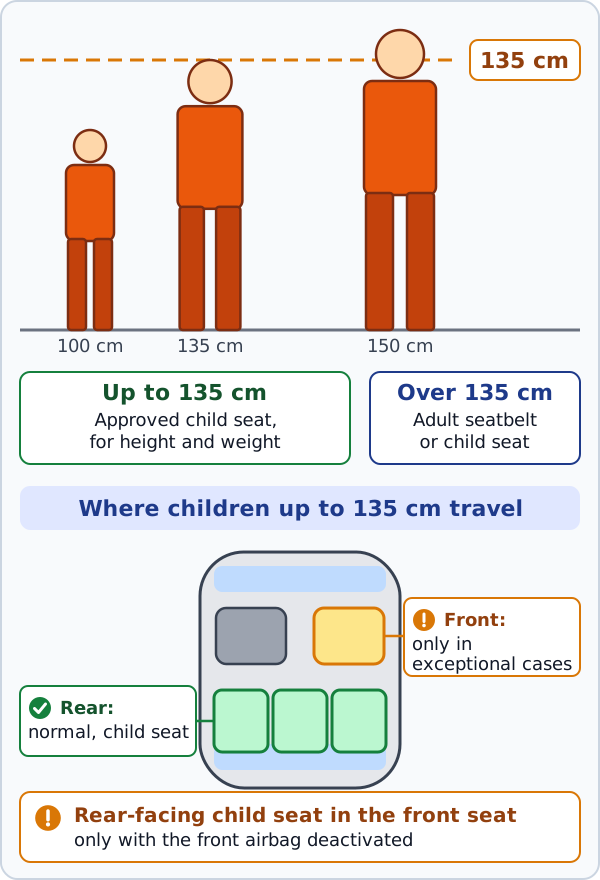
Figure 1. Up to 135 cm, an approved child seat suited to height and weight; above that, the adult seatbelt. Children travel in the back.
Where they sit
In a vehicle with up to nine seats, including the driver, children up to 135 cm travel in the rear seats. They may occupy the front seat only exceptionally, always in their approved child seat, in these three cases:
- The vehicle has no rear seats.
- All the rear seats are already occupied by other children up to 135 cm.
- It is not possible to install all the child seats in the rear.
If the vehicle has a front airbag and the child seat is rear-facing in the front seat, you may use it only with the airbag deactivated, manually or automatically. With the airbag active, its deployment would hit the child seat.
A 5-year-old without a child seat has no alternative: you must not carry the child with the adult seatbelt in the rear seats. An old question gives that answer as correct; the current rule always requires the CRS. In vehicles with more than nine seats it is different: children aged 3 or over use adapted child seats, and if there are none, the seatbelt if it is suitable for their height and weight.
How to choose and fit the child seat
- It is chosen according to the child's height and weight, not just by age or by “the biggest one so it lasts”.
- It is installed always according to the manufacturer's instructions.
- ISOFIX is a standardized anchoring system, a passive safety feature, to secure child seats properly.
- Children under 3 always travel with an adapted restraint system.
- The rear center seat is, statistically, the safest place to install the child seat, if it can be fitted properly.
- Shared-use vehicles (rental cars by the hour, for example) are not exempt: children up to 135 cm also travel in a CRS.
4. Animals and objects inside the car
A loose object or animal is a risk for you and for the occupants. You must place objects and animals so that they do not interfere with you or with your field of vision, and that includes pets: they travel in a place where they do not get in the way and well secured. A pet carrier and a divider grille are two ways of doing it.
The same goes for luggage: the preferred place is the trunk. Nothing loose on the rear parcel shelf, not even something light: in hard braking it is thrown forward.
5. The load: how to place it
The load and the accessories you use to secure it must be arranged, and tied down if necessary, so that they cannot:
- Drag, fall in part or entirely, or shift dangerously.
- Compromise the stability of the vehicle, through poor distribution or excess weight.
- Cause noise, dust or other avoidable nuisance.
- Hide the lights, the light signaling, the mandatory plates or distinguishing marks, or your hand signals.
If you carry materials that produce dust or that may fall (sand, gravel, leaves), you cover them completely and effectively. Loads that are bothersome, harmful, unhealthy or dangerous also follow their specific rules.
With more load the car behaves differently: it accelerates less and needs more distance to brake. That is why, with a heavily loaded van, you increase the safety distance to the vehicle in front and adapt your speed.
Watch out in the exam: driving with the doors or the trunk open to carry a load that does not fit is prohibited; the exam gives “no, under no circumstances” as the correct answer. If it does not fit, find another way to transport it.
6. Overhanging load
As a general rule, the load does not protrude beyond the plan-view projection of the vehicle: not at the front, not at the rear, not at the sides. The exceptions are strict and depend on the type of vehicle.
| Vehicle | At the front | At the rear | At the sides |
|---|---|---|---|
| Intended exclusively for goods, more than 5 m long | 2 m | 3 m | Up to 0.40 m on each side |
| Intended exclusively for goods, 5 m long or less | 1/3 of its length | 1/3 of its length | Up to 0.40 m on each side |
| Passenger car and the rest, not intended exclusively for goods | No | 10% of its length (15% if indivisible) | No |
| Vehicle less than 1 m wide (a motorcycle, for example) | No | 0.25 m | 0.50 m on each side of its axis |
Three points:
- The 2 m and 3 m (and the third) apply to loads that are indivisible in length (beams, poles, pipes). To protrude at the sides, the indivisible load must have its smallest dimension greater than the width of the vehicle, and the total width must not exceed 2.55 m. Only a goods vehicle is allowed to do this.
- On a passenger car, a divisible load protrudes up to 10% of the car's length and an indivisible one up to 15%. On a 4.5 m car that is 0.45 m and 0.675 m.
- The part that protrudes is protected at the end, to reduce the damage of a scrape or a collision, and every precaution is taken not to harm other road users.
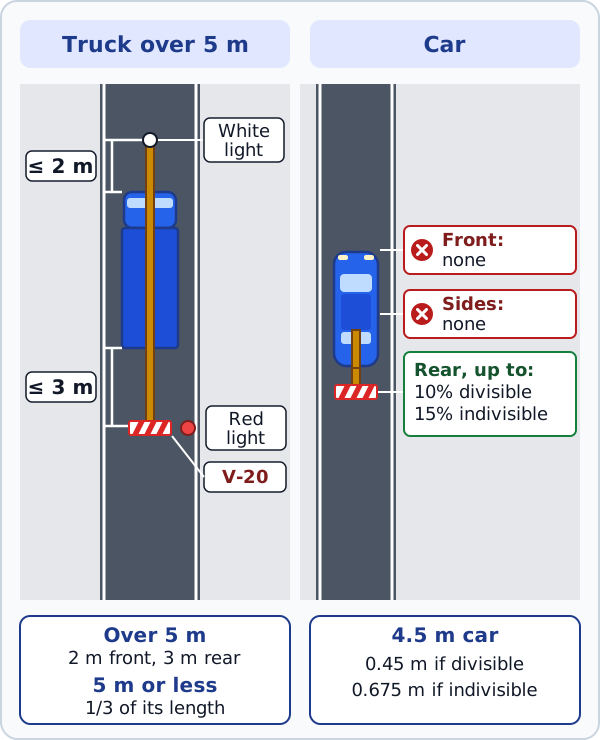
Figure 2. On the truck of more than 5 m, 2 m at the front and 3 m at the rear. On the passenger car, nothing at the front or the sides, and at the rear up to 10% (15% if indivisible).
The maximum dimensions of the vehicle with its load are, as a general rule, 2.55 m wide and 4 m high. If an indivisible load inevitably exceeds the limits, a supplementary authorization to travel is required, and you must drive under its conditions.
Examples: a 4.5 m truck with a 6 m pipe protrudes 1.5 m at the rear. That is exactly a third of its length and it is allowed, but it must be signaled. A 4.2 m passenger car with an indivisible load at the rear may let it protrude at most 0.63 m (15%).
7. Signaling the overhanging load
A load that protrudes at the rear is signaled with the V-20 sign, a panel of red and white diagonal stripes. It is mandatory by day and by night, both on goods vehicles and on passenger cars. Vehicles less than 1 m wide are exempt from this obligation.
- It is placed at the rear end of the load, always perpendicular to the longitudinal axis of the vehicle.
- If the load protrudes at the rear across the full width of the vehicle, two panels are placed, one at each end of the load or of its width, so that they form an inverted V.
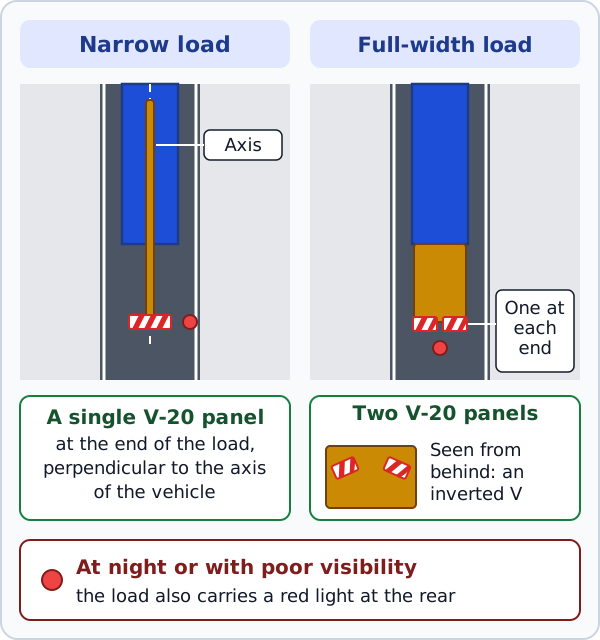
Figure 3. One panel if the load is narrow, two if it takes up the full width. At night, also a red light at the rear.
At night (between sunset and sunrise) or with very reduced visibility, the load is also signaled with a red light at the rear. If it protrudes at the front, with a white light. When it protrudes at both the front and the rear, the signaling is a white light at the front, a red light at the rear and the V-20 panel.
If the load protrudes at the sides so that its end is more than 0.40 m from the outer edge of the position light, then at night or with poor visibility each lateral end is signaled with a white light and a white reflector facing forward, and a red light and a red reflector facing backward.
Watch out in the exam: the V-20 only warns of a load that protrudes at the rear. Do not confuse it with the V-16 warning light, the yellow light that gives advance warning of a hazard, or with the V-6, which indicates that the vehicle is more than 12 m long.
8. Roof rack, parcel shelf and bicycle rack
On a passenger car you may carry luggage and also other loads on the roof rack, as long as it is suited to the characteristics of the vehicle, does not compromise its stability and, where applicable, is correctly signaled. With a roof rack:
- The total height of the vehicle with the load must not exceed 4 m.
- The load must not protrude at the front or at the sides. At the rear, only 10% or 15% of the car's length, with the V-20.
- Suitcases go well secured and lying flat, on their widest side: that way they move less and offer less air resistance, so you use less fuel.
- The heavier what you carry on top, the higher the car's center of gravity: it is advisable to carry the heaviest items in the trunk.
A bicycle rack is a load like any other: it is well secured, must not cover the lights or the license plate and, if it protrudes at the rear, it meets the limits in the table and is signaled with the V-20.
9. Loading and unloading
Loading and unloading operations are done off the road. Only when it is unavoidable to do them on the road, all of the following must be met:
- The stopping and parking rules are respected, and in a built-up area, those of the city council on hours and places.
- They are done without creating dangers or serious disruption to traffic, with enough means to be quick and avoiding noise and nuisance.
- They are done on the side of the vehicle closest to the edge of the roadway, where possible.
- It is prohibited to leave the goods on the roadway, the shoulder or pedestrian areas.
- Goods that are bothersome, harmful, unhealthy or dangerous also follow their specific rules.
On a two-way road, the loading side is the right. On a one-way urban road you may also position yourself on the left, if that is where the destination is. Outside built-up areas, the vehicle stops off the roadway, leaving the shoulder free.
If your load falls
Anyone who creates an obstacle on the road is required to signal it and to remove it as soon as possible. If the load falls onto the roadway:
- Stop safely and turn on the hazard lights.
- Signal the danger with the V-16.
- Remove the load as soon as possible.
From 1 January 2026 the valid device is the connected V-16. Warning triangles are no longer a valid means of warning. If you step onto the roadway or the shoulder of an interurban road, first put on the reflective vest. When the load falls on the road, the V-16 warns of precisely that. The rest of the procedure is the one in the topic on accidents.
10. Dangerous goods: the basics
The transport of dangerous goods has its own regulations, in addition to the general rules on loads; it is not treated like a normal load.
- The vehicle carries an orange plate with a black border and, inside it, two rectangles with numbers that identify the goods.
- If the vehicle is more than 12 m long it also carries the V-6, the rectangular “long vehicle” plate: it indicates a length of more than 12 meters, not that the load is dangerous.
- Passengers on public transport must not carry dangerous materials beyond what their specific regulations allow.
- No entry signs: there is one for all dangerous goods, another for explosive or easily flammable goods and another for water-polluting products.
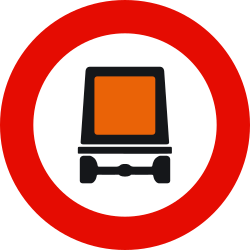
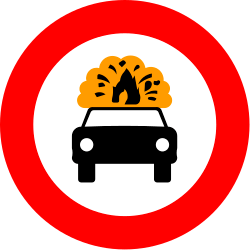
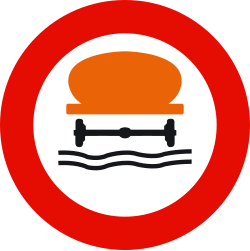
These signs are, in order, R-108 (dangerous goods), R-109 (explosive or flammable) and R-110 (water-polluting products). Anyone who transports dangerous goods drives as a professional: alcohol level of 0.3 g/l and a maximum speed 10 km/h lower than the general one.
11. Light trailer and three-wheeled vehicles
A light trailer has a maximum authorized mass of 750 kg or less. Only what affects what you transport and what you have to carry:
- Registration: a light trailer carries only the license plate of the towing vehicle, the passenger car's plate.
- ITV: the trailer has its own ITV card, and the passenger car's says that it has a coupling system compatible with the trailer's.
- Insurance: a trailer of up to 750 kg MAM does not need its own compulsory insurance; only those of more than 750 kg do. The towing vehicle must be insured. Check with your insurer what the combination covers: the fact that the trailer needs no insurance of its own does not mean that every kind of damage is covered.
- Fire extinguisher: vehicle combinations carry an approved fire extinguisher, so a passenger car with a light trailer needs one even if the car on its own does not carry one.
- A single trailer: as a general rule, a passenger car must not tow more than one at a time.
The license required to tow it and the speed of the combination belong to other topics.
Three-wheeled vehicles may tow a trailer if all the requirements are met: no more than 50% of the unladen mass of the vehicle, by day and with good visibility, at a speed 10% lower than the general one and with no people in the trailer. Motorcycles and mopeds have the same conditions (art. 12.3 of the General Traffic Regulations). In urban traffic the municipal ordinance also applies.
Special and agricultural vehicles
Special vehicles (tractors, construction machinery) use the roads only to move around and must not drive with any load, except those dedicated to special transport with the corresponding authorization. The traveling width of an agricultural tractor and its trailer is that of the vehicle when stopped, including the load. To carry more than five and fewer than nine people, yourself included, on an agricultural tractor with a trailer, the license required is the B.
12. Bicycles and cycles
From 1 October 2026 the General Traffic Regulations govern this in their article 154:
- To transport load or passengers on a bicycle or cycle, the driver must be of legal age.
- If the bicycle, by construction, cannot carry more than one person, it may carry a child of up to 22 kg who can sit up alone, in an approved additional seat.
- Trailers that meet the specifications set by the Ministry of the Interior may be towed, for people, animals of up to 15 kg or load.
- On interurban roads the same rules apply by day and with good visibility.
- What is transported must not drag, fall, shift or hide the lights.
Watch out in the exam: questions from before this reform speak of “a child of up to seven years” and of a trailer that does not exceed 50% of the bicycle's mass. The 2026 rule no longer uses those figures, but the bank still gives them as correct.
What has changed in the rules
- Seatbelt (1-10-2026, RD 518/2026). The exemptions that taxi drivers, delivery drivers and driving school instructors had in built-up areas disappear. In built-up areas only vehicles on an emergency call remain. The taxi exception for children under 135 cm is kept if they travel in the back.
- Cycles (1-10-2026). The new article 154 replaces the rule of “children up to 7 years” with that of children up to 22 kg who can sit up alone, and no longer requires the 50% limit for trailers.
- V-16 (1-1-2026). An immobilized vehicle, or a fallen load, is signaled with the connected V-16. Triangles are no longer valid.
- Vest. When stepping onto the roadway or the shoulder of an interurban road, the driver puts it on; from 1-10-2026 so does the motorcyclist.
Numbers you need to know
| What | Figure | Note |
|---|---|---|
| People | The authorized seats | Each person, one seat, also children and babies |
| Excess occupancy for immobilization | +50% of seats | Not counting the driver |
| Child restraint | Up to 135 cm | Approved child seat suited to height and weight, in the back |
| Adult seatbelt | More than 135 cm | |
| Overhanging load, goods vehicles of more than 5 m | 2 m at the front, 3 m at the rear | Indivisible, in length |
| Overhanging load, goods vehicles of 5 m or less | 1/3 of the length | Front and rear |
| Overhanging load, passenger car | 10% at the rear (15% indivisible) | Nothing at the front or the sides |
| Side load, goods vehicle | 0.40 m on each side | Total width up to 2.55 m |
| Load on a vehicle less than 1 m wide | 0.50 m on each side, 0.25 m at the rear | Nothing at the front |
| Maximum width and height | 2.55 m and 4 m | Including the load |
| Light for an overhanging load | Red at the rear, white at the front | Between sunset and sunrise or with poor visibility |
| Light trailer | Up to 750 kg | No compulsory insurance of its own; one of more than 750 kg does |
| Points for not using the seatbelt or CRS | 4 |
Summary
- Never more people than seats nor more mass than the MAM: they are two different limits.
- Each occupant takes up a seat: a child from 2 to 12 years old, a full one, and a baby also counts, in a child restraint system.
- The seatbelt is mandatory for everyone on any road; the exceptions are limited to reversing, parking, a medical certificate and vehicles on an emergency call in built-up areas.
- Up to 135 cm: approved child seat, suited to height and weight, in the rear seats.
- In front only in three cases, and with the airbag deactivated if the seat faces backward.
- The load must not fall, drag, shift or cover lights, plates or your signals.
- Passenger car: the load protrudes only at the rear (10% or 15%); goods vehicles of more than 5 m, 2 m at the front and 3 m at the rear.
- Load that protrudes at the rear: V-20; at night, a red light at the rear and a white one at the front.
- Loading and unloading off the road; otherwise, on the side closest to the edge, without leaving anything on the roadway or the shoulder.
- If the load falls: V-16, hazard lights and remove it as soon as possible.
- Light trailer: the passenger car's plate, its own insurance only if it exceeds 750 kg (the passenger car, insured) and a fire extinguisher in the combination.
Check your understanding
1. Your car has 5 seats, including the driver. Three adults, two children aged 3 and 6, and you are traveling. Is that correct?
Answer
No. Children from 2 to 12 years old take up a full seat: that is six people and there are only five seats.
2. You are carrying a girl who is 1.20 m tall. Where and how must she travel?
Answer
In the rear seats, with an approved child restraint system, suited to her height and weight. In front, with a child seat, only if there are no rear seats, they are occupied by other children or not all the child seats fit.
3. You put a rear-facing child seat in the front passenger seat. What do you do with the airbag?
Answer
You deactivate it. With the front airbag active you must not use a rear-facing child seat in the front seat.
4. A 6 m goods van carries a long pipe. How far may it protrude and how is it signaled?
Answer
Up to 2 m at the front and 3 m at the rear. At the rear it carries the V-20; at night, a red light at the rear and a white light at the front if it protrudes at the front.
5. A 4.2 m passenger car carries an indivisible load that protrudes at the rear. How far at most?
Answer
15% of its length: 0.63 m. It is signaled with the V-20. If it were divisible, the maximum would be 10%.
6. A box falls onto the roadway and gets in the way. What do you do?
Answer
You stop safely, turn on the hazard lights, signal the danger with the V-16 and remove the box as soon as possible.
7. You are going to tow a light trailer with your passenger car. What plate does the trailer carry and do you have to insure it?
Answer
It carries only the passenger car's license plate. A light trailer does not need its own compulsory insurance (those of more than 750 kg do); your passenger car must be insured, and it is advisable to check with the insurer what it covers for the combination. In addition, the combination must carry a fire extinguisher.