
Types of vehicles and definitions
In this topic:
- How vehicles are classified and why a moped or a tram is not a “motor vehicle”.
- What distinguishes a passenger car, a bus, a truck, a van, a car-derived vehicle and an adaptable dual-purpose vehicle.
- What tare, laden mass and MAM are, and what the M, N, O and L categories mean.
- What an electric scooter (PMV) requires today and what license plates and other vehicle plates look like.
The traffic rules are not the same for everyone: the speed, the license you need, the lighting or where you may drive depend on which vehicle is in front of you. That is why the Traffic Law (annex I) and the General Vehicle Regulations (annex II) begin by defining them. In the exam these definitions come up again and again, almost always as an “is it or is it not…?” question. Here you have them in order, with the cases that are most often confused.
1. Vehicle and driver
A vehicle is any apparatus fit to travel on the roads or land to which the Traffic Law applies. Notice what it does not say: it does not require a motor. A bicycle, a trailer or an animal-drawn cart are vehicles.
A driver is the person who handles the steering mechanism or is in command of a vehicle, or who is in charge of an animal or animals. If the vehicle is traveling for instruction purposes, the driver is the person in charge of the additional controls.
2. How they are classified
First look at whether it has a motor and then what kind of motor it is. The key is in three groups, which figure 1 summarizes.
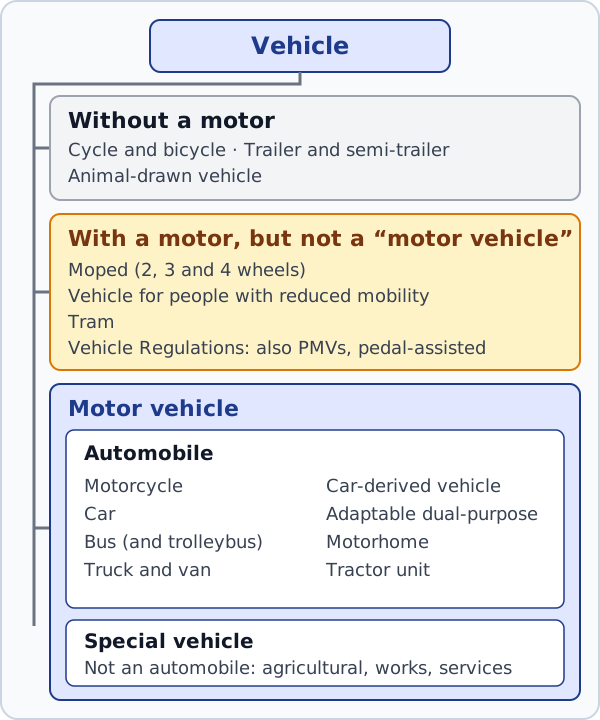
Figure 1. “Having a motor” is not the same as being a “motor vehicle”. And the special vehicle, even if it has a motor, is not an automobile.
- Without its own motor: cycles and bicycles, trailers and semi-trailers, animal-drawn vehicles. A trailer is a non-self-propelled vehicle.
- With a motor, but not a “motor vehicle”: the Traffic Law excludes mopeds, trams and vehicles for people with reduced mobility. The General Vehicle Regulations add pedal-assisted cycles and personal mobility vehicles (PMVs).
- Motor vehicle: one fitted with a motor for its propulsion, with those exclusions.
Among motor vehicles, the automobile is the one that normally serves to transport people or goods, or both at the same time, or to tow other vehicles. Special vehicles fall outside that definition.
What follows from this, and what they ask:
| Vehicle | Motor vehicle? | Automobile? |
|---|---|---|
| Motorcycle | Yes | Yes |
| Trolleybus | Yes (it is a bus) | Yes |
| Road train and articulated vehicle | Yes | Yes |
| Moped, light quadricycle | No (even though it has a motor) | No |
| Tram | No (even though it has a motor) | No |
| Agricultural tractor | Yes | No (it is a special vehicle) |
Watch out in the exam: “Is the moped fitted with a motor?” Yes. “Is it a motor vehicle?” No. Both answers are correct at the same time, and the exam puts them together to throw you off. The same goes for the motorcycle: it moves by itself and is an automobile.
In addition to its construction, the vehicle is assigned to a service, which is recorded in the vehicle registration certificate: public (the holder needs authorization from the Administration for that activity, such as a taxi) or private (assigned to a private activity of its holder).
3. Cycles, mopeds, motorcycles and quadricycles
These are the smallest two-, three- and four-wheeled vehicles. They are told apart by engine capacity (or power, if electric) and by maximum speed by construction, not by the speed you reach in practice.
| Vehicle | Definition |
|---|---|
| Cycle | At least two wheels, propelled exclusively or mainly by the muscular energy of the person riding it, above all with pedals. It includes pedal-assisted ones. |
| Bicycle | A two-wheeled cycle. |
| Pedal-assisted cycle | It has pedals and an auxiliary electric motor of 250 W at most, whose power decreases and cuts out before reaching 25 km/h or if you stop pedaling. |
| Motorized cycle | A pedal cycle with auxiliary propulsion to help with pedaling that cuts out at 25 km/h, of up to 1,000 W (category L1e-A). It is not a moped. |
| Two-wheeled moped | Maximum speed by construction of 45 km/h at most and an engine of 50 cm³ at most (if combustion) or 4 kW at most (if electric). |
| Three-wheeled moped | 45 km/h at most. Engine of 50 cm³ at most if it is spark-ignition, such as gasoline; 4 kW at most if it is another type of combustion, such as diesel, or electric. |
| Light quadricycle | It is a four-wheeled moped: 45 km/h at most, the same engine limits as the three-wheeled one and an unladen mass of 350 kg or less (without batteries, if electric). |
| Two-wheeled motorcycle | A two-wheeled automobile, without a sidecar, with an engine of more than 50 cm³ and/or with a maximum speed by construction of more than 45 km/h. |
| Motorcycle with a sidecar | A three-wheeled automobile with wheels asymmetrical about its axis, with those same values. |
| Three-wheeled vehicle | A three-wheeled automobile with symmetrical wheels, with an engine of more than 50 cm³ and/or more than 45 km/h. |
| Vehicle for people with reduced mobility | Tare of 350 kg or less and does not exceed 45 km/h on level ground; designed and built specifically (not merely adapted) for people with some physical dysfunction or disability. It is equated to a three-wheeled moped. |
The border between moped and motorcycle is the and/or in the motorcycle definition: it is enough for it to exceed 50 cm³ or 45 km/h to be a motorcycle. A two-wheeled vehicle capable of exceeding 45 km/h is a motorcycle, even if its engine is small.
Other notes:
- The moped may tow a trailer or semi-trailer under conditions (art. 12.3 of the General Traffic Regulations): it must not exceed 50% of its unladen mass, during the day and in good visibility, 10% more slowly and with no people in the trailer. In town the municipal ordinance also applies (you have it in the topic Transport of People and Goods).
- Cycles, in order to travel, have a braking system on the front and rear wheels and a bell: no other sound device is allowed.
- The Vehicle Regulations define the light quadricycle by category L6e of Regulation (EU) 168/2013, with different figures from the Traffic Law. In the exam, the figure is that of the Traffic Law: 350 kg of unladen mass.
- A bicycle with an auxiliary motor of 0.5 kW is not a moped: it is a motorized cycle (it does not exceed 1,000 W). Even so, it is not to be confused with the pedal-assisted one, which stays at 250 W.
4. Automobiles for people and for goods
They are told apart by what they are built for, how many seats they have and what the cab is like. Seats are always counted including the driver's.
| Automobile | What it is |
|---|---|
| Passenger car | For transporting people, with at least four wheels and, besides the driver's seat, eight seats at most (nine with yours). |
| Bus or coach | For people and their luggage, with more than nine seats including the driver's. The trolleybus (connected to an electric line, without rails) is a bus. |
| Truck | For goods, with four wheels or more, a cab not integrated into the bodywork and nine seats at most. |
| Van | For goods, with four wheels or more, a cab integrated into the bodywork and nine seats at most. |
| Tractor unit | Designed mainly to tow a semi-trailer. |
| Car-derived vehicle | For services or for transporting goods only; it keeps the bodywork of a passenger car and has a single row of seats. |
| Adaptable dual-purpose vehicle | For transporting goods and people, at the same time or separately, up to nine counting the driver. The load can be replaced, in whole or in part, by people, by adding seats. |
| Motorhome | Built with the special purpose of being a dwelling. It has, at least, seats and a table, beds or bunks that convert into seats, a kitchen and cupboards, fixed to the living area. |
| Pick-up | Of up to 3,500 kg maximum mass, with the seating and the load area in separate compartments (and of a height not exceeding 2 m, according to the Vehicle Regulations classification). |
How not to confuse them:
- Truck and van are told apart only by the cab: separate from the rest (truck) or integrated (van). The van has 9 seats at most, counting yours.
- Car-derived vehicle and adaptable dual-purpose vehicle. The car-derived vehicle keeps the bodywork of a passenger car, has a single row of seats and is for services or goods. The adaptable dual-purpose vehicle is arranged to carry goods and people at the same time or separately, and to replace the load with people by adding seats. Both are automobiles.
- Passenger car and bus. By the number of seats: up to nine with the driver is a passenger car; more than nine, a bus.
Vehicle combinations
A motor vehicle can have another one coupled to it. The trailer is the non-self-propelled vehicle designed to be towed by a motor vehicle. The semi-trailer is coupled to an automobile and rests part of its mass on it, transferring to it a substantial part of its weight. The combinations are of two types:
- Articulated vehicle: a motor vehicle coupled to a semi-trailer.
- Road train: a motor vehicle hitched to a trailer.
The trailer is light if its maximum authorized mass does not exceed 750 kg. As a general rule, a towing vehicle does not tow more than one trailer or semi-trailer. Which license you need for each combination is explained in the topic The Driving License: for example, the B is valid for passenger cars and trucks of up to 3,500 kg of MAM, also with a light trailer.
5. Special vehicles
A special vehicle is designed and built to carry out specific works or services, and for that reason it is either exempted from some technical condition of the Vehicle Regulations, or it permanently exceeds its limits of masses or dimensions. All agricultural machinery and its trailers are also special vehicles, whether self-propelled or towed. It can be self-propelled or towed.
They are grouped into two large families:
| Family | Examples |
|---|---|
| Agricultural | Agricultural tractor, walk-behind tractor (motocultor), tractor-carrier (tractocarro), self-propelled agricultural machine, carrier (portador), towed agricultural machine, agricultural trailer. |
| Works and services | Works tractor, services tractor, works and services machines (self-propelled or towed). |
In addition: the tourist train (a special vehicle with a tractor and one or several trailers to transport people for tourist purposes) and the quad (QUAD-ATV), with four or more wheels, handlebars and off-road use.
- The agricultural tractor is self-propelled, with two or more axles, to tow, push, carry or drive implements, machinery or agricultural trailers. The walk-behind tractor (motocultor) has a single axle and is steered on foot by the person operating it with handles. The services tractor tows or pushes service vehicles, wagons or other equipment.
- Agricultural implements (motorless tools to prepare or work the land) are not considered vehicles, nor is the rest of the towed agricultural machinery of less than 750 kg.
- They are not automobiles, but they do have to meet the technical conditions of the Vehicle Regulations, except those the regulation itself exempts them from.
- Work on the road: construction or maintenance work directly on the public road is only done by vehicles designated and authorized for it.
- Masses and dimensions: they are subject to some limitations of their own, but the general ones for other vehicles do not simply apply to them. If they exceed the regulatory ones, they need a supplementary authorization (the exam calls it “special authorization”). To measure the traveling width of an agricultural machine, 0.5 meters is subtracted from that of the machine at rest, unless it has folding or removable parts that have not been stowed.
- They are registered at the Provincial Traffic Office. Their plate is white with red letters and goes at the rear only (in the center or on the left): they carry no front plate. The trailer of a special vehicle of more than 750 kg has its own license plate.
- The speed of special vehicles is in the topic Speed, and which license is needed to drive them (the B authorizes agricultural ones, even if they are heavier or wider than a car), in The Driving License.
6. Personal mobility vehicles (PMVs)
Electric scooters are the most common. A personal mobility vehicle has one or more wheels, a single seat and is propelled only by electric motors, with a maximum design speed of between 6 and 25 km/h. Without self-balancing, it cannot have a seat. Competition vehicles, vehicles for people with reduced mobility (they are excluded) and pedal-assisted ones are not PMVs.
The light personal vehicle is a PMV of between 6 and 25 km/h if it weighs less than 25 kg, or of between 6 and 14 km/h if it weighs more than 25 kg.
Since they are not registered, they do not need a vehicle registration certificate. Instead, since 2026:
- Circulation certificate (requested by the manufacturer or importer, before marketing it).
- Registration in the DGT Register and a visible identification label (since 30 January 2026).
- Compulsory insurance (since 2 January 2026).
And when traveling:
- Minimum 15 years old, and a single occupant: you must not carry a passenger.
- Helmet mandatory and properly fastened. At night or in poor visibility, in addition, a light or reflective item visible from 150 meters.
- Lights always on (during the day it is required from 1 October 2027) and arm signals to indicate turns.
- Prohibited on motorways, dual carriageways, roads passing through a town (travesía), interurban roads and urban tunnels (except cycle paths and similar, or roads closed to motor vehicles), and on sidewalks.
Watch out in the exam: the PMV is not a motor vehicle, is not registered and does not need a license, but it does need a certificate, registration, a label and insurance. And the vehicle for people with reduced mobility is not a PMV.
7. Masses and categories
The masses
All are measured in kg. Do not confuse them:
| Concept | What it is |
|---|---|
| Tare | The mass of the empty vehicle, with its authorized fixed equipment and its full supply of water, fuel, lubricant, spare parts, tools and accessories, without service staff, passengers or load. |
| Mass in running order | The tare plus 75 kg for the driver (and 75 kg for the attendant on a bus, if it carries one). |
| Laden mass | The actual mass of the vehicle and its load at a given moment, including service staff and passengers. |
| MAM (maximum authorized mass) | The maximum mass for using the vehicle with a load in traffic on public roads. It must not be exceeded. |
| TPMM (technically permissible maximum mass) | The maximum declared by the manufacturer because of the construction of the vehicle. |
| Payload | What it can carry: the MAM minus the tare. |
| Axle mass | The mass that bears on the ground, transmitted by all the wheels of that axle. |
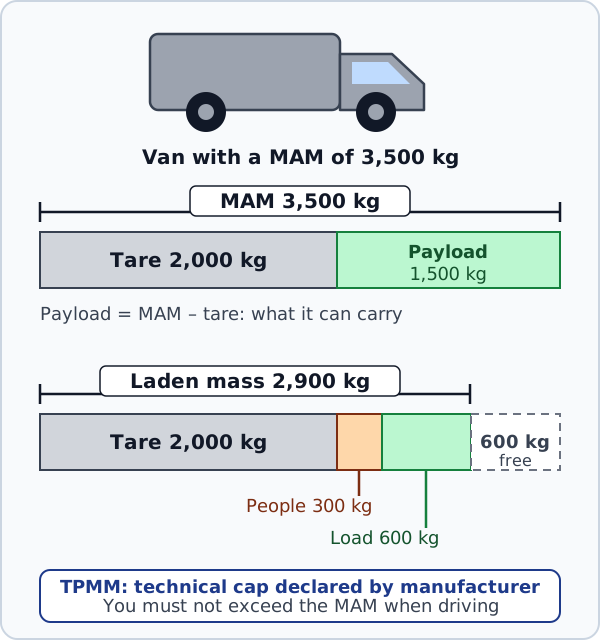
Figure 2. The MAM is a fixed ceiling. The laden mass changes with what you carry, and must always stay below the MAM.
Watch out in the exam: the MAM is the most it may weigh loaded, not what it weighs empty (that is the tare). “Effective mass of the vehicle and its load, including that of the passengers” is the laden mass, not the MAM.
The M, N, O and L categories
The European classification (Regulation (EU) 2018/858) divides vehicles by their use and by their maximum mass. It is the one you see in technical documents and in the environmental classification.
| Category | What it includes |
|---|---|
| M | Motor vehicles for people and their luggage. M1: up to eight passenger seats in addition to the driver's. M2: more than eight seats and up to 5 tonnes. M3: more than eight seats and more than 5 tonnes. |
| N | Motor vehicles for goods. N1: up to 3.5 t. N2: more than 3.5 and up to 12 t. N3: more than 12 t. |
| O | Trailers and semi-trailers. O1: up to 0.75 t. O2: more than 0.75 and up to 3.5 t. O3: more than 3.5 and up to 10 t. O4: more than 10 t. |
| L | Two- or three-wheeled vehicles and quadricycles: mopeds, motorcycles, tricycles and quadricycles. |
M and N are for motor vehicles and O is for trailers: that is why a trailer is never category M. A light trailer (up to 750 kg) is category O1.
8. Registration and plates
To put a motor vehicle, and a trailer or semi-trailer of more than 750 kg, into service, it must be registered (mopeds, with their own procedure). The license plate serves to identify the vehicle and must be approved, with a retroreflective background.
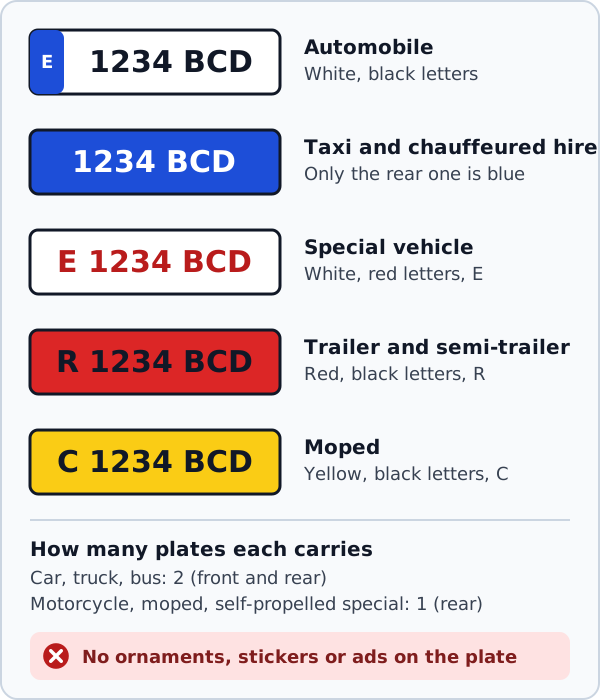
Figure 3. The color and the letter of the plate tell you what kind of vehicle it is. Those of the automobile carry the blue European band with the E for Spain.
- The motorhome is an automobile: white background plate.
- Trailers of more than 750 kg: their own license plate and, in addition, on the right side, another plate with the registration number of the vehicle towing them. A trailer of 850 or 900 kg has its own; one of 400 kg does not.
- Trailers of up to 750 kg: a single rear plate, in the center or on the left, with the registration number of the towing vehicle.
How many plates and where
| Vehicle | Plates |
|---|---|
| Automobile (except motorcycles and three-wheeled ones) | Two: front and rear, centered on the median longitudinal plane. If they cannot be centered: the rear one goes on the left; the front one, exceptionally, on the left or on the right. |
| Moped, motorcycle, three-wheeled vehicle and quadricycle | One, at the rear. Quadricycles may also carry the front one, optional. |
| Self-propelled agricultural or works special vehicle | One, at the rear, in the center or on the left. |
| Trailer of more than 750 kg | Its own rear one, centered, and the tractor's on the right. |
| Trailer of up to 750 kg | A single rear one, the same as the tractor's. |
What is not allowed on the plate
It is prohibited to put on the plate ornaments, signs or characters other than the regulatory ones, stickers, adhesives or advertising, and to fit complementary plates or badges that make it hard to read or that could be mistaken for it. A frame or an appendage below the plate is allowed, which may carry advertising engraved at the bottom if it does not extend more than 26 mm beyond the edge of the plate. If the plate carries the blue band with the European flag and the E, you do not need the Spanish nationality identifier (V-7) when traveling in the European Union.
Plates and panels on vehicles
- Test or research plate (V-12): it carries the letters F.V. and is placed at the front and rear, next to the license plate. It indicates that the vehicle is carrying out tests or research trials (testing a new vehicle before marketing it).
- Long vehicle plate (V-6): a rectangular yellow panel with a red border at the rear. It indicates that the vehicle or the combination is more than 12 meters long.
9. Mandatory equipment and how the car moves
The basic technical conditions most often asked about:
- Rearview mirrors of the passenger car: one inside and one outside on the left. The outside right one is optional. If the inside one does not allow you to see well what is behind (it does not cover from the horizon up to 60 meters behind and 20 meters wide), the outside right one becomes mandatory: then you have two outside mirrors, one on each side.
- Horn: every motor vehicle has one (except walk-behind tractors that are driven on foot), with a continuous, uniform sound of sufficient intensity. On cycles only the bell is allowed.
- Speedometer: every motor vehicle that can exceed 40 km/h on level ground has a speed indicator in km/h.
- Reverse gear: motor vehicles have it, except motorcycles, walk-behind tractors on foot and symmetrical three-wheeled vehicles.
- Silencer: it is prohibited to drive with an open exhaust, without the silencer device. It applies to all motor vehicles and mopeds.
- Roadworthiness test (ITV) card: all trailers and semi-trailers carry it, including caravans and light trailers.
Which wheels move the car:
| Type | Which wheels receive the power of the engine |
|---|---|
| Front-wheel drive | The front wheels. |
| Rear-wheel drive | The rear wheels. |
| All-wheel drive (to all four wheels) | Those of both axles. |
The gear lever can be on the dashboard, although it is not the most common arrangement.
10. Speed: only a summary
The limit depends on the group. The detail and the adjustments are in the topic Speed; here it is only to know which group each vehicle falls into (motorway and dual carriageway / conventional road):
| Group | Motorway and dual carriageway | Conventional |
|---|---|---|
| Passenger car, motorcycle, motorhome of up to 3,500 kg, pick-up | 120 km/h | 90 km/h |
| Bus, car-derived vehicle and adaptable dual-purpose vehicle | 100 km/h | 90 km/h |
| Truck, van, motorhome of more than 3,500 kg and combinations (also the passenger car with a trailer) | 90 km/h | 80 km/h |
Cycles and mopeds: 45 km/h on the roads where they may travel.
Watch out in the exam: the car-derived vehicle and the adaptable dual-purpose vehicle go with the bus, not with the trucks. And a generic limit of 100 km/h on conventional roads no longer exists: it is 90 km/h for the passenger car.
What has changed in the rules
- 2 and 30 January 2026 (Law 5/2025 and Royal Decree 52/2026). PMVs need compulsory insurance, a circulation certificate, registration in the DGT Register and a label. The definition of light personal vehicle appears. Uncertified ones sold before 22 January 2024 will not be able to travel from 22 January 2027.
- 1 October 2026 (Royal Decree 518/2026). PMVs: minimum age of 15, helmet, arm to signal, prohibited on roads passing through a town (travesía), interurban roads and urban tunnels (except cycle paths and similar) and, as always, on motorways, dual carriageways and sidewalks.
- 30 May 2026 (Order PJC/528/2026). The Vehicle Regulations add the motorized cycle as a class of its own.
If a question does not mention these changes, it predates them.
Numbers you need to know
| What | Number | Nuance |
|---|---|---|
| Moped | 45 km/h and 50 cm³ (or 4 kW) | By construction, not by how fast it goes |
| Motorcycle | More than 50 cm³ and/or more than 45 km/h | Either one is enough |
| Light quadricycle | Unladen mass of 350 kg or less | It is a four-wheeled moped |
| Passenger car | Eight seats plus the driver's | Nine with yours |
| Bus | More than nine seats | With the driver's |
| Truck and van | Up to nine seats | The cab separates them |
| Light trailer | Up to 750 kg of MAM | No license plate of its own |
| Trailer with its own license plate | More than 750 kg | Red, R |
| Pedal assistance | 250 W and 25 km/h | It is not a motor vehicle |
| Motorized cycle | Up to 1,000 W | It is not a moped |
| PMV | 6 to 25 km/h, one seat | From age 15, with a helmet |
| Speedometer | If it exceeds 40 km/h on level ground | |
| Long vehicle (V-6) | More than 12 meters | Yellow panel with a red border |
| Width of an agricultural machine | That at rest minus 0.5 m | Unless folding parts are not stowed |
Summary
- A vehicle is any apparatus fit to travel; a motor is not needed.
- Mopeds, trams and vehicles for people with reduced mobility have a motor but are not “motor vehicles”.
- The motorcycle is an automobile; the moped and the light quadricycle are not.
- Moped: 45 km/h and 50 cm³ at most. More than 50 cm³ or 45 km/h, motorcycle.
- Passenger car: eight seats plus the driver. Bus: more than nine with the driver.
- Truck and van are told apart by the cab (separate or integrated).
- The car-derived vehicle has one row of seats and carries goods; the adaptable dual-purpose vehicle carries people and goods and is converted by adding seats.
- Special vehicles are not automobiles, carry a white plate with red letters at the rear only and, if they exceed the masses or dimensions, a supplementary authorization.
- A PMV has a single seat, 6 to 25 km/h, a certificate, registration, a label, insurance and a helmet; no passenger.
- Tare is empty; laden mass is the actual mass with passengers and load; MAM is the authorized ceiling.
- Categories: M people, N goods, O trailers, L two- and three-wheeled vehicles and quadricycles.
- Plate color: white automobile and motorhome, red trailer, yellow moped; ornaments and stickers prohibited.
Check your understanding
1. Is a moped a motor vehicle? And is a motorcycle an automobile?
Answer
The moped is not a motor vehicle (even though it has a motor). The motorcycle is an automobile.
2. A two-wheeled vehicle with a 49 cm³ engine can reach 60 km/h by construction. What is it?
Answer
A motorcycle. It is enough to exceed 45 km/h by construction, even if the engine does not exceed 50 cm³.
3. A goods vehicle has the cab integrated into the bodywork and seven seats. What is it called?
Answer
Van. If the cab were separate, it would be a truck.
4. A van has a MAM of 3,500 kg and a tare of 2,100 kg. Today it carries two people (160 kg) and 900 kg of load. What is its laden mass and how much payload does it have?
Answer
Laden mass: 2,100 + 160 + 900 = 3,160 kg. Payload: 3,500 – 2,100 = 1,400 kg. It is below the MAM.
5. What plate does a 900 kg trailer carry? And a 400 kg one?
Answer
The 900 kg one carries its own red license plate (R) and, on the right, another with the registration number of the tractor. The 400 kg one carries a single plate with the registration number of the towing vehicle.
6. What does an electric scooter require today in order to travel?
Answer
A circulation certificate, registration in the DGT Register with its label, insurance and a helmet. It does not need a vehicle registration certificate or a license plate, and the driver is at least 15 years old.