
Use of public roads
In this topic:
- What a roadway, a lane, a shoulder, a road passing through a town (travesía) or a dual carriageway is, and how each type of road differs.
- Where you drive according to the number of lanes, the type of road and your vehicle, and which markings and signs organize the lanes.
- Who uses the shoulder, who may not enter a motorway or dual carriageway and how the emergency lane is formed.
- What to do at a level crossing or in a tunnel, and what the Regulations prohibit doing on the road.
The road is the stage of traffic, and the exam asks a lot about it: almost 400 questions, nearly all of the type “where do I drive and where do I not.” You answer them correctly if you know two things: the exact words for each concept (lane, shoulder, travesía, urban road) and the general rule of each section, before the exception.
1. The parts of a road
These definitions come from Annex I of the Traffic Law. The questions repeat them almost word for word.
| Part | What it is |
|---|---|
| Platform | The roadway and the shoulders. |
| Roadway | The part of the road used for vehicle traffic. It is made up of one or more lanes. It does not have to keep the same width: it may narrow on one side or on both. A road may have several roadways. |
| Lane | A longitudinal strip of the roadway, with or without markings, wide enough for one line of automobiles other than motorcycles. Without markings, the lanes that fit by width count: if two lines of automobiles can pass, there are two lanes. |
| Shoulder | A paved longitudinal strip adjoining the roadway, not intended for automobiles except in exceptional circumstances. |
| Verge | The strip between the outer edge of the shoulder and the ditch or the embankment (Roads Act). |
| Median | A strip that separates two roadways and is not used for driving. |
| Sidewalk | A longitudinal area of the road, raised or not, intended for pedestrian traffic. |
| Pedestrian area | Sidewalks, squares, boulevards, promenades, platforms and similar areas, reserved for the priority traffic and presence of pedestrians. No vehicle travels on sidewalks; in the other pedestrian areas, the town council may allow cycles and PMVs, always with pedestrian priority. |
| Refuge | A pedestrian area located on the roadway and protected from traffic. |
| Lay-by | A widening of the roadway for stopping without blocking traffic. |
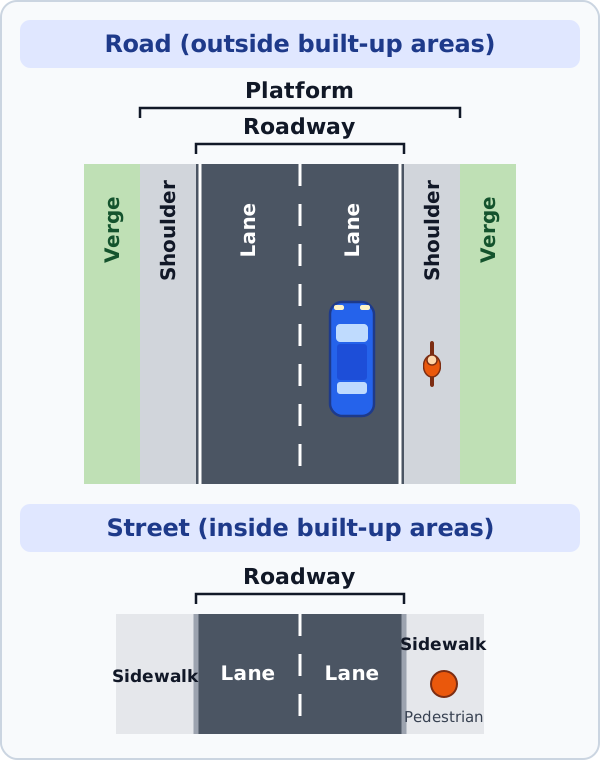
Figure 1. The roadway is what the lanes form; the platform, the roadway plus the shoulders. Not to scale.
Where you are. These words are not synonyms:
| Term | What it is |
|---|---|
| Built-up area | A space with buildings whose entry and exit roads carry the signs marking the entry to and exit from a built-up area. |
| Road | A paved public road located outside built-up areas, except sections passing through a town (travesía). |
| Interurban road | A public road located outside built-up areas. |
| Urban road | A public road located inside built-up areas, except travesías. |
| Road passing through a town (travesía) | A section of road that runs through a built-up area. A section is not a travesía if there is a bypass that can be accessed. |
A travesía is not an urban road, but the rules for built-up areas apply to it (for example, the lane that best suits your destination).
2. Types of road
| Road | What it is like |
|---|---|
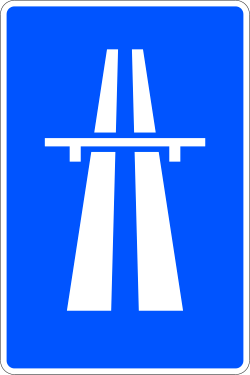
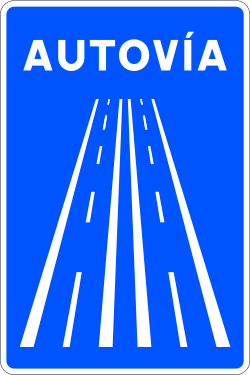
| Motorway | A road designed, built and signed as such for the exclusive use of automobiles. With no access from adjoining properties, no level intersections and separate roadways for each direction. |
| Dual carriageway | The same, but with limited access from adjoining properties. |
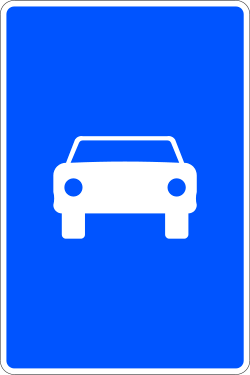
| Road reserved for motor vehicles | A road reserved for automobiles, with a single roadway and total access restriction. It is signed with the S-3 (start) and the S-4 (end). |
| Conventional road | One that does not have the characteristics of a motorway, a dual carriageway or a road reserved for motor vehicles. |
Motorways and dual carriageways are entered only through their interchanges. A motorway may pass through a town when it works as a ring road; it is still a motorway and, while it runs through a built-up area, its general limit is 80 km/h. Toll booths can be at entrances, exits or intermediate sections. Service areas may include gas stations, hotels, restaurants and repair workshops; rest areas are spaces to park for a while away from traffic.
Cycle paths. The bike lane is attached to the roadway (in one direction or two) and the protected bike lane has side elements that separate it from the roadway and from the sidewalk. The sidewalk bike lane is a cycle path marked on the sidewalk; the segregated bike path, a road separated from motorized traffic with a layout independent of roads; the cycle track, a road for pedestrians and cycles through parks, gardens or woods. Other vehicles use them only if the authority allows it and signs it.
Areas designed for people (new definitions since 1-10-2026). On a single platform of roadway and sidewalk the pedestrian has priority at any point of the roadway and the limit is 20 km/h. The residential priority zone restricts access by vehicles of non-residents. The safe school route consists of roads prepared for going to school on foot or without a motor, with possible speed limits and restrictions on motor vehicles.
3. Direction of travel and position on the roadway
General rule: on the right and as close as possible to the edge of the roadway, with enough lateral distance to pass oncoming traffic safely. It applies on any road, and even more so on curves and changes of gradient.
- Two-way roadway without markings: on the right, not in the center. The same on an urban street with one lane in each direction. On a one-way roadway without markings, even if it is wide, also close to the right edge.
- Curves and changes of gradient with reduced visibility: even if there are no markings, you leave the half of the roadway used by oncoming vehicles completely free (unless you are passing an obstacle). On a left curve you do not move toward the center: you stay close to the right edge.
- Driving on the left on a two-way road is a very serious offense and costs 6 points.
Refuges, traffic islands and guiding devices. On a two-way road you pass to the right of them. If they are on a one-way road, or within the one-way part, you may pass on either side. The R-401 sign indicates on which side you must pass.

Roads divided into roadways. If a median or a separator divides the road into two roadways, you use the one on your right in your direction of travel. If there are three, the central one may serve both directions or one, permanently or temporarily, according to the signs; the side ones are one-way unless indicated otherwise.
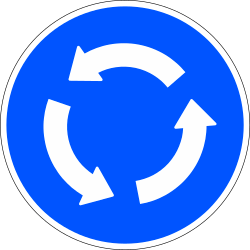
Roundabouts and squares. You keep the center on your left: you drive counterclockwise, even if no sign says so. A split roundabout (two sections joined directly across the island) is not a roundabout in the strict sense. Priority when entering and exiting is in the Right of Way topic.
4. Use of lanes
4.1 Two-way roadways
Automobiles and special vehicles over 3,500 kg drive on the roadway, not on the shoulder (except in an emergency), and in addition:
- Two lanes, separated by markings or not: in the one on your right.
- Three lanes separated by broken lines: in the one on your right and in no case in the one furthest to your left. The center one is used only to overtake when you need to and to turn left; not to make a U-turn. You also do not use it to overtake if oncoming traffic occupies it for the same purpose.
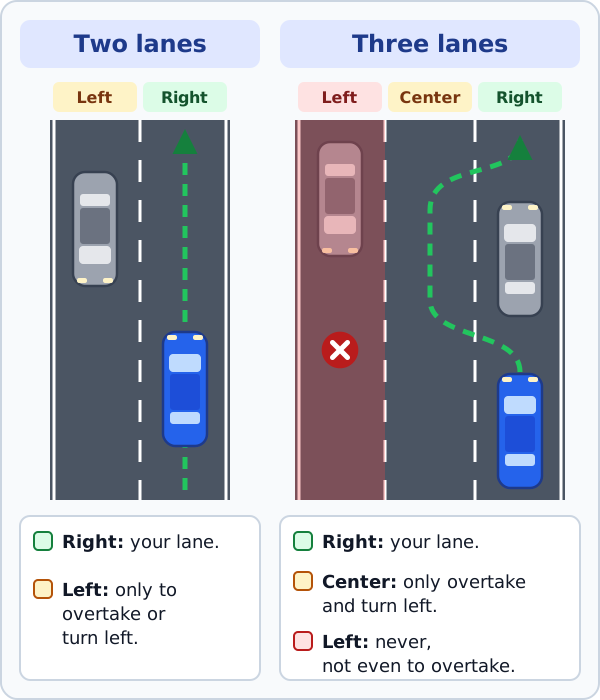
Figure 2. With two lanes, the right one is yours. With three, the center one is only for overtaking and turning left, and you never use the left one. Not to scale.
4.2 More than one lane in your direction, outside built-up areas
The usual lane is the right one. You use the others when the traffic or road circumstances advise it, provided you do not obstruct another vehicle following you. With three or more lanes in your direction, the rule is stricter for some vehicles:
| Vehicle | Lanes |
|---|---|
| Passenger car, truck or van of up to 3,500 kg, motorcycle | The right one normally, and the others if the circumstances advise it and you do not obstruct the vehicle following you. |
| Truck or van of more than 3,500 kg, special vehicle that is not using the shoulder, combination of more than 7 meters (also a passenger car with a trailer) | The right one and only the one next to it, if needed and without obstructing. Never the one furthest to the left. |
A passenger car with a trailer forming an 8-meter combination falls in the second row. A truck of exactly 3,500 kg does not exceed 3,500 kg, so it may use all three.
On motorways and dual carriageways you normally drive in the right lane, even if the others are free. After overtaking, you return to the right one as soon as it is free and safe. You stay in the left one only if you are going to overtake again right away and you do not bother those coming up behind faster.
4.3 More than one lane in your direction, in built-up areas
With at least two lanes for the same direction, delimited by longitudinal markings, you may use the one that best suits your destination, provided you are not an obstacle. You leave it only to get ready to change direction, overtake, stop or park. If you are in the left one because you will turn left at an intersection that is still far away, that is correct.
Watch out in the exam: this freedom does not apply on motorways or dual carriageways, even if they pass through a built-up area (the right lane), or outside built-up areas.
4.4 Which lanes do not count
To apply these rules, lanes reserved for certain vehicles (bus, HOV...) and those reserved for certain maneuvers (acceleration, deceleration) are not counted. A reversible lane does count.
4.5 Lanes according to speed
A minimum speed sign (R-411) over a lane prohibits you from using it if you do not reach that speed. If you do reach it, you are not obliged to use it: you stay in the right one when circumstances allow.
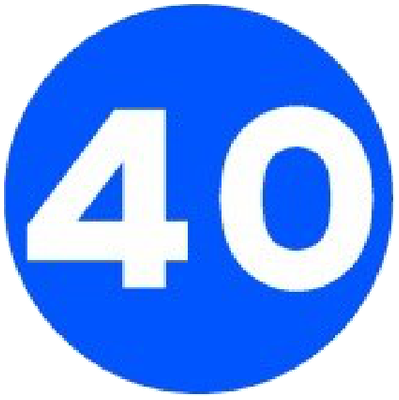
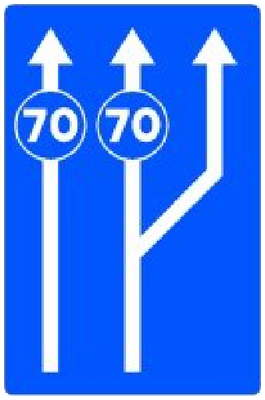
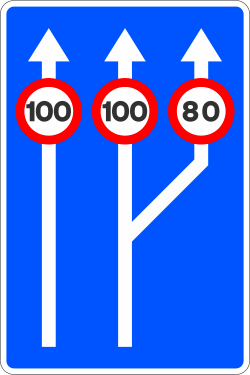
Pay attention to the type of sign each lane of the panel carries: not all the figures on a lane panel are minimums. The R-411, a blue circle, indicates a minimum speed, and works that way inside a lane panel such as the S-50c (an additional lane on the right on a one-way roadway): the lanes carrying the blue circle may only be used by those traveling at that speed or more, although, if circumstances allow, they must use the right one. Someone traveling at the minimum speed of the dual carriageway (60 km/h) on a slope with an S-50c showing 70 uses only the right lane; someone traveling at 90 or 100 km/h stays in the right one while able to.
The S-53c, on the other hand, carries circles with a red border: it indicates the change from two to three lanes and the maximum speed of each. The additional slow-traffic lane is added to the right of the main ones so that slow vehicles move aside and fast ones overtake.
5. Markings that organize lanes
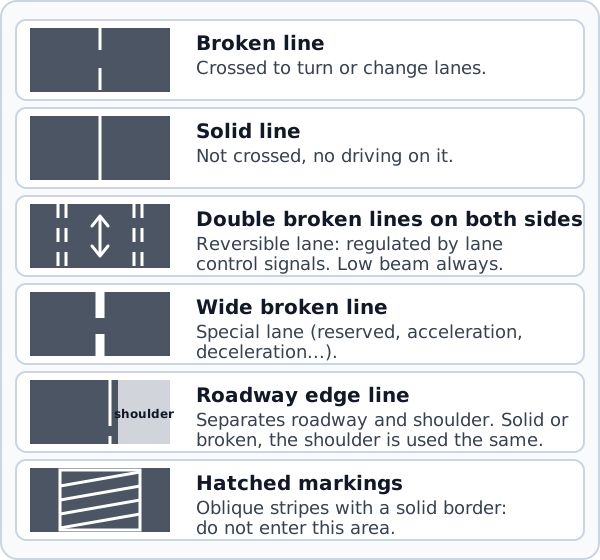
Figure 3. The markings asked about most in this topic and what each one means.
- Broken. No one may drive on it, except when the width of the lanes makes it necessary and safety allows it. It is crossed to turn or change lanes, respecting the vehicle in the lane you are entering.
- Solid. It is not crossed and you do not drive on it; if it separates the two directions, you do not drive to its left either.
- Double broken lines on both sides of a lane. It is a reversible lane: traffic is regulated in one direction or the other with lane control signals or other means.
- Broken line with a wider stroke. It is a special lane: it separates a reserved lane (bus, taxi...), an acceleration, deceleration or weaving lane.
- Roadway edge line. It separates the roadway from the shoulder. Solid or broken, it does not change how the shoulder is used, and it does not count as a longitudinal lane marking.
- Hatched markings (oblique stripes with a solid border). Nobody enters, except those who must use the shoulder: not to join traffic, not to take an exit, not to stop at a stop sign. Stopping and parking on them is prohibited.
- Lane arrows. They indicate the movements allowed or required from that lane. If they include going straight ahead, they do not prevent changing lanes while keeping the direction, if the markings allow it. A mandatory turn arrow does prevent you from going straight.
- Cones, beacons and amber lights. They prohibit passing across the line, real or imaginary, that joins them, even if you could pass without knocking them over. A steady red light indicates a closed roadway.
Lane control signals. They affect only the vehicles in that lane:
| Light | What it means |
|---|---|
| Red X | Occupying the lane is prohibited; those in it leave it as soon as possible. |
| Green arrow pointing down | You may drive in the lane. It does not exempt you from stopping at a red traffic light or from obeying another sign that requires you to stop or yield. |
| White or yellow oblique arrow, steady or flashing | Your lane is about to close: merge safely into the lane it points to. |
6. Reversible, contraflow, additional and reserved lanes
6.1 Reversible lane
Those using it have at least the low beam on, day and night. Driving in the opposite direction to the one the traffic light shows is a very serious offense.
6.2 Lane opened in contraflow
It is a lane used in the direction opposite to the normal one. There are two cases and the vehicles admitted differ:
| For traffic flow | Because of road works on the roadway | |
|---|---|---|
| Who opens it | The traffic authority, on roadways with more than one lane per direction. | The authority responsible for the road. |
| Who may use it | Only motorcycles and passenger cars. A passenger car with a trailer, even a light one, may not. | All vehicles authorized on the road under works, unless expressly prohibited. A passenger car with a trailer may, if there is no prohibition. |
In both cases you drive with at least the low beam, day and night, at 80 km/h at most and 60 at least. You must not move into the lane of the normal direction, not even to overtake. Nor may the vehicles in the adjacent normal lane enter the opened one, even if they do not knock over the cones. And you do not make a U-turn in it.
6.3 Temporary additional lane
If the platform is wide, the authority may open an additional lane with cones in the center of a two-way roadway with shoulders; using the two shoulders, there are two lanes in one direction and one in the other. Those using the shoulders and the additional lane drive at 80 km/h at most and 60 at least, with at least the low beam, day and night, and without entering the opposite direction, not even to overtake.
6.4 HOV lanes (high occupancy)
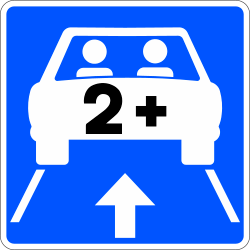
These are lanes reserved for automobiles carrying people, with the number of occupants set for each section.
- May use them: motorcycles, passenger cars and adaptable dual-purpose vehicles of up to 3,500 kg with the required occupants.
- May not: passenger cars with trailers, mopeds (not even with two occupants), cycles, PMVs, animal-drawn vehicles, pedestrians or animals.
- May travel with only the driver: vehicles with the V-15 sign or the parking card for persons with reduced mobility, and buses over 3,500 kg and articulated ones. In the exam, traveling alone with the 0 emissions environmental label is also accepted as valid, or when a variable message sign allows vehicles with the B label.
- Emergency services and road maintenance crews may use them. The lane may be permanent or temporary, and the traffic authority may allow other vehicles to use it for safety or traffic flow.
6.5 Lanes reserved for buses, taxis and others
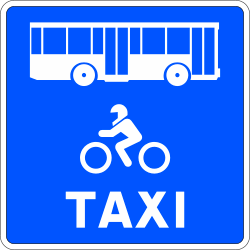
- With a broken line between the lane and the rest of the roadway, other vehicles may enter only for a maneuver that is not stopping, parking, making a U-turn or overtaking, giving priority to the authorized ones. For example, to turn.
- With a solid line, you do not enter.
- You do not overtake using a reserved lane (not even on the right in a built-up area if you have to enter it).
- In a lane for the exclusive use of urban public transport stopping is prohibited and, therefore, so is parking.
- A lane marked with the inscription “TAXI” is for taxis only.
7. Emergency lane and snow
Emergency lane (article 32, since 1-10-2026). On motorways and dual carriageways, when a traffic jam makes vehicles move at walking pace or stop, you must pull aside to leave a free space through which priority vehicles can pass.
- Two lanes in your direction: the gap forms in the center, between the two.
- Three or more: the gap forms between the leftmost lane and the one next to it. Those in the leftmost lane move as far left as possible; those in the other lanes, as far right as possible.
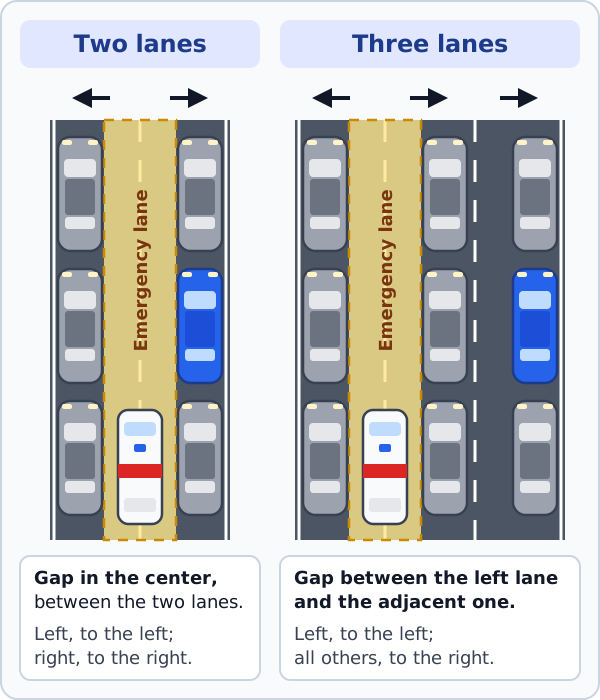
Figure 4. In a traffic jam, the gap is in the center with two lanes, and between the left one and the adjacent one with three or more. Not to scale.
A passenger car does not use the shoulder to move forward in a traffic jam: the shoulder is used only in the cases in section 8.
Snow. On motorways and dual carriageways, when snow makes driving difficult, overtaking is prohibited and it is mandatory to use the right lane (with three or more lanes, also the one next to it). You leave the left ones free for emergency vehicles and snowplows.
8. The shoulder
The shoulder is not for you: automobiles and special vehicles over 3,500 kg drive on the roadway and use the shoulder only in an emergency.
| Who | What they do |
|---|---|
| Animal-drawn vehicles, special vehicles of up to 3,500 kg (an agricultural tractor of 3,500 kg, for example), cycles, mopeds, vehicles for persons with reduced mobility and vehicles following cyclists | If there is no road or part of it intended for them (bike lane...), they use the shoulder on their right, if it is passable and sufficient. If it is not, they use the essential part of the roadway. |
| Any vehicle of up to 3,500 kg that, because of an emergency, travels at abnormally low speed and seriously disrupts traffic | Right shoulder if it is passable and sufficient; if not, the essential part of the roadway. On a motorway or dual carriageway, in addition, it leaves by the first exit. |
| Bicycles | Two abreast on the shoulder (if it is not passable, on the essential part of the roadway); in single file where there is no visibility, if they affect traffic flow or at night. On long descents with curves they may move onto the roadway if it is safer, except on dual carriageways. |
| Mopeds and the other vehicles of the first row | Riding side by side is prohibited. Since 1-10-2026, mopeds may no longer ride two abreast: only bicycles may. |
| Motorcycles (since 1-10-2026) | Right shoulder only on sections signed with a vertical sign and markings, only with the traffic in the lanes stopped by congestion, at 30 km/h at most, in single file and leaving it if they obstruct those who are required to use it. |
| Emergency, assistance and maintenance | To attend an emergency or maintain the road, with the V-1, V-2, V-23 and V-24 signs that apply and at 30 km/h at most (priority vehicles on an emergency call, with no limit). If they are not on duty, they use the roadway. |
Stopping or parking on the passable part of the shoulder of an interurban road is prohibited. On that of a motorway or dual carriageway only stopping in an emergency is allowed. Slow vehicles in the first row do not overtake another if they are side by side for more than 15 seconds or 200 meters (Maneuvers topic).
9. Motorways and dual carriageways
Who may not use them. The following are prohibited on motorways and dual carriageways: animal-drawn vehicles, bicycles, mopeds and vehicles for persons with reduced mobility, and also animals and PMVs (electric scooters). You must not pick up anyone who is hitchhiking, not even in the toll plazas.
There is one exception: cyclists over 14 years old may use the shoulder of dual carriageways, unless a sign prohibits it for safety reasons, accompanied by a panel with the alternative route. On a motorway, never.
Special vehicles enter if they exceed 60 km/h on level ground and meet Annex III of the Regulations, or with a supplementary authorization if they exceed masses or dimensions.
Pedestrians. They must not walk on them. If you are immobilized by a breakdown, you leave on the side opposite to traffic if there is a safe place outside the platform, without walking on the roadway. Those working in emergency, maintenance or assistance services walk on it only when strictly indispensable.
How you drive:
- Minimum speed: 60 km/h. If you cannot reach it because of a breakdown, you turn on the hazard lights, use the shoulder and leave by the first exit.
- Right lane normally, and you return to it after overtaking.
- A novice driver may drive on them, with the general limits (120 km/h).
- Stopping is prohibited except in the designated areas (service and rest areas). To rest, a signed place: never the shoulder or the median.
- U-turns only in designated places; crossings in the median do not count. Reversing is always prohibited, even to go back to an exit you have missed: it costs 4 points.
- Breakdown: you signal with the connected V-16 (the triangles are no longer valid), which is placed at the highest point of the vehicle without stepping onto the roadway. Towing a broken-down vehicle with your car is prohibited: only an assistance vehicle removes it.
- On a dual carriageway inside a built-up area, the general limit is 80 km/h and the lane, the right one.
10. Other elements of the road
| Element | What it is for |
|---|---|
| Safety barriers | They protect against run-off-road accidents at the edges and medians: they delimit the platform and prevent vehicles from leaving it. |
| Parapets | The same on bridges and other crossing structures. |
| Median, traffic island, separator | They channel traffic. Stopping or parking on them is a serious obstruction. |
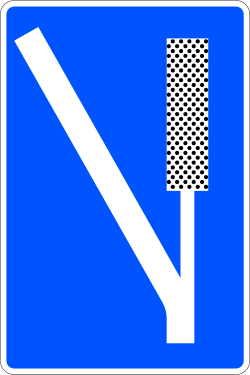
| Escape lane (emergency braking zone, S-16) | An escape area for stopping a vehicle with brake failure on a descent. It is not used for stopping or resting. Its entrance has a red and white checkerboard. |
| Speed bumps and strips at pedestrian crossings | They are not obstacles if they comply with the basic regulation of the Ministry of Development and guarantee safety, especially for cyclists. |
11. Intersections and level crossings
Intersections. Even if you have the right of way, you do not enter an intersection, a pedestrian crossing or a cyclist crossing if you foresee that you will be left stopped and blocking cross traffic. If you are already stopped at an intersection with a traffic light and you are in the way, you leave in any direction without waiting for your way to open, provided you do not obstruct those advancing on a green light. The yellow box junction reminds you of this rule.
Level crossings and movable bridges.
- As you approach, you reduce below the maximum permitted speed, take extreme care and, if necessary, stop.
- If it is closed, or the barriers or half-barriers are moving (going down or up), you do not enter: you wait, one behind the other, in your lane, until the way is clear.
- You cross without delay and only after checking that there is no risk of being left immobilized inside. With no barriers or traffic lights, you first check that no train or tram is coming.
- If, due to force majeure, your vehicle stops at a level crossing or a movable bridge, you quickly get the occupants out and clear the way as soon as possible; if you cannot, you warn the train drivers and the drivers approaching of the danger in advance.
- You do not overtake, make a U-turn or stop at a level crossing.
12. Tunnels and underpasses
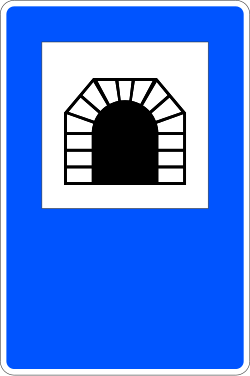
The S-5 sign marks the beginning of a tunnel, an underpass or an equivalent section. Inside:
- You do not stop, park, make a U-turn, reverse or overtake. You may overtake if there is more than one lane in your direction and you do not enter the opposite one. You use the lighting that applies.
- Without intending to overtake, you leave 100 meters or 4 seconds to the vehicle ahead as a minimum; over 3,500 kg, 150 meters or 6 seconds.
- You obey traffic lights, variable message signs and loudspeakers, and you do not enter if the traffic light at the entrance does not let you.
- If your breakdown still lets you move, you continue until you leave the tunnel or, if you cannot, until an area reserved for emergencies. Stopping in a widening of the tunnel shoulder is prohibited.
If you become immobilized inside:
| Situation | What you do |
|---|---|
| Breakdown or emergency | You switch off the engine, turn on the hazard lights and leave the position lights on. You go to the nearest emergency area or, if there is none, as far to the right as possible. You activate the V-16 and call for help from the nearest SOS post. The occupants go to the nearest refuge or exit, without stepping on the roadway if there are areas closed to traffic. |
| Traffic jam or traffic needs | You do not abandon the vehicle. You switch off the engine, turn on the hazard lights temporarily to warn those behind, leave the position lights on and stop as far as possible from the vehicle ahead of you. |
| Fire | You move the vehicle to the right so as not to obstruct emergency crews, switch off the engine and leave the key in the ignition and the doors open. You and the occupants go to the nearest refuge or exit, in the direction opposite to the fire. |
Watch out in the exam: stopped for more than two minutes in a tunnel, you switch off the engine and keep the position lights on. Getting out of the vehicle is for a breakdown with danger and for a fire; in a traffic jam you stay inside.
13. How you must behave on the road
- Do not improperly obstruct traffic or cause danger, harm or unnecessary inconvenience to people, or damage to property. You obstruct when you delay traffic without justified cause.
- Drive with the diligence and care necessary to avoid any damage, to yourself or others. Driving negligently (serious offense) or recklessly (very serious) is prohibited, even if there is no accident.
- Safety distance: the free space that lets you stop without a collision if the vehicle ahead brakes suddenly, according to speed, grip and braking. Not keeping it costs 4 points.
- Works and objects on the road, even if temporary, require prior authorization from the authority responsible for the road. The Central Traffic Headquarters may ask for them to be interrupted if there are special traffic circumstances. Nor may filming, surveys or tests that obstruct traffic be carried out.
- It is prohibited to throw, deposit or abandon on the road objects that obstruct traffic, stopping or parking, make it dangerous or damage the road and its installations (signs, guardrails, lighting, drainage), such as leaving the garbage on the roadway for the truck to pick up.
- Throwing onto the road or its surroundings something that could cause a fire or endanger road safety (a cigarette butt, an empty pack) is a very serious offense and costs 6 points. Cigarette butts go in the ashtray.
- Whoever creates an obstacle or danger removes it as soon as possible and, meanwhile, signals it effectively, day and night. Emergency, assistance and maintenance crews must affect traffic as little as possible, occupying the minimum of roadway.
- Horn. Exceptional and not shrill: to avoid a possible accident, to warn outside built-up areas that you are going to overtake and to warn of your presence if you are a non-priority vehicle on an emergency call. In a built-up area it is not used to warn of an overtaking maneuver or to tell the vehicle ahead that the light is green.
- All the turn signals on. They warn that the vehicle is temporarily a danger or that it does not reach the minimum required speed and there is a risk of a rear-end collision: take extreme care.
- Priority vehicle approaching: you move aside to the right or stop if necessary. If it is not on an emergency call, it drives on the roadway and like anyone else.
- Mobile phone and headphones. Holding the phone in your hand while driving is prohibited (also when stopped at a traffic light), and so are headphones and earphones. The seatbelt is mandatory on urban and interurban roads, that is, on all of them.
Traffic officers and road works staff. Arm raised vertically: you stop if you are approaching the officer (at the nearest stop line or in front of the officer, and before entering an intersection). Arms extended horizontally: those approaching from directions that cross the direction of the arm stop. Arm moving up and down: you reduce speed if you approach from the officer's side and perpendicularly. A series of short whistle blasts: stop; one long blast, resume driving. You obey road works staff who regulate the passage in the absence of officers. Not obeying the orders of officers costs 4 points.
14. Stopping, parking, removal
The places for stopping and parking are in the Maneuvers topic. Here, what is asked most:
- Halting: immobilizing the vehicle because of an emergency, traffic needs or to comply with a rule. Stopping: less than two minutes, without the driver leaving it. Parking: everything else (if you get out to go into a cinema, you are parking).
- Outside built-up areas, always off the roadway and on the right, leaving the passable part of the shoulder free, even if the road is one-way. In a built-up area, next to the right edge; on a one-way street, also on the left.
- Stopping is prohibited (and therefore parking): curves and changes of gradient without visibility, tunnels, level crossings, cyclist and pedestrian crossings, reserved lanes, motorways and dual carriageways outside designated areas and areas exclusively for persons with disabilities.
- Seriously obstructs: parking on medians, separators or traffic islands, on a lowered crossing for persons with disabilities, in the middle of the roadway or preventing an authorized turn.
- Double parking: parking is prohibited; a brief stop without leaving the car is not among the prohibitions, if it does not obstruct. On the sidewalk, you do not park.
- Yellow markings on the curb: broken, parking prohibited; solid, stopping and parking prohibited; zigzag, parking prohibited.
Immobilization and removal (Traffic Law, arts. 104 to 106):
- Officers may immobilize a vehicle, among other cases, if it exceeds the permitted levels of gases, smoke and noise. The town council may immobilize it (with a wheel clamp) if it parks in a restricted zone without a ticket or beyond the time.
- The authority may remove it to the vehicle pound if it constitutes a danger, causes serious disruption or is left after an accident that prevents it from continuing, or if it parks without a badge in a zone for persons with disabilities, in reserved lanes, in loading and unloading zones or beyond three times the time paid. The costs are paid by the holder, the lessee or the habitual driver before recovering it.
- An abandoned vehicle goes to an Authorized Treatment Center to be scrapped and decontaminated: after more than two months since its removal without claims from the holder, or more than one month in the same place with damage that prevents it from being moved or without plates. Beforehand, the Administration summons the holder.
Watch out in the exam: the questions about the period for retrieving the vehicle from the pound before it is treated as urban solid waste accept 15 days as the right answer.
What has changed in the rules
- 1 October 2026 (Royal Decree 518/2026). Emergency lane and snow rule (new article 32; the old one, on trucks and combinations with three lanes, becomes 31.2). Right shoulder for motorcycles in congestion (article 36.3). Mopeds no longer ride two abreast on the shoulder. PMVs are prohibited on motorways, dual carriageways, travesías, interurban roads and urban tunnels (except cycle paths and similar) and in HOV lanes. New definitions: single platform, residential priority zone, safe school route and vulnerable users.
- 6 June 2026 (Royal Decree 450/2026). Traffic restrictions may also be imposed for environmental reasons; driving without the corresponding authorization on a road restricted in this way is a very serious offense (RGC art. 37.6). Not complying with the restrictions of a low-emission zone is serious (Safety and Economic Driving topic).
- 1 July 2025 (Royal Decree 465/2025). New Catalog of road signs and markings: it describes the markings in section 5 and the lane control signals.
Numbers you need to know
| What | Figure | Detail |
|---|---|---|
| Minimum speed on a motorway and dual carriageway | 60 km/h | Below it: hazard lights, shoulder and first exit |
| Contraflow or additional lane | 80 km/h max. and 60 km/h min. | With at least the low beam, day and night |
| Distance in a tunnel without overtaking | 100 m or 4 s | Over 3,500 kg: 150 m or 6 s |
| Combination with lane restriction | More than 7 meters | The right one and its adjacent one, with 3 or more lanes |
| Special vehicles using the shoulder | Up to 3,500 kg | Tractor, special vehicle |
| Bicycle on the shoulder of a dual carriageway | Over 14 years old | Unless a sign prohibits it |
| Motorcycle on the shoulder in congestion | 30 km/h, in single file | Only signed sections and with stopped traffic |
| Dual carriageway or motorway inside a built-up area | 80 km/h | Unless a signed extension applies |
| Points | 6 / 4 / 3 | Opposite direction or throwing objects / distance, reversing on a motorway or officers' orders / improper U-turn |
Summary
- The roadway is divided into lanes; the platform is the roadway plus the shoulders. A travesía passes through a built-up area and is not an urban road.
- You drive on the right and close to the edge, and you leave the half of the opposite direction free on curves and changes of gradient without visibility.
- Two-way with two lanes: the right one. With three: the right one; the center one, only to overtake and turn left; the left one, never.
- Outside built-up areas, the right lane; trucks over 3,500 kg and combinations over 7 meters, with three or more lanes, only the right one and the one next to it.
- In a built-up area, with marked lanes, the one that best suits your destination; on motorways and dual carriageways, the right one.
- Lane opened in the opposite direction: for traffic flow, only motorcycles and passenger cars without a trailer; for works, all authorized vehicles. Low beam, 80 km/h max. and 60 min., without entering the normal direction, not even to overtake.
- In a traffic jam on a motorway or dual carriageway you form the emergency lane: in the center with two lanes; between the left one and the adjacent one with three or more.
- On the shoulder go animal-drawn vehicles, special vehicles of up to 3,500 kg, cycles, mopeds and vehicles for reduced mobility; the passenger car, only in an emergency.
- Animal-drawn vehicles, bicycles, mopeds, PMVs and animals do not enter motorways or dual carriageways (except bicycles over 14 on the shoulder of a dual carriageway); you do not stop, reverse or make a U-turn.
- With the barriers of a level crossing moving you do not enter. In a tunnel you do not stop or make a U-turn, and stopped by a traffic jam you do not get out.
Check your understanding
1. You are on a two-way roadway with three lanes separated by broken lines. Which one do you use and what is the center one for?
Answer
The one on your right. The center one is only for the overtaking you need and for turning left. You do not use the left one in any case, not even to overtake.
2. There is a traffic jam on a dual carriageway with three lanes in your direction and an ambulance is approaching. What do you do?
Answer
You pull aside to form the emergency lane between the left lane and the one next to it. If you are in the left one, you keep as far left as possible; if you are in any other, as far right as possible.
3. Which vehicles may not use a dual carriageway and what exception is there?
Answer
Animal-drawn vehicles, bicycles, mopeds and vehicles for persons with reduced mobility (and PMVs and animals). The exception: cyclists over 14 years old may use the shoulder of the dual carriageway, unless a sign prohibits it. On a motorway, none.
4. You are driving a 4,000 kg truck on a road outside built-up areas with three lanes in your direction. May you use the left one?
Answer
No. Because it exceeds 3,500 kg, you use the right lane and, if needed and without obstructing, the adjacent one. The same applies to a passenger car with a trailer if the combination is more than 7 meters long.
5. You are stopped in a tunnel because of a traffic jam. Do you get out of the car?
Answer
No. You switch off the engine, turn on the hazard lights temporarily, leave the position lights on and stop as far as possible from the vehicle ahead of you. Abandoning the vehicle is for a breakdown with danger or a fire.
6. You reach a level crossing and the barriers start to come down. May you cross?
Answer
No. With the barriers down or moving (also going up) you do not enter: you wait, one behind the other, until the way is clear.
Frequently asked questions about Use of Public Roads
General Driver Obligation
Access to Dual Carriageways from Adjacent Properties
Acera-Bici Definition and Types of Cycle Paths
Who regulates speed bumps and transverse bands?
Prohibition on Throwing Objects on the Road
Is Throwing Objects on the Road Allowed?
Undue Hindrance to Traffic
Obligation to Control the Vehicle at All Times
Is a Repair Shop Allowed in a Service Area?
Definition of Lay-by
Topic test
1025 questions available for this topic.