
Visibility and road hazards
In this topic:
- What the windshield, windows and mirrors of your car must comply with, how they are adjusted and where the blind spots are.
- How you adapt your driving to rain, fog, snow, wind, low sun and night.
- How you deal with curves, changes of gradient, road works, level crossings, tunnels and animals, and which signs announce them.
- What you do if your vehicle is immobilized and how you pass another one that is.
Most accidents begin with poor information: the driver does not see something in time, or others do not see the driver. Driving safely means seeing well, being seen and anticipating what the road hides from you. In the exam, this topic asks mostly about mirrors and windows, about driving in bad weather and about curve technique.
1. You must see well
The General Traffic Regulations require you to maintain the necessary field of vision and permanent attention to driving. They also require you to adapt your speed to the circumstances, so that you can always stop the vehicle within the limits of your field of vision and before any obstacle that may appear.
That sentence is the basis of the whole topic. If you cannot see further than 40 meters, you must drive at a speed that lets you stop in less than 40 meters. It does not matter what the limit of the road is: the limit is the maximum, not a recommendation.
Visibility depends on three things:
- Your vehicle: windows, windshield wipers, mirrors, lights.
- The surroundings: rain, fog, snow, sun, night.
- The road: curves, changes of gradient, road works, tunnels.
And there is something worth remembering: obstacles are not always seen in time. Sometimes they are and sometimes they are not. That is why defensive driving consists of constantly observing the road, the traffic and dangerous areas, and adapting your speed and your distance from others. It is the most effective measure against the risks of road conditions.
2. Windows and transparent elements
Safety glass. The windows of the vehicle must be safety glass: if they break, they do not fly apart into sharp pieces. The windshield is laminated glass, which cracks but does not come off.
Clear visibility. The vehicle must be built and maintained so that you see the road “clearly” to the front, to the right and to the left. The windows must not distort objects or confuse the colors of signs.
Films, curtains and tinted windows. This is regulated by the General Traffic Regulations:
| What | Rule |
|---|---|
| Sun curtains or adhesive sun films | Only on the rear side windows (including the rear window), and only if the vehicle has two exterior rearview mirrors, one on each side. |
| Tinted or colored windows | They are prohibited if they are not approved. |
| Stickers on the windshield | Only if they do not block your view of the road. Labels attached to it (such as the environmental label, in the lower right corner) are placed so that they do not obstruct your view. |
| Passenger sun visor | It is not mandatory, but it is advisable. |
Watch out in the exam: the condition for curtains is always the same: two exterior mirrors. An answer that says “only one exterior mirror” or “yes, always” is false.
Cleaning and defogging.
- Windshield wipers and washer: they are mandatory if from your seat you can only see the road ahead through the windshield. Check that the washer fluid reservoir has fluid and that the wiper blades are not damaged. Do not operate the windshield wipers on dry glass, because you will scratch it: use the washer first.
- Rear wiper: it is not mandatory in a passenger car, but it is highly recommended for seeing through the interior mirror in the rain.
- Heated rear window and defogger: the heated rear window melts the ice and clears the condensation on the rear glass with electric filaments. The defogger removes the condensation that forms on the inside of the windshield.
- Frozen windows: before setting off, clean all the windows, not just a gap to look through. A peephole in the windshield leaves you with no side vision.
- Loose gravel and road works: the tires of other vehicles throw stones. To avoid breaking the windshield, increase the distance from the vehicle ahead and reduce your speed.
Smoke. It is prohibited to drive a vehicle that emits smoke that hinders the visibility of other drivers. If the vehicle ahead emits it, leave it more distance and keep following without tailgating it.
What does not help you see. Clean windows, windshield wipers, sun visor, heated rear window and mirrors improve your visibility. The instrument panel does not.
3. Rearview mirrors
Mirrors show you what happens behind and to the sides. A passenger car must have at least two mirrors.
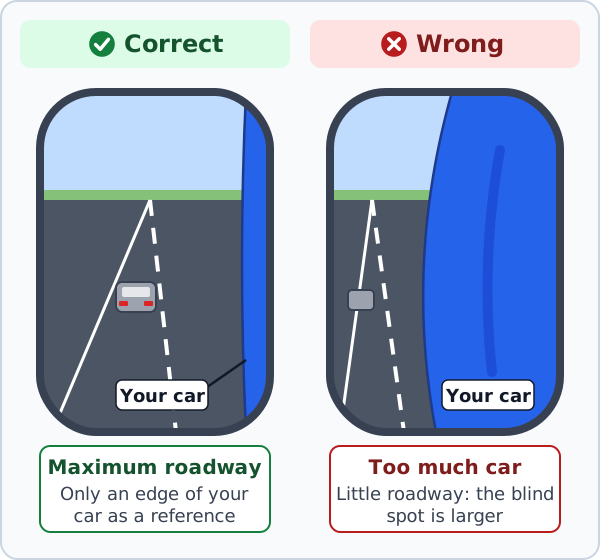
Figure 1. Adjust the exterior mirror to see the maximum amount of roadway and only an edge of your car as a reference.
3.1 Which ones and how many
| Mirror | In a passenger car |
|---|---|
| Interior (class I) | Mandatory, unless because of the load or the shape of the car you cannot see through it what the Regulations require. |
| Left exterior (class III) | Always mandatory. Without it you must not drive. |
| Right exterior (class III) | Optional, unless the interior one does not comply. |
The interior mirror must let you see the flat, level road from the horizon up to 60 meters behind, with a width of 20 meters. If it does not achieve this, the interior mirror becomes optional and the right exterior mirror becomes mandatory.
That happens, for example, when the rear window is small, it is covered by curtains, or the load, a trailer or too many occupants prevent you from seeing. Then you have two exterior mirrors, one on each side.
Keep this summary clear: the left exterior mirror is mandatory always; the right one only when the interior one is not valid. The exam also asks how many mirrors a passenger car has at minimum (two: the interior and the left one) and what class each one is.
Mirror classes:
- Class I: interior.
- Class II and III: main exterior mirrors. Class III is the one for passenger cars (and light vans); class II is the one for buses, trucks and tractors.
- Class IV: wide-angle.
- Class V: close-proximity.
Trucks of more than 7.5 tonnes (N2 and N3) must have, in addition to the two exterior mirrors, a wide-angle mirror and a close-proximity mirror, because their blind spot is much larger. An agricultural tractor is not required to have an interior mirror (it is optional), but it must have the left exterior one.
3.2 How they are adjusted
- When: before setting off, with the vehicle stopped and on level ground, never while driving. Adjusting them while moving distracts you and pulls you off your path. Check the adjustment every time you get in the car.
- Your posture first: adjust the seat and the steering wheel, and then the mirrors.
- Interior mirror: it should frame the entire rear window.
- Exterior mirrors: they must show you the maximum possible amount of roadway and only a minimal part of the side of your own car, as a reference. If you see a lot of your bodywork, you waste mirror and increase the blind spot (figure 1). The exam gives, as a minimum, a strip of roadway 2.50 meters wide in the left exterior mirror.
3.3 How they are used
- Look in the mirrors regularly, even if you are not going to maneuver: you must always know what is behind you. It is advisable every 5 to 10 seconds in the city or in heavy traffic, and every 10 to 15 seconds on a motorway, dual carriageway or road with little traffic.
- Glances are brief: you look, assess and return to the road.
- Before any maneuver, mirrors and, if needed, your head (MSM rule, see the topic Maneuvers).
- They are not for checking that the indicators work: that is what the warning lamps on the dashboard are for.
3.4 The blind spot
The blind spot is the area around the vehicle that the driver cannot see either directly or through the mirrors, because of the structure of the car (the pillars) and the reach of the mirrors. Even if you adjust them well, one always remains, and it is compensated for by turning your head and looking over your shoulder before changing lanes. Specially curved mirrors also reduce it.
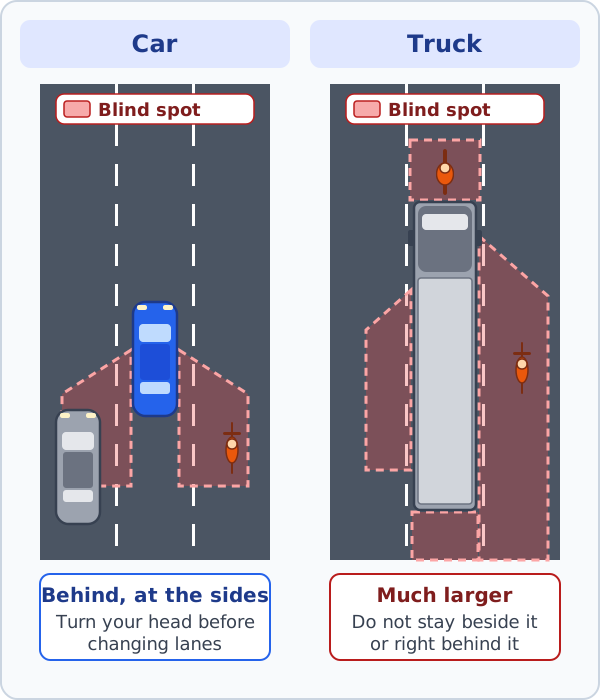
Figure 2. A truck has much larger blind spots than a passenger car. The areas are approximate, not to scale.
The truck has blind spots in front of the cab, along the entire right side, to a lesser extent on the left and behind the trailer. It is advisable not to drive beside it or right behind it. If you cannot see its mirrors, its driver probably cannot see you.
4. Bad weather, sun and night
When the weather or the environment worsens visibility (dense fog, heavy rain, snowfall, clouds of dust or smoke), the Regulations require you to drive at a moderate speed and, if necessary, to stop.
You have two rules that repeat throughout this section:
- Seeing well and being seen: clean windows, windshield wipers, lights on (the part on lights, fog lights included, is in the topic Lighting and Optical Signaling).
- More distance and less speed: more time and space are needed to react. In heavy rain, thick fog or snowfall, the gap to the vehicle ahead must be greater.
4.1 Rain
Rain makes the roadway slippery and reduces visibility: two reasons to go slower. The water thrown up by other vehicles and the condensation on the glass worsen your vision, and the drops distort the lights.
- In normal rain: reduce your speed, increase the distance, switch on the lights and adjust the windshield wipers.
- With puddles: slow down. This way you avoid aquaplaning and do not splash pedestrians and cyclists (the Regulations require this when driving over a slippery surface or where you could throw up water).
- In torrential rain that drastically reduces visibility, the most appropriate thing is to stop in a permitted place that is safe, off the roadway, and wait for it to ease. Parking in a permitted area is not the same as stopping in the middle of the road, which is dangerous.
Aquaplaning and grip are in the topic Adherence, Tires and Brakes.
4.2 Fog
Fog is dangerous because you cannot see the road or obstacles: that is why the safety distance must be increased. In dense fog:
- Reduce your speed and take extreme care: always adapt it to what you can see of the road.
- Low beam (short-range lights): in dense fog, the high beam bounces off the droplets and dazzles you yourself. Fog lights, and when each one is used, are in the topic Lighting and Optical Signaling.
- Do not overtake if you cannot see enough to do it and to abort it.
- If necessary, stop in a safe place.
On some stretches with intense fog there is luminous temporary delineation (amber and red lights) so that you keep the minimum safety distance. The P-33 sign warns of a section with a notable loss of visibility due to fog, rain, snow or smoke.
4.3 Snow and ice
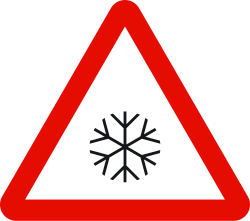
When it snows, the most dangerous moment is the start of the snowfall: the first flakes mix with the dirt and oil on the roadway and form a very slippery layer, without the road yet looking snowy. With ice, grip is minimal. In winter, night is the most dangerous time on a mountain pass, because the temperature drops (more ice) and you see less.
How you drive:
- Drive slowly, but in the highest gear possible, smoothly and without sudden acceleration or braking.
- You may follow the tracks of the vehicles ahead of you, which usually give more grip.
- Chains, winter tires, starting and braking on snow are in the topic Adherence, Tires and Brakes.
- Sunglasses if it is sunny: snow reflects a lot of light and dazzles. They are not mandatory, but it is advisable to have them.
- Before a winter trip, it is advisable to have a full fuel tank: if you get trapped in a tailback or in the snow, you need the engine and the heating.
Snow traffic levels. On mountain passes and roads with snowfall, the DGT uses the colors of a traffic light on the passability panels:
| Level | What it means |
|---|---|
| Green | It is starting to snow. |
| Yellow | The roadway is starting to be covered with snow. |
| Red | You must carry chains or winter tires. In the exam, a passenger car must not exceed 30 km/h. |
| Black | It is prohibited to drive. |
Motorways and dual carriageways with snow (since 1 October 2026). If snow hinders traffic, overtaking is prohibited and it is mandatory to drive in the right-hand lane (with three or more lanes, also in the adjacent one), leaving the left-hand lanes free for emergency vehicles and snowplows.
4.4 Wind
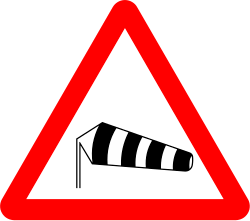
Crosswind pushes the car off its path, especially on bridges and viaducts. The P-29 sign warns of an area where strong wind frequently blows in a transverse direction.
- Adapt your speed.
- Grip the steering wheel firmly and correct smoothly. The exam accepts the answer “drive in low gears when necessary”.
- Take care when overtaking: the vehicle you overtake, especially if it is large, shields you from the wind and, when you pass it, the gust arrives all at once. Leave more lateral distance.
- Remove the roof rack if you do not need it: with a load on the roof the car presents more surface to the wind, is less stable and its center of gravity rises. In strong gusts it is not advisable to drive with it.
4.5 Low sun
At sunrise and sunset, with the sun near the horizon, the rays hit you almost head-on and can dazzle you or tire your eyes. That is why the time you set out on a trip matters.
- It is advisable to use the sun visor and sunglasses (they are fine for daytime sun).
- Clean the windshield inside and out: a dirty or scratched glass scatters light and dazzles more.
- If you are dazzled, reduce your speed, even to the point of stopping, until you recover your vision.
4.6 Driving at night
At night you see less, others see you less and your eye takes time to recover from being dazzled.
- Good lighting is essential: clean headlights, lights that work and are properly adjusted (see the topic Lighting and Optical Signaling).
- Do not drive with the interior light on: it creates a contrast that reduces your vision of the road and is reflected in the windows.
- If you are dazzled by the lights of another vehicle (head-on, or from behind through the mirror), reduce your speed as much as necessary, even to a complete stop, so as not to hit a vehicle or a pedestrian ahead. Sunglasses are not recommended at night: they are for daytime sun.
- Pedestrians and cyclists without lights or reflective items are seen late. Slow down in poorly lit areas.
5. Curves and changes of gradient
5.1 The physics of the curve
When you take a curve, the car tends to continue straight and leave along the tangent. What keeps it on its path is the force that the tires exert against the ground. The force that the car needs:
- grows with the square of the speed (at double the speed, four times more);
- is greater the more mass the vehicle has;
- increases the smaller the radius, that is, the tighter the curve.
The danger of a curve depends on the radius and the layout (banking, visibility, condition of the road surface). The banking is the lateral inclination of the roadway toward the inside; it helps counteract the force that pulls you out of the curve.
5.2 The technique
- Brake before entering the curve, on the straight part.
- Enter with the vehicle under control, at a speed at which you can control it.
- Accelerate gently when exiting, when you begin to straighten up. Accelerating gently helps the wheels grip.
- Avoid braking hard in the middle of the curve.
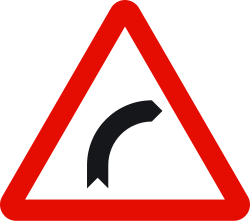
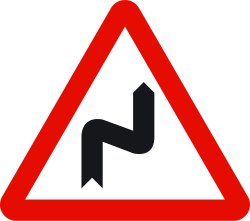
The P-13a/P-13b sign warns of a dangerous curve and the P-14a/P-14b, of a succession of curves close to each other. The directional panels mark the layout of the curve and indicate its direction, in relation to the speed reduction that is advisable to take it safely.
5.3 Curves with reduced visibility
A curve with trees, an embankment or a wall on the inside hides what is coming. In it, the main danger is not seeing whether a vehicle is coming the other way. That is why:
- You have the obligation to slow down: you must be able to stop within the space you can see. There is no fixed speed (“50 km/h”) valid for all curves; it depends on how tight it is and on what you can see.
- Drive as close as possible to the right edge of the roadway and leave the left half completely free, which is the half for oncoming traffic (figure 3). The Regulations require this on curves and changes of gradient with reduced visibility.
- On those curves and in their vicinity it is prohibited to overtake, stop and park. You also must not turn around, because U-turns are prohibited where you cannot see well and where overtaking is prohibited.
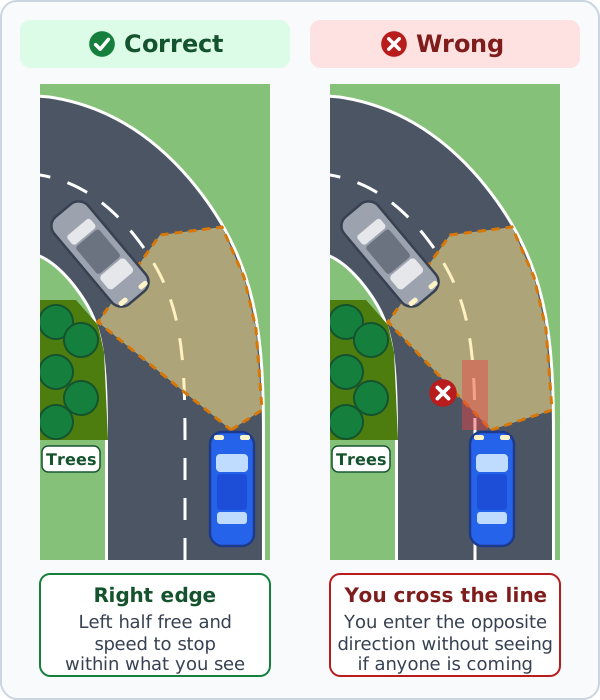
Figure 3. On a curve with reduced visibility, keep to the right edge, leave the left half free and adapt your speed to what you can see.
What reduces your vision in a curve: trees or other natural obstacles on the inside, embankments, buildings, and also a large vehicle ahead.
5.4 Changes of gradient
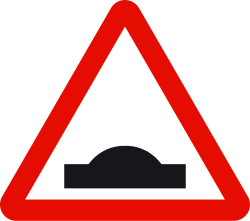
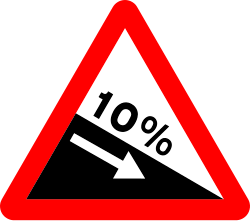
A change of gradient is the place where two sections of road with a different slope meet (an uphill and a downhill, or a gentle uphill and a steep one). It is not the same as the gradient, which is the slope of a section, nor as a speed hump, which is an abrupt rise in the road surface.
If the change of gradient prevents you from seeing the full width of the roadway or those coming the other way, it is considered reduced visibility: the same rules apply to you as on a curve, that is, right edge, moderate speed and overtaking, stopping and parking prohibited in its vicinity.
6. Road works
When you approach a section with road works, reduce your speed, because there is machinery, there are workers and, often, there is loose gravel.
- Follow the instructions of the personnel regulating the passage, and drive where indicated.
- If when you reach the road works there is already a vehicle waiting, position yourself behind it, as close as possible to the right edge, and do not try to pass: follow the one in front of you.
- The vehicles of the police, firefighters, civil protection and medical assistance, on an emergency call and with their signaling, may pass through the section under repair if possible without damaging the works.
- Increase the distance from the vehicle ahead and reduce your speed so that the stones it throws up do not break your windshield.
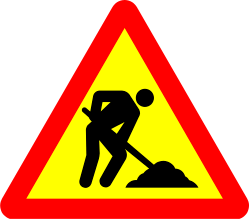
Road works signs (2025 Catalog). Since 1 July 2025:
- In a section with road works, the warning signs (P), R-1 (yield), the priority-to-oncoming-traffic sign R-5, the no-entry signs (R-100 to R-120, except R-101), the passage restriction signs (R-200 to R-205), R-300 to R-306 and the end-of-prohibition signs R-500 to R-504 have a yellow background.
- The P-18 “Road works” sign is only used with a yellow background.
- Lane signs are used with a yellow background and black symbols.
- New road markings are yellow. If the previous ones are still valid, they may be kept white.
- Signs that do not apply while the works last are covered with black adhesive.
- When temporary signage is needed for other causes (an accident, snow...), the same applies, but in orange.
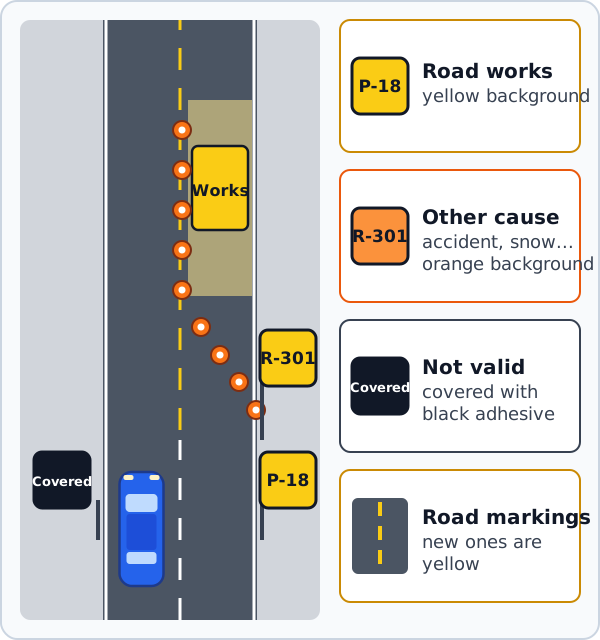
Figure 4. Road works in yellow; another cause (accident, snow...) in orange; what does not apply, covered in black.
These signs have the same meaning as the normal ones and are equally binding. In addition, temporary signage and delineation prevail over the usual vertical signs and road markings: if they contradict each other, the temporary signage rules (the order of precedence is traffic officers, temporary signage and delineation, traffic lights, vertical signs and road markings).
7. Level crossings
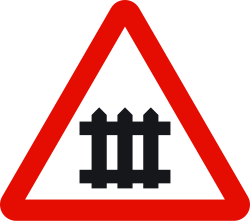
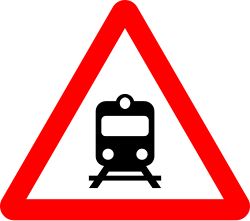
A train cannot brake or swerve, so the rule is very strict:
- When approaching, take extreme care and reduce your speed below the maximum permitted. The P-7, P-8 and P-11 signs warn of the level crossing, and the P-9 and P-10 approach beacons warn of the approach, at 200, 150 and 100 meters.
- With barriers or half-barriers closed or moving, stop one behind the other, in your lane, until you have a clear way. And do not enter if the traffic light prevents you.
- Without barriers or traffic lights, do not enter without first checking that no train is approaching.
- To cross, do so without delay and after making sure that you cannot become immobilized within the crossing (for example, because there is a queue on the other side). Crossing “without stopping” is correct; doing so “at full speed” or “very slowly” is not.
- Overtaking is prohibited at level crossings and in their vicinity, without exceptions (since 1 October 2026 not even a two-wheeled vehicle), and it is prohibited to stop, park or make a U-turn.
- If your vehicle is stopped on the crossing due to force majeure, get the occupants out as soon as possible and clear the crossing in the shortest time possible. If you do not manage to do so, immediately warn the train drivers and the drivers who are approaching of the danger.
The right of way at level crossings, movable bridges and narrowings is in the topic Right of Way.
8. Tunnels and underpasses
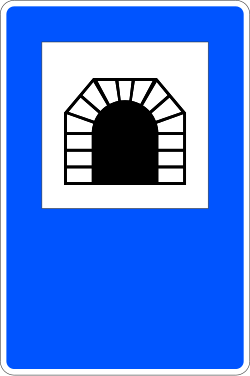
The S-5 sign indicates the start of a tunnel, an underpass or an equivalent section. A tunnel is an enclosed space, with little room to pull aside and where smoke accumulates: that is why the rules are stricter. Tunnels, of any length, and underpasses of more than 200 meters are signposted.
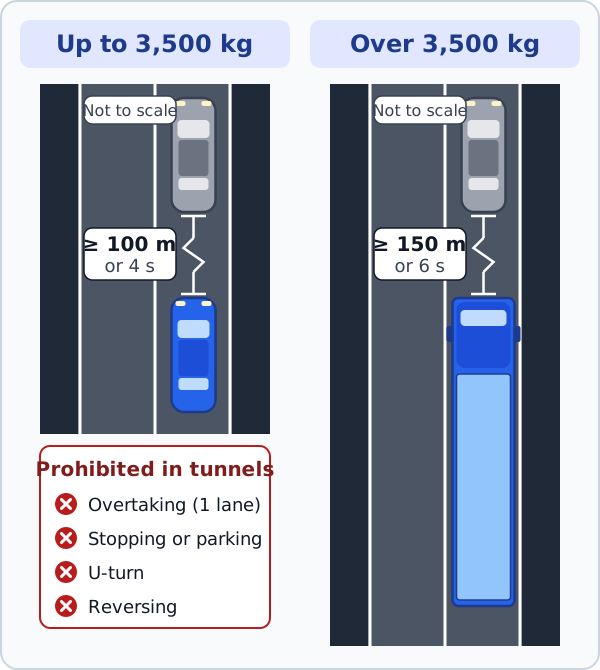
Figure 5. In a tunnel, if you are not going to overtake, keep 100 meters (4 seconds), or 150 meters (6 seconds) if your vehicle weighs more than 3,500 kg. Not to scale.
What you do in a tunnel:
- Lighting: you must have the lights on at any time, also during the day (position lights and low beam). The details are in the topic Lighting and Optical Signaling.
- Safety distance: when you do not intend to overtake, at least 100 meters or 4 seconds from the vehicle ahead. If your vehicle weighs more than 3,500 kg, at least 150 meters or 6 seconds. Those figures are equivalent to going at 90 km/h: at 25 meters per second, 4 seconds are 100 meters and 6 seconds are 150.
- Prohibitions: strictly apply the rules of the tunnel, above all the prohibition on stopping, parking, making a U-turn and driving in reverse.
- Overtaking: in a tunnel with a single lane per direction it is prohibited. If there is more than one lane in your direction, you may overtake without entering the opposite direction.
- Indications: always obey the traffic lights, the variable message signs and the instructions over the loudspeakers. Do not enter if the traffic light at the entrance does not let you through.
- Engine: when you are stopped in the tunnel, switch off the engine.
The M-7.12 road marking (chevrons) serves as a reference for keeping the gap in tunnels and sections with a higher risk of rear-end collisions.
If you are stopped in the tunnel:
- Because of a tailback or the traffic itself: do not leave the vehicle. Temporarily switch on the hazard lights to warn those behind you, keep the position lights on, switch off the engine and stop as far as possible from the vehicle ahead of you.
- Because of a breakdown or a fire: it is an emergency and you do get out. The steps (switching off the engine, hazard lights, V-16, SOS post, emergency exit, key left in the ignition in a fire) are in the topic Accidents and First Aid. If the breakdown lets you keep driving, do not stop: continue to the exit of the tunnel or, if that is not possible, to an emergency area.
9. Animals
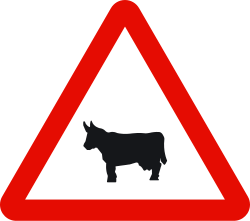
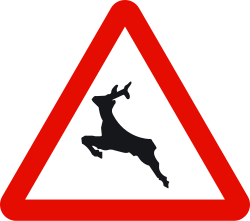
If there are animals on the road, or it can be foreseen that they will appear, slow down and, if necessary, stop. The P-23 warns of a place where domestic animals or livestock frequently cross, and the P-24 of wild animals.
In general you have the right of way over animals. The exceptions are:
- On duly signposted livestock routes (cañadas): they are announced with a supplementary panel that says “cañada”, under the P-23.
- When you are going to turn to enter another road and there are animals crossing it, even if there is no crossing for them.
- When you cross a shoulder along which animals that do not have a livestock route are traveling.
10. Slippery road surface, gravel and other hazards
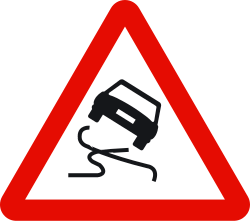
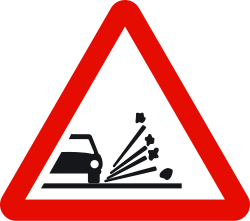
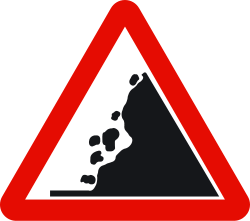
When the road surface is slippery or water, gravel or other materials can be thrown up, the Regulations require you to drive at a moderate speed.
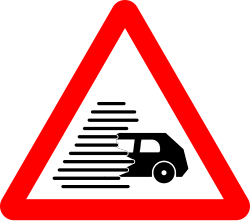
- Slippery road surface (P-19, P-34): due to water, ice or snow. Reduce your speed and avoid braking or turning abruptly.
- Loose gravel (P-28): the main risk is skidding for lack of grip, especially if it is also wet. Reduce your speed so as not to throw stones at others and increase the distance from the vehicle ahead to protect your windshield.
- Falling rocks (P-26): they can leave obstacles on the roadway.
- Congestion (P-31) and road obstruction (P-32): when approaching a queue or stopped vehicles, reduce your speed in good time.
11. An immobilized vehicle
If the vehicle is yours. The purpose of signaling a danger or obstacle is to prevent traffic from being affected and to prevent further accidents. The steps are in the topic Accidents and First Aid. Remember the essentials:
- Switch on the hazard lights and place the connected V-16 warning light on top of the vehicle. Since 1 January 2026 it is the only valid device: warning triangles are no longer valid.
- If you go out onto the roadway or the shoulder of an interurban road, put on the high-visibility reflective vest.
- The occupants get out on the side away from traffic if there is a safe place off the road; if not, they stay inside with their seatbelts on.
If the vehicle belongs to someone else. Outside built-up areas, when approaching a vehicle immobilized on the roadway, reduce your speed and be extremely attentive: there may be people you cannot see. If you have to pass it (because of a breakdown, accident, emergency service, assistance or road maintenance), you must leave at least 1.5 meters of separation, even if you have to move into the opposite lane, and drive at least 20 km/h below the limit of the road (since 1 October 2026).
What has changed in the rules
- 1-1-2026, connected V-16: it is the only means of hazard warning. Before, triangles could be used. If you have read “triangles or V-16”, it is out of date.
- 1-7-2025, new Catalog of signs (Royal Decree 465/2025): road works signs have a yellow background and temporary signage for other causes, orange; the new markings at road works are yellow.
- 1-10-2026, reform for vulnerable users (Royal Decree 518/2026): when passing an immobilized vehicle, 1.5 meters of separation and 20 km/h below the limit; with snow on motorways and dual carriageways, overtaking is prohibited and driving in the right-hand lane is mandatory; at level crossings and pedestrian crossings overtaking is prohibited without exceptions.
Numbers you need to know
| What | Number | Nuance |
|---|---|---|
| Interior mirror | 60 m behind and 20 m wide | If it does not comply, the right exterior one is mandatory |
| Left exterior mirror | 2.50 m wide | Figure used by the exam |
| Minimum mirrors in a passenger car | 2 | Interior and left exterior |
| Looking in the mirrors | Every 5-10 s in the city; 10-15 s on a road with little traffic | Advice, not an obligation |
| Distance in a tunnel (up to 3,500 kg) | 100 m or 4 s | If you are not going to overtake |
| Distance in a tunnel (more than 3,500 kg) | 150 m or 6 s | If you are not going to overtake |
| Signposted underpasses | Those of more than 200 m | Tunnels, of any length |
| Passing an immobilized vehicle | 1.5 m and 20 km/h less | Since 1-10-2026 |
| Red snow level | 30 km/h (passenger car, in the exam) | With chains or winter tires |
Summary
- The speed limit is a maximum: you must be able to stop within what you see.
- Sun curtains and films are only allowed on the rear windows and with two exterior mirrors. Tinted windows that are not approved are prohibited.
- A passenger car has at minimum the interior mirror and the left exterior one; the right exterior one is mandatory if the interior one does not comply.
- Mirrors are adjusted before setting off, with the car stopped and on level ground, and the exterior ones show the maximum amount of roadway and an edge of your car.
- The blind spot is covered by turning your head; that of a truck is much larger.
- In rain, fog or snow: less speed and more distance. When dazzled, reduce your speed until you stop if necessary.
- On a curve with reduced visibility: brake beforehand, keep to the right edge, leave the left half free and do not overtake, stop or park.
- At road works, signage is yellow; temporary signage for other causes is orange.
- At a level crossing, you cross without delay and only if you cannot become immobilized; overtaking and stopping are prohibited.
- In a tunnel, keep 100 m (or 150 m if you weigh more than 3,500 kg) and do not overtake with a single lane.
- With a tailback in the tunnel you do not leave the car; with a breakdown or a fire, you do.
- Since 2026 an immobilized vehicle is signaled with the connected V-16; triangles are no longer valid.
Check your understanding
1. Under what conditions are you allowed to have sun curtains on the rear windows?
Answer
Only if the vehicle has two exterior rearview mirrors, one on each side.
2. Your rear window is covered by the load. Which mirrors must you have?
Answer
Two exterior ones, one on each side: the right one becomes mandatory because the interior one does not let you see the 60 meters required by the Regulations.
3. You are going around a curve with reduced visibility. Where do you position yourself and what are you prohibited from doing?
Answer
As close as possible to the right edge, leaving the left half free. Overtaking, stopping and parking are prohibited, and so is making a U-turn.
4. You are dazzled by lights at night. What do you do?
Answer
You reduce your speed as much as necessary, even to the point of stopping, so as not to hit a vehicle or a pedestrian. Sunglasses are no use at night.
5. You are driving a 1,800 kg passenger car through a tunnel with one lane per direction. What distance do you leave and what are you allowed to do?
Answer
At least 100 meters or 4 seconds from the vehicle ahead (150 m or 6 s if you weighed more than 3,500 kg). Overtaking is prohibited; you also must not stop, make a U-turn or reverse.
6. Your car has broken down on the dual carriageway. What do you signal it with?
Answer
With the hazard lights and the connected V-16 warning light, placed on top of the vehicle. Warning triangles are no longer a valid means.