
Basic concepts of the motorcycle
In this topic:
- Who is a driver and who is a pedestrian, and when pushing your motorcycle still makes you a driver.
- What distinguishes a moped, a motorcycle, a motorcycle with a sidecar and a three-wheeled vehicle, and which motorcycle each license allows.
- What the parts of the road are called and on which side you go around a traffic island or a roundabout.
- What keeps the motorcycle upright at 10 and at 30 km/h, how to sit, use the controls and mirrors, and how to ride in a group.
- How to signal with your arm, how to refuel and what to do when you see a row of amber lights.
A motorcycle is not ridden like a car. It runs on two wheels, has no bodywork and its balance depends on speed and on you. This topic gathers what the exam takes for granted: the definitions of the Traffic Law, the motorcycle licenses, the roads and the safety concepts specific to the motorcycle. Almost everything is asked with a vocabulary trap, so learn each term with its nuance.
1. Driver, pedestrian and other users
- Driver: a person who handles the steering mechanism or is in charge of a vehicle. In a learner vehicle, the driver is the person in charge of the additional controls (the instructor), not the student.
- Pedestrian: a person who travels on foot without being a driver. The following also count as pedestrians: a person who pushes a baby stroller or a wheelchair, a person who walks beside a two-wheeled cycle or moped, and a person with a disability who travels at walking pace in a wheelchair, with or without a motor.
- Vehicle holder: the person in whose name the vehicle is registered in the official register.
- Vulnerable user: a person who, because of their means of transport or their age, runs a higher risk of being injured or of being injured more seriously. This includes pedestrians, cyclists, PMV drivers and, from 1 October 2026, drivers and passengers of motorcycles and mopeds.
Watch out in the exam: if a breakdown forces you to push your motorcycle, you are still a driver and you follow the rules for drivers. The exception only applies to the two-wheeled cycle and moped: a person who pushes them on foot is a pedestrian.
2. What is a motorcycle and what is not
The Traffic Law (annex I) and the General Vehicle Regulations (annex II) classify small motor vehicles by three data points: number of wheels, engine capacity (or power, if electric) and maximum design speed. What counts is what the manufacturer designed, not the speed you reach in practice. Figure 1 summarizes it.
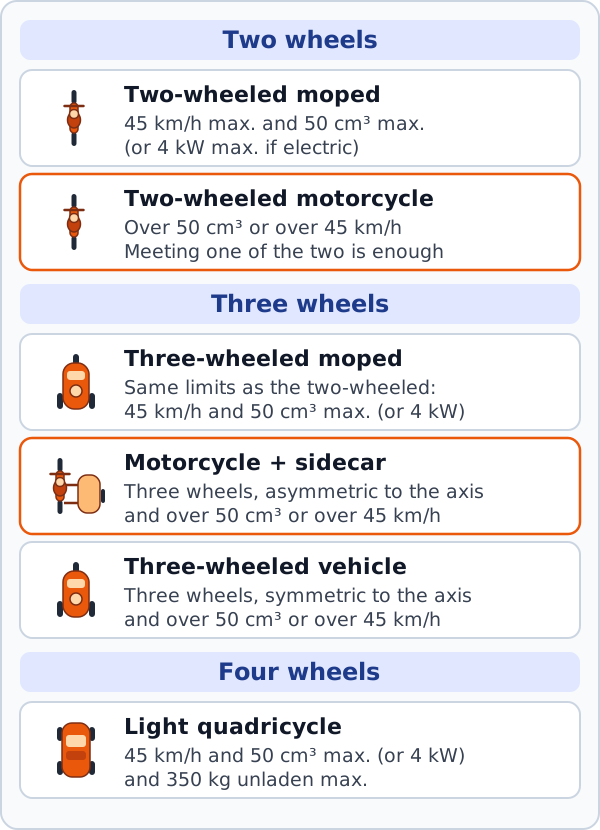
Figure 1. The cards with an orange border are motorcycles. Between a moped and a motorcycle, the “or” of the motorcycle rules: exceeding just one of the two limits means it is no longer a moped.
| Vehicle | Definition |
|---|---|
| Two-wheeled moped | Maximum design speed of 45 km/h at most and an engine of 50 cm³ at most (4 kW at most, if electric). |
| Three-wheeled moped | The same speed and engine limits. |
| Light quadricycle | A four-wheeled moped: 45 km/h and 50 cm³ (or 4 kW) at most and an unladen mass of 350 kg or less (without batteries, if electric). |
| Two-wheeled motorcycle | Two-wheeled automobile, without a sidecar, with an engine of more than 50 cm³ and/or a maximum design speed of more than 45 km/h. |
| Motorcycle with a sidecar | Three-wheeled automobile with wheels that are asymmetric with respect to its longitudinal median axis, with those same values: the sidecar wheel sits outside the axis of the motorcycle. |
| Three-wheeled vehicle | Three-wheeled automobile with wheels that are symmetric with respect to its axis, with more than 50 cm³ and/or more than 45 km/h. |
Note three things:
- 50 cm³ and 45 km/h separate the moped from the motorcycle. A two-wheeled vehicle with a small engine that can nevertheless exceed 45 km/h is a motorcycle.
- Sidecar or not separates the “motorcycle with a sidecar” (three asymmetric wheels) from the “three-wheeled vehicle” (three symmetric wheels).
- The light quadricycle: the Vehicle Regulations define it by category L6e of Regulation (EU) 168/2013, with different figures from the Traffic Law. In the exam, the figure is the one in the Traffic Law: 350 kg.
2.1 Vehicle, motor vehicle and automobile
These are three levels that get confused:
| Concept | What it is | Motorcycle | Moped |
|---|---|---|---|
| Vehicle | A device suitable for traveling on roads. It does not require an engine. | Yes | Yes |
| Motor vehicle | A vehicle with an engine for its propulsion. The Traffic Law excludes mopeds, trams and vehicles for persons with reduced mobility. | Yes | No |
| Automobile | A motor vehicle for carrying people or goods, or for towing other vehicles. | Yes | No |
Watch out in the exam: the moped has an engine, but it is not a motor vehicle. The motorcycle is a motor vehicle and an automobile. An electric scooter (PMV) is not a motor vehicle either.
3. Which motorcycle each license allows
Each license is defined by the power and the power-to-weight ratio of the motorcycle, not by its appearance. The details (ages, tests, steps from one license to the next) are in Administrative requirements for riding a motorcycle. This is what you need to know here:
| License | Age | Which motorcycle it allows |
|---|---|---|
| A1 | 16 years | Motorcycles of up to 125 cm³, 11 kW and 0.1 kW/kg, and motor tricycles of up to 15 kW. It also gives you the AM. |
| A2 | 18 years | Motorcycles of up to 35 kW and 0.2 kW/kg, not derived from a vehicle with more than twice that power. It also gives you the A1. |
| A | 20 years | Motorcycles with no power limit. It requires holding the A2 for at least 2 years. Motor tricycles of more than 15 kW, only from the age of 21. |
The idea is progressive: from the A1 to the A2 and the A you go up in power and in age. To get the A you first need the A2.
4. Roads
The exam asks about these definitions from the Traffic Law. Sort them by where they are and by what they are like.
4.1 The parts of the road
| Concept | What it is |
|---|---|
| Platform | The area of the road dedicated to the use of vehicles: the roadway and the shoulders. |
| Roadway | The part of the road dedicated to vehicle traffic. It is made up of lanes. |
| Lane | A longitudinal strip of the roadway, marked out or not by markings, wide enough for one line of automobiles other than motorcycles. |
| Shoulder | A paved strip adjacent to the roadway, not intended for automobiles except in exceptional circumstances. |
| Sidewalk | A longitudinal area of the road, raised or not, for pedestrian traffic. |
| Refuge | A pedestrian area located on the roadway and protected from traffic. |
| Area with a single platform for roadway and sidewalk | An area designed to favor pedestrian traffic: the pedestrian has priority at any point of the roadway. |
4.2 Inside and outside built-up areas
A built-up area is a space with buildings whose entry and exit roads carry the signs for entering and leaving a built-up area.
| Concept | What it is |
|---|---|
| Urban road | A public road inside a built-up area, except roads passing through a town (travesías). |
| Travesía (a road passing through a town) | A section of road that runs through a built-up area. A section that has a bypass that can be accessed is not one. The rules for urban roads apply on it. |
| Interurban road | A public road outside a built-up area. |
| Road | A paved public road outside a built-up area, except for travesía sections. |
4.3 Types of road
| Road | Characteristics |
|---|---|
| Motorway | Designed and signed for the exclusive use of automobiles. No access from adjoining properties, no level intersections and separate roadways for each direction. |
| Dual carriageway | No level intersections and separate roadways, but with limited access from adjoining properties (not nonexistent, as on the motorway). |
| Road reserved for motor vehicles | Reserved for automobiles, with a single roadway and total access restriction. It is signed with signs S-3 and S-4. |
| Conventional road | One that does not meet the characteristics of the above. |
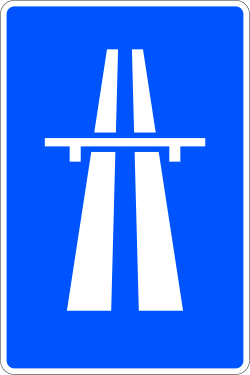
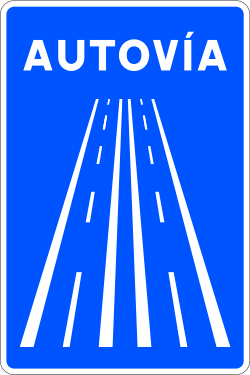
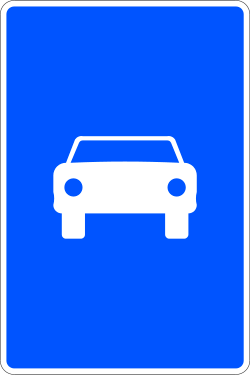
The motorcycle is an automobile, so it can be ridden on motorways and dual carriageways. They are prohibited for animal-drawn vehicles, bicycles (with one exception on the shoulder of some dual carriageways), mopeds and vehicles for persons with reduced mobility.
5. Traffic islands, refuges and roundabouts
Traffic islands, refuges and guide devices organize traffic within the roadway. The General Traffic Regulations (art. 43) set the side on which you go around them (figure 2):
- Two-way road: you pass on the part of the roadway that is to the right of the island, in your direction of travel. In other words, you leave it on your left. This way you do not enter the opposite lane.
- One-way road (or a part of the roadway with a single direction): you may pass on either side.
- Squares, roundabouts and places where roads meet: you ride leaving the center on your left. At the roundabout, that means turning counterclockwise.
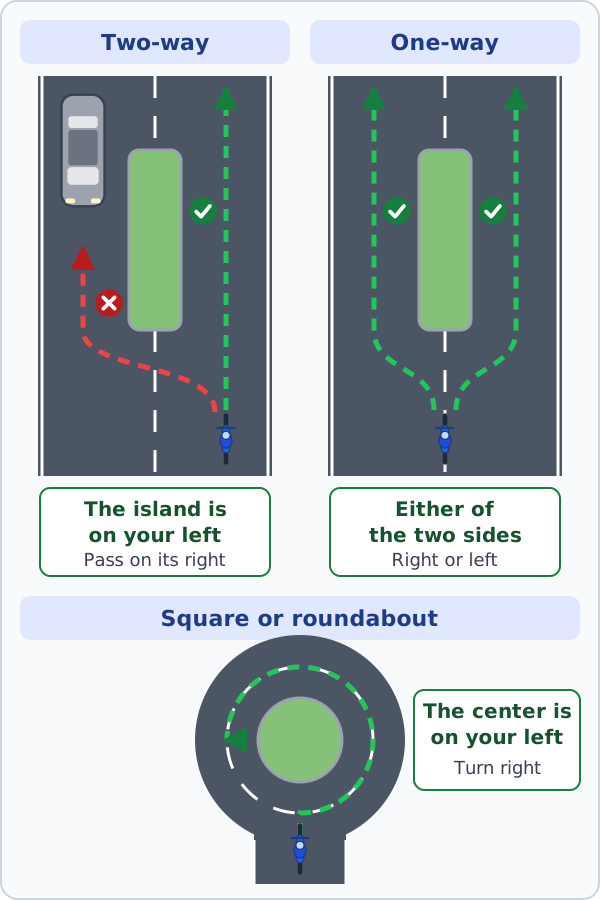
Figure 2. Two-way: island on your left. One-way: either side. Roundabout: center on your left.
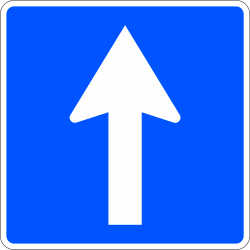
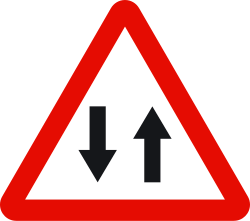
Riding in the opposite direction to the one required is a very serious offense, even if there are no islands.
Watch out in the exam: the questions sometimes talk about a “square” that you go around on a one-way street, and give “on either side” as the correct answer. That is the rule for islands and refuges. A square with circular traffic or a roundabout is always gone around with the center on your left.
6. Balance and stability
Two wheels in line cannot hold themselves up. The motorcycle is less stable and more fragile than other vehicles: it has no bodywork, and it is your body that absorbs the impact in a fall or a collision. It is also less visible, not more: its size is small.
What keeps it upright changes with speed (figure 3):
- At very low speed (for example, at 10 km/h) the motorcycle stays balanced thanks to you: you make quick, short movements with the handlebars and your body to compensate for any lean. This is when balance is hardest.
- From about 30 km/h the gyroscopic effect acts: the spinning wheels tend to keep their plane of rotation and stabilize the motorcycle. The faster they spin, the more stable it is.
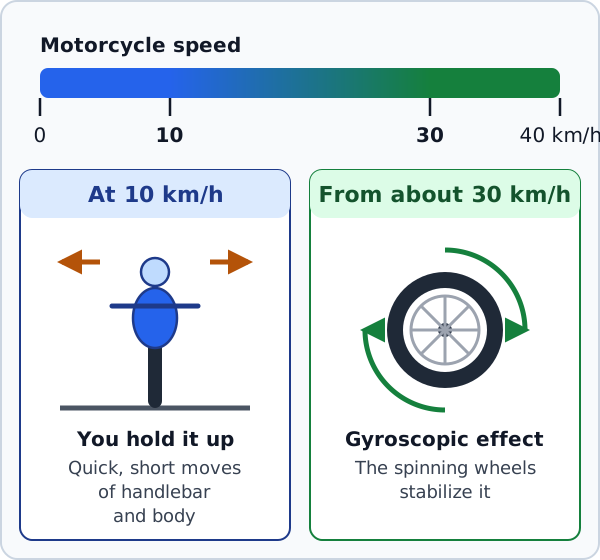
Figure 3. At 10 km/h balance depends on your movements; from about 30 km/h it is stabilized by the gyroscopic effect of the wheels.
Watch out in the exam: “the higher the speed, the harder it is to keep your balance” is false. It is the other way round: what is hard is keeping your balance at low speed. It is another matter that at higher speed a fall is more serious.
7. Riding position, controls and mirrors
7.1 The riding position
A correct position gives you control and tires you less:
- Adjust what can be adjusted. On many motorcycles you can adjust the levers, the handlebars and, on some models, the footrests, according to your build. The seat height, on the other hand, is usually not adjustable: choose a motorcycle that suits your height from the start.
- Arms slightly bent, never straight or rigid.
- Knees pressed against the tank. In a hard straight-line braking, your body tends to slide forward. With your knees gripping, your body stays more stable, the weight does not fall on your arms and you keep control of the steering. It has nothing to do with centrifugal force or the rear brake.
- Slightly crouched, you offer less air resistance: less effort to move forward and lower fuel consumption.
7.2 The controls
On most motorcycles with gears:
| Control | What it controls |
|---|---|
| Right hand | The throttle (the grip) and the front brake. |
| Left hand | The clutch. |
| Right foot | The rear brake. |
| Left foot | The gear pedal. |
The gearbox works by pedal: first gear is engaged by pressing the pedal down and the others are engaged by lifting it, one at a time. Neutral is between 1st and 2nd.
The throttle is operated by hand, not by a pedal, and smoothly and progressively. Sudden throttle openings and hard braking destabilize the motorcycle and use more fuel.
Watch out in the exam: the clutch is on the left hand. When an option says that the right hand controls the throttle and the clutch, it is false.
7.3 The mirrors
Many motorcycle rearview mirrors are slightly convex: they cover more of the field of view, but the vehicles behind look smaller and farther away than they are. Always allow for that margin: the vehicle behind you is closer than it looks (figure 4).
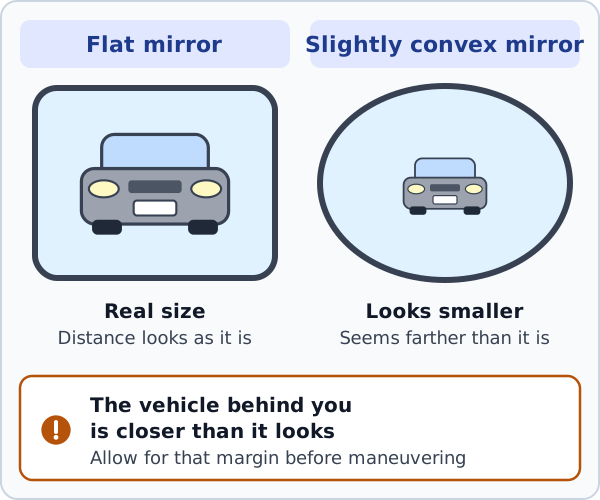
Figure 4. In a slightly convex mirror the same car looks smaller and farther away.
8. Riding in a group
When you go out with other motorcycles, the group influences how you ride. These are the rules the exam uses (figure 5):
- In single file, not side by side. The exam treats it as incorrect for two motorcycles to ride next to each other in the same lane. The advisable way is to ride in single file or staggered (also called “staggered formation”): one motorcycle toward one side of the lane, the next toward the other, each keeping its distance from the one in front.
- At the front, the least powerful. It is advisable for the least powerful motorcycle (or the rider with the least experience) to lead the group. It sets a pace that everyone can follow, and nobody is left behind or pushes the pace to catch up.
- Large groups, in small groups. It is advisable to split them into subgroups to make it easier for other road users to overtake.
- No competitive spirit. The group does influence safety: someone may get carried away by competition and take or accept risks. It must always be avoided, not only on the motorway or with many motorcycles. Do not let yourself be dragged along by group pressure.
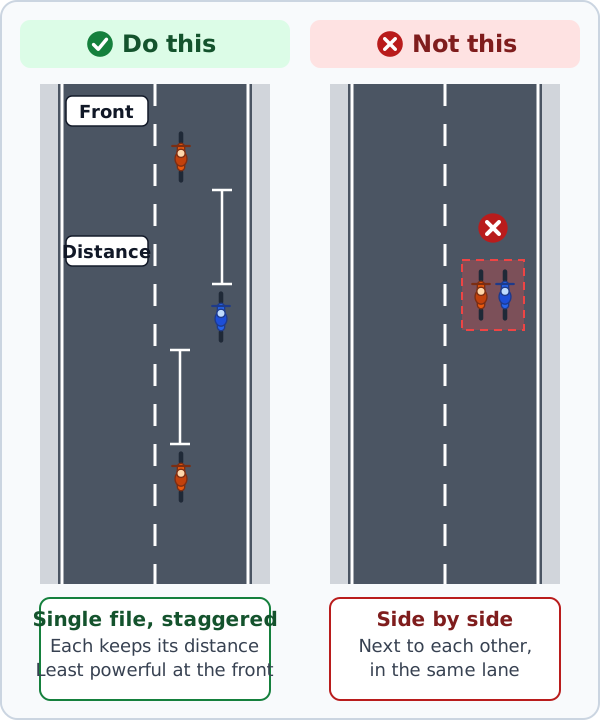
Figure 5. In a group, in single file or staggered and with distance; never one motorcycle next to another in the same lane.
9. Signaling with your arm when the indicator fails
You must warn of every maneuver with enough notice. This is done with the vehicle's lights or, if you do not have them, with your arm. If the indicator breaks down, you use your left arm:
| You want to… | Left arm |
|---|---|
| Turn or move to the left | In a horizontal position, with the palm of the hand extended downward. |
| Turn or move to the right | Bent upward, with the palm of the hand extended. |
| Brake or stop considerably | Moving it up and down, with short, quick movements. |
The arm prevails: if what the arm shows and what a light shows contradict each other, the arm applies. The arm signal only counts if the others can see it.
10. Efficient driving and defensive driving
Defensive driving consists of seeing, anticipating and managing space to avoid danger. Efficient driving reduces consumption and emissions through smooth driving. They are not the same, nor is one better than the other: they are complementary, because efficient driving requires applying the principles of defensive driving (vision, anticipation, space management).
Your riding style has an influence on consumption, and a large one. Sudden acceleration and continual hard braking use more fuel; smooth, anticipating riding uses less, pollutes less, improves safety and wears the mechanics less. As you can see, riding crouched (section 7.1) also helps.
11. The rider: emotions and children
On the motorcycle, safety depends on three things: the motorcycle, the road and you. As for you, above all your state:
- Depression: you lose information from your surroundings. The search for important data becomes less active and you take longer to detect what is happening.
- Stress: riding becomes more reckless. Aggressiveness and competitiveness increase.
- A heated argument before riding makes you lose concentration and increases the risk of an accident. It is not a good idea to have a drink to relax. Calming down before you set off is the prudent thing to do.
- Children have a more limited field of vision, above all because of their short height: they cannot see over a parked car, and you cannot see them either. Take extreme care in the areas that children frequent.
The rest of the factors (alcohol, drugs, fatigue, sleep) are in Factors that reduce rider fitness.
12. Two loose rules
Refueling. Stop the engine and turn off the lights, the radio and the mobile phone. The General Traffic Regulations (art. 115) require the engine to be stopped during refueling and, if an attendant does not serve you, require you to meet the other requirements yourself. The low beam that you always keep on while riding is also turned off.
Row of amber lights. A group of amber lights, steady or flashing, lined up on the roadway is a delineation element: it prohibits crossing the imaginary line that joins them. They are used mainly at road works. It is not a simple warning of road works or a stop line: what you must not do is cross that line.
What has changed in the rules
- 1 October 2026 (Royal Decree 518/2026): annex I of the Traffic Law adds the definition of vulnerable user, which includes drivers and passengers of motorcycles and mopeds, and those of single platform for roadway and sidewalk, residential priority zone and safe school route. Before, they were not defined.
- The definitions of moped and motorcycle in the Traffic Law do not change with this reform.
Numbers you need to know
| What | Figure | Nuance |
|---|---|---|
| Moped | 45 km/h and 50 cm³ at most | 4 kW if electric. Light quadricycle: also 350 kg unladen. |
| Motorcycle | More than 50 cm³ or more than 45 km/h | One of the two conditions is enough. |
| A1 license | 16 years; 125 cm³, 11 kW, 0.1 kW/kg | It also gives the AM. |
| A2 license | 18 years; 35 kW, 0.2 kW/kg | Not derived from a motorcycle with more than twice the power. It also gives the A1. |
| A license | 20 years; no power limit | With 2 years of A2. |
| Balance by you | At low speed (10 km/h) | Quick, short movements of the handlebars and the body. |
| Gyroscopic effect | From about 30 km/h | It is approximate. |
Summary
- The moped has an engine but is not a motor vehicle; the motorcycle is a motor vehicle and an automobile.
- Moped: 45 km/h and 50 cm³ at most. Motorcycle: more than 50 cm³ or more than 45 km/h.
- A sidecar (three asymmetric wheels) and a three-wheeled vehicle (symmetric) are different things.
- If you push your motorcycle you are a driver; if you push a two-wheeled cycle or moped, you are a pedestrian.
- A1: 125 cm³, 11 kW. A2: 35 kW. A: no limit. Each requires more age.
- The motorcycle can be ridden on motorways and dual carriageways; the moped cannot.
- Island: on a two-way road, on your left; on a one-way road, on either side. The center of a square or roundabout, on your left.
- At low speed (10 km/h) you provide the balance; from about 30 km/h the gyroscopic effect acts.
- Knees against the tank when braking, arms bent and the throttle smooth and progressive.
- A slightly convex mirror makes what is behind look smaller and farther away.
- In a group, in single file or staggered, never side by side, and the least powerful motorcycle at the front.
- Refueling: engine stopped, lights and mobile phone off.
Check your understanding
1. A two-wheeled vehicle reaches 60 km/h and its engine is 49 cm³. Is it a moped?
Answer
No. It exceeds 45 km/h, and exceeding one of the two limits (50 cm³ or 45 km/h) is enough for it to be a motorcycle.
2. A breakdown forces you to push your motorcycle on foot along the roadway. Are you a pedestrian?
Answer
No, you are a driver. Only a person who pushes a two-wheeled cycle or moped on foot is a pedestrian.
3. You are riding along a two-way street and there is an island in the middle. On which side do you pass?
Answer
On the side that is to the right of the island: you leave it on your left. On a one-way street you could pass on either side.
4. You are going at 10 km/h and the motorcycle stays balanced. What holds it up? And from about 30 km/h?
Answer
At 10 km/h, you, with quick, short movements of the handlebars and the body. From about 30 km/h, the gyroscopic effect of the wheels.
5. Your left indicator has broken down and you are going to turn left. What do you do with your arm?
Answer
You extend your left arm horizontally, with the palm of the hand facing down. If the indicator and the arm contradicted each other, the arm would prevail.
6. You go out for a ride with other motorcycles. How do you position yourselves and who leads?
Answer
In single file or staggered, each keeping its distance, never one next to another in the same lane. At the front, the least powerful motorcycle or the rider with the least experience.
Do you know it already?