
Factors that reduce rider fitness
In this topic:
- Why the rider, and not the motorcycle or the road, is the factor that weighs most in an accident.
- Which alcohol limit applies to you as a rider, what a checkpoint is like and what happens if you test positive or refuse.
- What the rules say about drugs and medicines, and how to recognize the pictogram on the package.
- What tires you out most on a motorcycle (wind, posture, cold), how fatigue and sleep are prevented and what you do when they appear.
- What you may and may not do with the phone, the navigation system, headphones and the intercom.
To ride you need more than knowing the rules: you must be in a condition to follow them. On a motorcycle, moreover, there is no bodywork or seatbelt to hold you: if tiredness, alcohol or a distraction make you react late, balance and coordination are the first things to suffer. In the exam this topic mixes health advice with exact figures (limits, points, fines) that leave no room for error.
1. The rider is the factor that weighs most
Three things influence riding a motorcycle: the condition of the rider, the vehicle and the road. Of the three, the one that causes the most accidents is the human factor: the statistics used in the exam say that most accidents are due to the rider. That is the good news, because it is the factor you can control most: accidents can be avoided by knowing their causes, and to reduce the probability of having one it is advisable to avoid the risk factors that depend on you: alcohol, drugs, fatigue, sleep, distractions, illnesses and inappropriate speed.
These factors (alcohol, fatigue, bad weather, inappropriate speed, illnesses) are risk factors: they increase the probability and the severity of accidents. Some facts that come up in the exam:
- Traffic accidents are one of the main causes of death among young people in Spain. Lack of experience, alcohol, drugs and speed play a part, as does a tendency to take more risks at those ages.
- During the day, most accidents happen at the times when people arrive at or leave work, above all in the afternoon, at the end of the working day: there is more traffic and you arrive with the tiredness and stress of the day.
- Defensive driving consists of anticipating dangers, watching your surroundings and so gaining time to react and avoid the risk.
1.1 Perceive, decide, act
The law requires you to be in a condition to control your vehicle at all times (General Traffic Regulations, art. 17). Art. 18 makes this specific: you must keep your freedom of movement, the necessary field of vision and permanent attention to riding.
Riding is a chain of three steps: you perceive the danger (a car braking, a pedestrian, gravel), you decide what to do and you act on the controls. The time you take from perceiving to starting to act is the reaction time, which as a guide is around one second. While you react, the motorcycle keeps moving at the same speed: what you cover in that time is the reaction distance. The braking distance is added to it, and the two make up the stopping distance (in the topic Speed you have the table of seconds and meters).
Everything you see in this topic (alcohol, drugs, some medicines, fatigue, sleep, distractions, illness) spoils one of those three steps:
- It increases the reaction time, and with it the reaction distance and the stopping distance. The stopping distance also varies with the condition of the motorcycle and of the road.
- It worsens perception: you see less, and you judge distances and speeds worse.
- It worsens execution: slower and less precise movements, worse coordination and worse balance.
Watch out in the exam: alcohol, drugs, fatigue, sleep, heavy meals, some medicines and old age increase the reaction time, and the reaction distance grows with it. If an option says they reduce it, it is false.
2. Alcohol
2.1 How it acts
Alcohol passes into the blood and through it reaches the brain. It starts to be noticed right away and its effect is at its maximum between 30 and 90 minutes after drinking, as a general rule around one hour after the last drink (figure 1). That is the worst moment to ride.
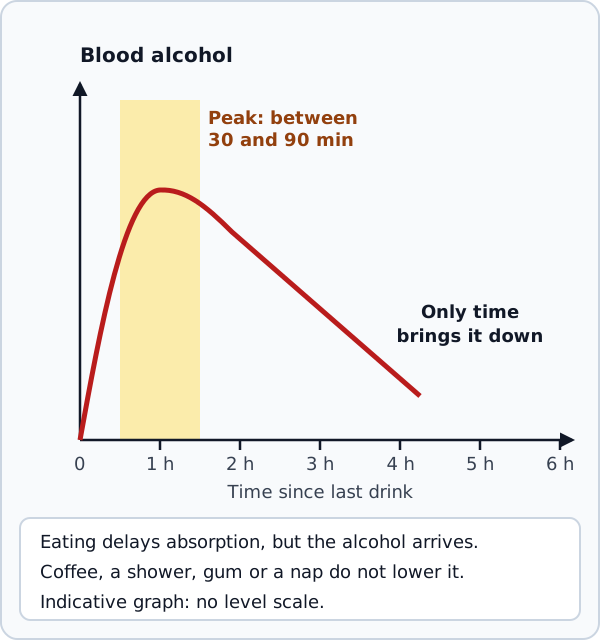
Figure 1. Alcohol reaches its maximum between 30 and 90 minutes after drinking, and only time eliminates it. No alcohol level scale: the shape of the curve is indicative.
What changes and what does not:
- Eating or drinking water while you drink delays the absorption of alcohol, but does not reduce the alcohol level or stop it from reaching the blood.
- Only time eliminates alcohol, and it does so slowly. Coffee, a shower, chewing gum or candy, sleeping for a while or exercising do not lower it. If you are asked: sleeping a little does not eliminate alcohol faster.
- The effects are not the same in everyone and do not depend only on what you drink: weight and whether you have eaten, for example, count.
2.2 What it does to you at the handlebars
- False sense of security: you think you are a better rider and you take more risks.
- It increases the reaction time and, with it, the stopping distance.
- It reduces your perception of your surroundings (tunnel effect: you see less at the sides) and makes you judge distances and speeds badly.
- It increases glare: your eyes take longer to recover after too much light and the lights of other vehicles bother you more.
- It increases distractions while riding.
- On a motorcycle, it also damages balance and coordination of movements, which is exactly what keeps the motorcycle upright and lets you take a curve. That is why the exam insists that a glass of wine or a beer before riding already increases the risk of an accident.
These effects are noticed even in small amounts and below the permitted limits: with 0.15 mg/l in exhaled air you can still react more slowly, and you can have an accident because of alcohol without exceeding the limit. If you drink frequently, you will probably end up having an accident in time. And combined with drugs or with some medicines, the effects increase. The safe rule is simple: if you are going to ride, do not drink.
Watch out in the exam: the maximum alcohol level also exists for motorcycles, and there is no trick (eating, coffee, a shower, gum, sleeping) that lowers it: only time.
2.3 Maximum alcohol levels
The alcohol level is measured in two ways: in blood (grams per liter, g/l) and in exhaled air (milligrams per liter, mg/l). The figure in blood is twice that in air.
| Who | Blood | Exhaled air |
|---|---|---|
| General rule | 0.5 g/l | 0.25 mg/l |
| Novice drivers: the 2 years after obtaining the first license | 0.3 g/l | 0.15 mg/l |
| Professionals: depending on the vehicle (goods vehicles over 3,500 kg, passenger vehicles with more than 9 seats, public service, school transport and transport of minors, dangerous goods, emergency service or special transport) | 0.3 g/l | 0.15 mg/l |
| Minors | 0 g/l | 0 mg/l |
How it applies to the motorcycle:
- The novice limit counts from your first license, not from the latest one. If the A2 is your first license, during the next two years your limit is 0.15 mg/l. If you already had the B for more than two years and you get the A2, your limit is the general one: 0.25 mg/l.
- The professional limit depends on the vehicle, not on the person. With a motorcycle for private use it is not yours.
- Minors: limit 0, whatever the vehicle. At 16 or 17 with an AM or an A1, any amount of alcohol is an offense.
- The limits apply to any vehicle and also to cyclists.
Watch out in the exam: do not mix up the periods. The L plate (V-13) is carried for one year; the reduced alcohol level for novices lasts two years, both from the first license.
2.4 Alcohol tests
Who is obliged. All drivers of vehicles and cyclists. Also other road users, such as a pedestrian, when they are involved in a traffic accident.
When traffic officers may ask you:
- If you are directly involved as a possible person responsible in an accident.
- If you ride with obvious symptoms of being under the influence of alcohol.
- If you are reported for a traffic offense.
- At a preventive checkpoint, even if you have done nothing and have no symptoms.
How they are done:
- Normally, with an officially authorized breathalyzer, which measures alcohol in the exhaled air.
- If it shows more than the limit that applies to you, or if it shows less but you have obvious symptoms, the officer gives you a second test to confirm. You have the right to have at least 10 minutes between the two. For example, with 0.30 mg/l you may ask for a second test, after at least 10 minutes.
- You may ask for a confirmatory test (of blood, urine or other) at a health center. You deposit its cost beforehand: if the confirmatory test is positive, you pay for it; if it is negative, your deposit is returned.
- You may make any statements you want, and they are recorded in writing.
Immobilization of the motorcycle. If you test positive or refuse the tests, the officer may immobilize the motorcycle, unless another duly qualified person takes charge of it to ride it. The immobilization is lifted as soon as the cause disappears (your level drops to the permitted level) or when another qualified driver replaces you. The costs of immobilization, transfer and pound are the rider's.
Watch out in the exam: your motorcycle is immobilized for a level above the permitted one: you may ride again when the level drops to the permitted level (or if another qualified person replaces you).
2.5 Penalties and crime
Riding with an alcohol level above the permitted one is a very serious offense (as long as it is not a crime). What you pay and the points you lose depend on how far over you are (figure 2).
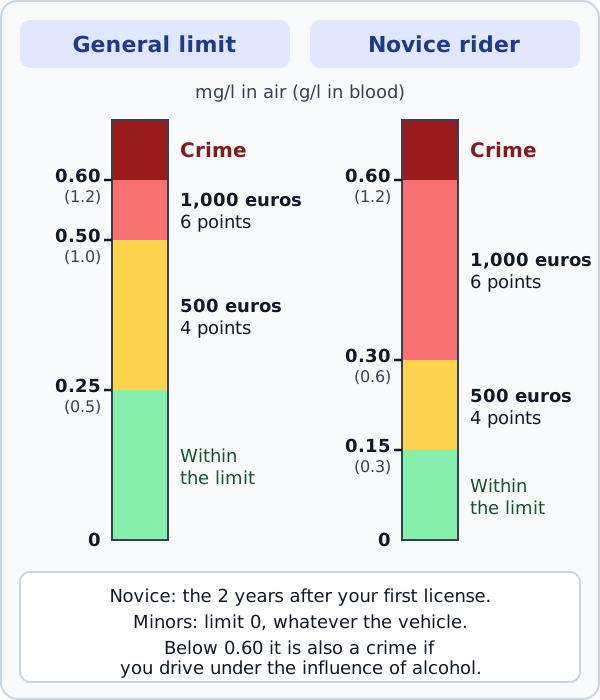
Figure 2. The same positive weighs more if you are a novice: your limit is lower (0.15 versus 0.25) and the 6-point step comes sooner. Above 0.60 mg/l, it is a crime for everyone.
| Offense | Fine | Points |
|---|---|---|
| Exceeding the limit without reaching double (general: from 0.25 to 0.50 mg/l; novice or professional: from 0.15 to 0.30 mg/l) | 500 euros (1,000 euros if you were already penalized for excess alcohol the previous year) | 4 |
| Exceeding double the limit (general: more than 0.50 mg/l; novice or professional: more than 0.30 mg/l) | 1,000 euros | 6 |
| Refusing the alcohol or drug tests | 1,000 euros | 6 |
| Riding with drugs in the body | 1,000 euros | 6 |
In addition, it may be a crime (Criminal Code):
- Driving a motor vehicle or a moped with more than 0.60 mg/l in air or 1.2 g/l in blood is always a crime. With less, it is also a crime if you drive under the influence of alcohol or drugs. It is punished with imprisonment of 3 to 6 months, a fine of 6 to 12 months or community service of 31 to 90 days, and always with deprivation of the right to drive for more than 1 year and up to 4.
- Refusing the tests when an officer asks you is a crime: imprisonment of 6 months to 1 year and the same deprivation of the right to drive.
The exam sums it up like this: driving under the effects of alcohol or drugs is considered a crime in the Criminal Code.
Watch out in the exam: refusing the test does not get you off anything: it is a very serious offense, with 6 points, the motorcycle may be immobilized and, in addition, it is a crime.
3. Drugs
It is prohibited to drive with drugs present in the body. Their effects do not need to be noticeable, and there is no permitted amount. The General Traffic Regulations speak of narcotics, psychotropic substances, stimulants and other similar substances. It is a very serious offense that takes away 6 points (table in section 2.5) and, if you drive under their influence, it is a crime.
The tests are done under the same conditions as those for alcohol, also at a preventive traffic checkpoint. A saliva test is done first with an authorized device and then a saliva sample is analyzed in a laboratory. If there are reasons that prevent them, a medical examination or a clinical analysis may be ordered. If you test positive or refuse, the motorcycle may be immobilized and the costs are yours.
What they do when you ride. Not all drugs are the same, but all of them are dangerous for road safety, each in its own way:
- Wrong perception of time and space: you misjudge distances and speeds.
- Cannabis increases drowsiness and worsens coordination and reflexes.
- Ecstasy reduces the ability to concentrate.
- Cocaine and other stimulants make you competitive and impulsive: you overrate your abilities, tolerate more risk and ride more aggressively. They also reduce concentration, and when the effect wears off tiredness arrives.
- With alcohol or other drugs, the negative effects increase.
Anyone who drives under the effects of drugs puts everyone around them at serious risk of an accident, not just themselves.
4. Medicines
Taking a medicine can change your behavior when you ride. The Traffic Law does not consider as a drug what you take with a medical prescription and a therapeutic purpose, as long as you are in a condition to drive with due attention. But the General Traffic Regulations include among the prohibited substances the medicines that alter the physical or mental state needed to drive without danger: if one leaves you like that, you must not drive.
What you should know:
- Some medicines reduce attention and increase the reaction time. They cause drowsiness: anxiolytics, some for colds, some painkillers, anti-allergy medicines or sleeping medicines. A cold, which by itself can cause drowsiness, and the medicine you take for it can add up.
- Some produce an effect similar to that of alcohol.
- “Natural” medicines can also have negative effects, in some cases. “Natural” does not mean harmless.
- They do not cause the same reactions in everyone: it depends on age, the habit of use and physical condition, and also on circumstances such as stress, fatigue or being on an empty stomach.
- Misuse of medicines increases the risk of an accident.
The package of medicines that may affect driving carries a pictogram: a red triangle with a black car inside, with the legend “Driving: see package leaflet”.
If you are undergoing treatment:
- Read the package leaflet and learn the side effects.
- Ask your doctor or pharmacist whether you may ride, and follow their instructions.
- Do not self-medicate and do not mix medicines with alcohol.
- If you feel sleepy, dizzy or slow, do not ride.
5. Fatigue
Fatigue is a drop in your ability to ride: both physical and mental. Tiredness appears, attention drops and movements lose precision. Riding a motorcycle demands more physical and mental effort than a passenger car, so the rider's physical endurance affects safety: being in good shape delays fatigue and helps you react to the unexpected.
5.1 What favors it
What depends on you, in any vehicle:
- Alcohol or heavy meals.
- Poor diet or little hydration.
- Stress: suffering stress makes you feel more fatigue.
- Lack of experience: every maneuver costs you more effort.
- Riding many hours in a row without resting.
From the road and the conditions:
- Heavy traffic: it forces you to concentrate more and favors fatigue.
- Bad weather (rain, fog, wind) and poor visibility: they demand more attention, so it is advisable to rest more often.
- Monotonous roads and high speed kept up for a long time.
Specific to the motorcycle:
| What | Why it tires you | What is advisable |
|---|---|---|
| Wind and posture | Your body acts as a sail. With long, high handlebars you sit upright and offer a lot of aerodynamic resistance: more tiredness and more consumption. A very high, upright position also raises the center of gravity | Centered and relaxed position, slightly crouched. The fairing helps; on motorcycles without a fairing, fatigue arrives sooner |
| Speed | The faster you go, the more attention and effort it demands. The possibility of suffering oscillations also increases and handling gets worse | Adapt your speed to the motorcycle and the road |
| Cold | You lose heat and sensitivity in your hands. Without the appropriate gear, you will probably react more slowly and handle the controls less smoothly | Dress for the cold. Do not take a stimulant drink to fight it |
| Heat and dehydration | Heat with your gear on can exhaust you and lower your attention | Advice: drink water before leaving and at every stop |
| Noise | The continuous noise of the wind and the engine can tire you on long trips | Advice: more frequent stops if you are very exposed |
We discuss gear, which is what protects you most from cold, wind and rain, in Motorcycle rider clothing. For posture, see Basic concepts.
5.2 How you notice it and what it causes
Heavy head, stiffness in the neck and back, constant changes of posture, itching or tiredness in the eyes and stiff muscles. When you ride:
- Lack of precision in movements.
- Difficulty keeping your attention.
- The reaction time increases and, with it, the reaction distance: if you ride fatigued, it will be greater.
- More irritability and abrupt riding.
5.3 How it is prevented and what to do
- Rest well before a long trip and do not eat heavily.
- Stop every 2 hours or every 200 kilometers, approximately, even if you have plenty of fuel. Stretch, hydrate, eat something light and check the motorcycle and the luggage.
- In bad weather, rest more often.
- Avoid the hours when you feel sleepy.
If you are fatigued, what you must do is immobilize the motorcycle in a suitable place and rest. Do not keep “holding on”.
Stimulant drinks can prevent sleep in the short term, but they hide fatigue and the sleepiness may return later, sometimes suddenly. They are not a substitute for rest.
Watch out in the exam: faced with “if you are very fatigued on a trip, what do you do?”, the answer is always stop in a suitable place and rest.
6. Sleep
Drowsiness is the prelude to falling asleep. Before you fall asleep you have already lost reaction capacity, and you may have a microsleep of a few seconds without realizing it: on a motorcycle, that means letting go of control over a very long distance. At 90 km/h, every second is 25 meters.
When it appears most:
- In the early hours, and also by day: accidents caused by sleep also happen during the day.
- After heavy meals. Before a motorcycle trip it is not advisable to eat abundantly, because it can cause sleepiness.
- When your usual sleeping hours change or you have slept little, and on monotonous stretches.
- With some medicines.
How to prevent it: sleep well before leaving, eat light and avoid riding in the early hours of the morning.
If you get sleepy, especially at night: park in a safe place and rest. Opening the visor or taking a stimulant drink gives you a few minutes, not the solution.
7. Distractions
A distraction is anything that takes you away from riding: it makes you take your eyes off the road, let go of the handlebars or think about something else. The result is always the same: you react late.
Distractions are related, above all, to the condition and behavior of the rider: tiredness, worries, an argument, use of the phone. But other factors also favor them:
- An excessively complex traffic situation, with many signs, vehicles or pedestrians, which overloads your attention.
- A very familiar road or a routine trip: you get overconfident and relax your alertness, and you delay your reaction to the unexpected.
- Monotony, alcohol and fatigue.
When your attention goes, the cost is measured in meters (figure 3).
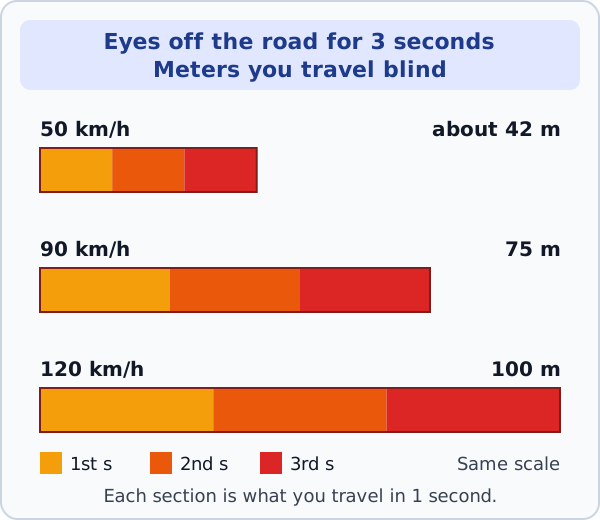
Figure 3. Three seconds with your eyes off the road are 75 meters at 90 km/h. The faster you go, the more meters you travel blind.
7.1 The phone
It is prohibited to use mobile phones and any other means or system of communication while riding. You may only communicate without using your hands or using headphones, earphones or similar instruments. The exception specific to the motorcycle is in section 7.3.
- “While riding” includes being stopped at a traffic light or in a traffic jam: there you may not pick it up either.
- Only law enforcement officers in the course of their duties and drivers of the Armed Forces traveling in a convoy are exempt.
- Even when it is legal, talking distracts: the conversation occupies your mind. If you have to call, stop in a safe place.
| What you do | Points | Fine |
|---|---|---|
| Holding the phone in your hand | 6 | 200 euros |
| Carrying the phone wedged between the helmet and your head | 3 | 200 euros |
| Using it manually in another way (touching it to type, for example) | 3 | 200 euros |
| Operating the navigation system manually | 3 | 200 euros |
| Riding with headphones or audio headsets | 3 | 200 euros |
7.2 Navigation system and screens
The navigation system (GPS) is allowed, but it is a source of distraction if you handle it while riding: that is a serious offense and takes away 3 points.
- Program the route before leaving and, if you need to change it, stop in a safe place.
- Your judgment prevails: if the GPS tells you to do something dangerous or contrary to the signs, the signs and your judgment take precedence.
- With the motorcycle moving you may not use screens with internet access, television monitors or video or DVD players. The General Traffic Regulations make an exception for maneuvering cameras and the GPS.
7.3 Headphones and intercom
It is prohibited to drive with any type of audio headset, headphones or similar instruments connected to devices that receive or play sound, or other devices that reduce attention. It is not valid for talking on the phone either.
The rider's exception. You may use wireless devices that are certified or approved and integrated into the helmet, exclusively for intercommunication or navigation and as long as they do not affect the safety of riding. This is what is called an intercom. It is not the same as loose earphones under the helmet, which remain prohibited.
Watch out in the exam: for the phone, the exception for the motorcycle is not “an earphone under the helmet”: it is the intercom integrated in the helmet, only to talk to someone or follow the navigation system.
7.4 Riding in a group
The group influences safety: it can push you to compete and to accept risks. Do not let yourself be carried away. In the exam:
- Large groups do not all go together: they split into subgroups separated from each other, so that others can overtake them.
- The exam considers it incorrect to ride side by side with other motorcycles in the same lane: each one goes in single file or staggered. You see this in more detail in Basic concepts.
8. Health, state of mind and age
8.1 Illnesses and state of mind
| Situation | How it affects you | What is advisable |
|---|---|---|
| Cold or flu | It can cause drowsiness and lowers concentration | Follow the doctor's instructions and check the effect of what you take |
| Respiratory allergy | A sneezing fit reduces your ability to keep your concentration in traffic | If a fit comes on, stop in a safe place |
| Illness in general | It can affect your physical or mental ability | Avoid riding during a crisis or in the acute phase. Ask your doctor what precautions to take |
| Stress or anger | More fatigue, more aggressiveness and competitiveness | Calm down before setting off. A drink “to relax” is not a solution |
8.2 Eyesight, reflexes and medical and psychological fitness test
Having lost some ability, physical (vision) or mental (reflexes), affects safety. That is why, to obtain and renew the license, you must prove your psychophysical fitness at an authorized driver medical test center. For the AM, A1, A2, A and B licenses, binocular visual acuity must be at least 0.5, with corrective lenses if needed; if the report says you need them, it is mandatory to wear them when you ride.
The validity of the A1, the A2 and the A is 10 years, and 5 years from age 65.
8.3 Age
- In young people, lack of experience, excess speed and the tendency to take more risks weigh heavily. At 16 or 17, your motorcycle license is the A1 and your alcohol limit is 0.
- In older people, eyesight and reflexes tend to get worse and reaction is slower. They compensate with more caution and more margin. From age 65 the license is renewed every 5 years, and each renewal requires the medical test.
What has changed in the rules
- 1 October 2026 (Royal Decree 518/2026). The General Traffic Regulations prohibit driving with any type of audio headset, headphones or similar instruments, or other devices that reduce attention (before, they spoke only of headsets or headphones), and expressly name the exception of the certified or approved wireless intercom integrated into the motorcycle or moped helmet. The phone is still allowed only hands-free and without headphones.
- 21 March 2022 (Law 18/2021). Limit 0 for minors. Holding the phone in your hand started to take away 6 points (before, 3).
Numbers you need to know
| What | Figure | Detail |
|---|---|---|
| General limit | 0.5 g/l in blood / 0.25 mg/l in air | Motorcycles included; also bicycles |
| Novice | 0.3 g/l / 0.15 mg/l | 2 years from the first license |
| Minors | 0 | Any vehicle |
| Crime for alcohol | More than 0.60 mg/l or 1.2 g/l | With less, if you drive under its influence |
| Second alcohol test | At least 10 minutes later | Also if you show less but with obvious symptoms |
| Alcohol: fine and points | 500 euros and 4 points / 1,000 euros and 6 points | Up to double your limit / more than double. Repeat offender within the year: 1,000 euros |
| Drugs or refusing the tests | 1,000 euros and 6 points | Refusing is, in addition, a crime |
| Phone held in the hand | 6 points | Fine of 200 euros |
| Phone between helmet and head, headphones or navigation system handled | 3 points | Fine of 200 euros |
| Alcohol peak | Between 30 and 90 minutes | As a general rule, around one hour |
| Breaks on a long trip | Every 2 hours or 200 km | Advice, approximate |
| Binocular visual acuity | At least 0.5 | With corrective lenses if needed |
| Validity of the A1, A2 and A | 10 years | 5 years from age 65 |
Summary
- The human factor is the cause of most accidents. Avoid the risk factors that depend on you.
- Alcohol, drugs, some medicines, fatigue, sleep and distractions increase the reaction time and the distance you travel without braking.
- Alcohol reaches its maximum between 30 and 90 minutes after drinking, and it damages balance and coordination. Only time eliminates it: eating, coffee, a shower, gum or sleeping do not lower the level.
- Limits: 0.25 mg/l (0.5 g/l) in general; 0.15 mg/l (0.3 g/l) for novices, two years from the first license; 0 for minors.
- All drivers are obliged to take alcohol and drug tests, also at preventive checkpoints. Second test at least 10 minutes later; the motorcycle is immobilized if you test positive and you may continue when the level drops.
- Positive: 500 euros and 4 points, or 1,000 euros and 6 points if you exceed double. Drugs or refusing: 1,000 euros and 6 points. More than 0.60 mg/l, refusing or driving under the influence: a crime.
- Some medicines cause drowsiness and lengthen the reaction. Look for the pictogram of the red triangle with a black car and consult your doctor or pharmacist.
- On a motorcycle fatigue comes sooner: wind, upright posture, speed, cold and heat. If you are fatigued, stop in a suitable place and rest; stimulants only mask it.
- Phone held in the hand: 6 points. Headphones, phone under the helmet or handled navigation system: 3. Only the intercom integrated in the helmet is valid.
- Before riding with an illness or a treatment, ask your doctor; avoid riding in the acute phase.
Check your understanding
1. You got the A2 six months ago. Your first license was the B, five years ago. What is your maximum alcohol level in exhaled air? And if the A2 were your first license?
Answer
With the B from five years ago, the general one: 0.25 mg/l (0.5 g/l). If the A2 were your first license, the novice one, 0.15 mg/l (0.3 g/l), during the next two years. If you are a minor, 0.
2. At a checkpoint you register 0.40 mg/l and you are not a novice. What penalty do you get? And if you register 0.70?
Answer
With 0.40 mg/l (more than 0.25 without reaching double), 500 euros and 4 points. With 0.70 mg/l, more than 0.60: a crime, with imprisonment, a fine or community service, and deprivation of the right to drive for more than 1 and up to 4 years.
3. You have drunk two beers and you think “a coffee and a shower will sort it out”. Is that true?
Answer
No. Neither coffee nor a shower, nor gum, nor sleeping for a while lowers the level. Only time eliminates it, and slowly. Moreover, the maximum arrives between 30 and 90 minutes after drinking.
4. You are on a long motorcycle trip and you notice stiff arms and that your head is nodding. What do you do?
Answer
You stop the motorcycle in a suitable place and rest (and sleep if necessary). A stimulant drink only masks the tiredness for a while, and a long trip calls for stops every 2 hours or 200 km.
5. Are you allowed to wear earphones under the helmet to listen to the navigation system? And an intercom?
Answer
Earphones, no: they are prohibited, and take away 3 points. A wireless intercom that is certified or approved and integrated into the helmet, yes, only for intercommunication or navigation.
6. On the package of your medicine there is a red triangle with a black car. What does it mean and what do you do?
Answer
That the medicine may affect driving (“Driving: see package leaflet”). You read the package leaflet, ask your doctor or pharmacist whether you may ride and, if you feel sleepy, dizzy or slow, you do not ride.
Do you know it already?