
Traffic rules and signs for the motorcycle
In this topic:
- Which sign takes precedence when two contradict each other, what a traffic officer orders you to do and which traffic lights apply to you.
- Which no entry and mandatory signs apply to the motorcycle, and which do not.
- What the most frequently asked prohibition signs say (overtaking, speed, distance, parking) under the 2025 Catalog.
- How to ride, overtake, stop and park the motorcycle, and when to use each light.
- What equipment is mandatory on the motorcycle and what is not, and what to do in a breakdown or an accident.
This topic gathers the general rules and the signs that appear most in the motorcycle exam, with what changes when the vehicle is a motorcycle. Since 1 July 2025 a new Catalog of signs has been in force and, since 1 October 2026, the reform on vulnerable users: both change exam answers.
1. Who is in charge: traffic officers, traffic lights and signs
All road users must obey the signs that establish an obligation or a prohibition and adapt to the message of the others. If a sign seems to contradict a rule of conduct, you obey the sign, unless special circumstances justify otherwise.
When two signs contradict each other, the one with the higher category prevails. The order of precedence is:
- Law enforcement officers who regulate traffic.
- Temporary signage and delineation (road works, detours, cones, temporary directional panels).
- Traffic lights.
- Vertical signs.
- Road markings.
Between two signs of the same type, the more restrictive one prevails. That is why, if an officer tells you to stop while the traffic light is green, you stop.
1.1 What an officer orders you to do
| Officer's signal | What you must do |
|---|---|
| Arm raised vertically | Stop at the nearest stop line or, if there is none, before the officer (at an intersection, before entering). Whoever has already entered does not have to stop. |
| Arm or arms extended horizontally | Stop if you are coming from a direction that crosses the line of the arms. It remains in force even if the officer lowers the arm, as long as the officer does not change position. |
| Swinging a red or yellow light | Stop, if the light is aimed at you. |
| Arm moving up and down | Slow down, if you are approaching from the side of the moving arm. |
| Short, frequent whistle blasts | Stop. One long blast: resume your journey. |
Officer in a vehicle. Since 1 July 2025, if a police vehicle positions itself behind you and emits a flashing or blinking red light toward the front, you must stop on the right side, in front of the police vehicle, in a place where you do not cause a nuisance, and stay where you are following its instructions. Before, the light was yellow.
2. Traffic lights
A circular traffic light is obeyed according to its light:
| Light | What it means |
|---|---|
| Steady red | Prohibits passage. You do not go past the traffic light or the stop line. |
| Steady yellow | You stop as with the red, if you can do so safely. If when it comes on you are already so close that you cannot stop safely before the traffic light, you continue. |
| Flashing yellow | You take extreme care and, if necessary, yield. It does not exempt you from obeying another sign that obliges you to stop. |
| Steady green | You may go with priority, except for the exceptions in the rules. |
| Green arrow on a black background | You may take that direction with any light on, but yielding to those traveling in the lane you are joining and without endangering anyone who is crossing. |
| Flashing red (or two alternating) | Prohibits passage: level crossing, movable bridge, fire station exit or low-flying aircraft. |
Which traffic light you obey. The one on your right or above your lane or the roadway. If there is none and you are going straight or turning left, the one on your left.
Lane control signal (square). A red cross prohibits using that lane and you must leave it as soon as possible. A green arrow pointing down allows you to travel in it. A white or yellow diagonal arrow warns you that your lane is closing and you must merge into the one it points to.
Traffic light with a cycle silhouette. Since the 2025 Catalog it refers only to cycles. Before, it also applied to mopeds. A motorcycle does not obey it: it follows the circular traffic light that applies to it. If that one is red and the bicycle one is another color, you stop.
3. Right of way
Without signs, you yield to whoever comes from your right. Signs change that rule:
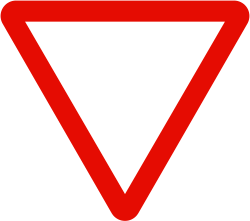
- R-1 (yield): you yield to the vehicles on the road you are approaching.
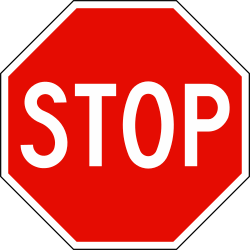
- R-2 (stop): you stop at the stop line or, if there is none, before the intersection, and yield. If you cannot see from there, you stop again where you can see.
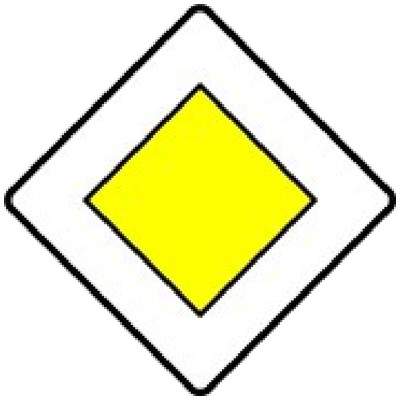
- R-3: tells you that your roadway has priority at intersections.
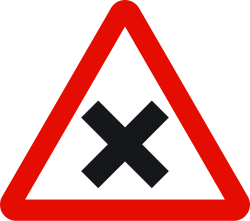
- P-2: warns of an intersection where the general rule applies: yield to whoever comes from the right. It neither gives nor takes away priority: the rule is the usual one.
3.1 Narrow passages
If on a stretch two vehicles that meet cannot fit and there is no sign:
- The one that entered first goes through.
- If you arrive at the same time or there is doubt, the one with the greatest maneuvering difficulties goes through. This is decided with an order by type of vehicle that looks at who would have to back up.
In that order, the motorcycle comes last (with two-wheeled mopeds and bicycles). Before it come, among others, buses, trucks, passenger cars and three-wheeled vehicles and motorcycles with a sidecar.
| If they meet… | Goes through first… |
|---|---|
| Bus and motorcycle | The bus |
| Passenger car and motorcycle | The passenger car |
| Agricultural tractor and motorcycle with a sidecar | The tractor: the motorcycle with a sidecar backs up |
| Two of the same type | The one that would have to back up the greater distance; if tied, the one with the greater width, length or mass |
Two exceptions to the rule of whoever enters first:
- Priority signs. If there is an R-6 (priority over oncoming traffic) at one end, whoever arrives from there goes through. If what there is is an R-5 (priority to oncoming traffic) or a yield at your end, you back up.
- Steep gradient (at least 7%): the one going uphill has preference, unless that driver can reach a lay-by sooner: then that driver is the one who pulls aside.
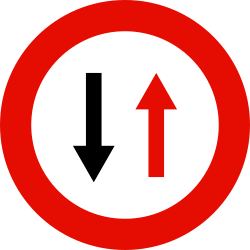
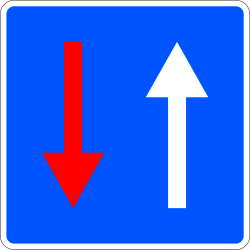
Watch out in the exam: if you are asked which of two signs gives you priority in a narrow passage, it is the R-6 (square and blue). The R-5 (circular with a red border) is the one that prohibits entering if you force the other to stop.
3.2 Pedestrians and animals
- Drivers have priority over pedestrians and animals, except in the cases set out in the rules. In those cases you yield, stopping if necessary.
- Pedestrians have priority at marked crossings, on sidewalks and in pedestrian areas, when you turn to enter a road that they are crossing (even if there is no crossing) and when you cross a shoulder on which they are walking.
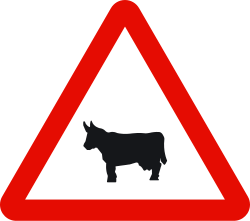
- Animals have priority on marked livestock routes (cañadas): the domestic animals crossing sign with a panel that says “cañada”.
- Near children and elderly people, you take the necessary precautions so as not to endanger them, and slow down, stopping if necessary.
4. No entry and mandatory signs: what they do to the motorcycle
The most repeated question in the topic is whether you may enter or are obliged to. It is answered by looking at which vehicles the sign names.

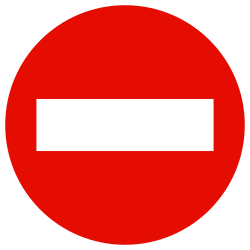
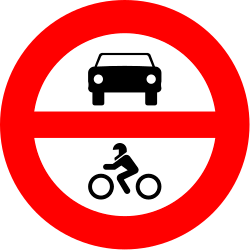
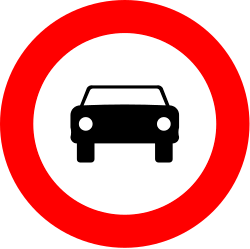
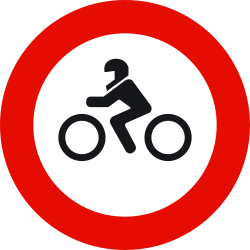
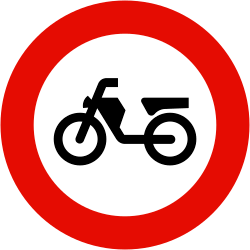
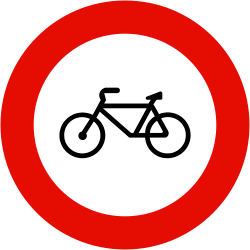
| Sign | You, with your motorcycle |
|---|---|
| R-100 Closed to all vehicles | You do not drive, like nobody else. |
| R-101 No entry | You do not enter. |
| R-102 No entry for motor vehicles | You do not enter: the motorcycle is a motor vehicle. The drawing shows a passenger car and a motorcycle. |
| R-103 No entry for motor vehicles, except two-wheeled motorcycles | You do enter, with your two-wheeled motorcycle. It also does not prohibit entry to three-wheeled vehicles equivalent to motorcycles. |
| R-104 No entry for motorcycles | You do not enter. Since 2025 it also prohibits three-wheeled vehicles equivalent to motorcycles. |
| R-105 No entry for mopeds | You do enter. It prohibits mopeds and vehicles for persons with reduced mobility, not motorcycles. |
| R-114 No entry for cycles | You do enter. It only prohibits bicycles and other cycles. |
New in the 2025 Catalog: the signs R-103, R-104, R-404 and R-405 now speak of “two-wheeled motorcycles”. The expression “without sidecar” disappears and equivalent three-wheeled vehicles are added. A motorcycle with a sidecar is not a two-wheeled motorcycle: the exam treats it separately, as a vehicle to which neither the exception of R-103 nor the obligation of R-405 applies.
Obligation to travel on a roadway.
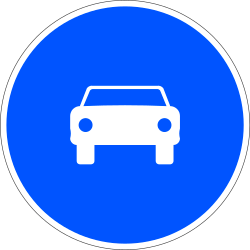
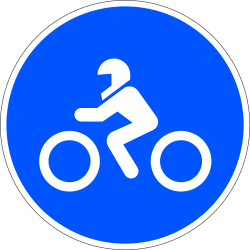
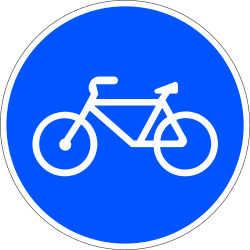
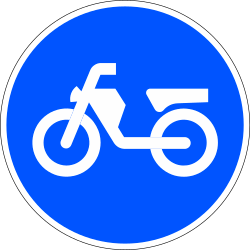
- R-405: obliges two-wheeled motorcycles to travel on the roadway at whose entrance it stands. If you ride a motorcycle with a sidecar, it does not oblige you.
- R-404: obliges automobiles, except two-wheeled motorcycles. You are not obliged.
- R-407a (cycles) and R-407b (mopeds): roads reserved for those vehicles. The motorcycle must not use them. You are not obliged to go that way.
5. Prohibition and restriction signs
5.1 Overtaking: R-305 and R-306
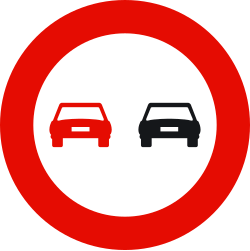
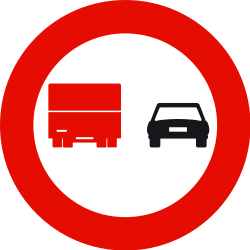
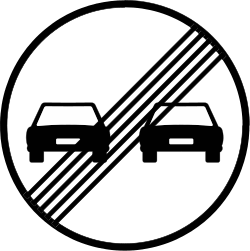
This is the sign where the exam has changed the most (figure 1). Before, with R-305 you could overtake two-wheeled motorcycles if you did not enter the opposite direction. There is no longer an exception for motorcycles.
- R-305: prohibits all vehicles from overtaking motor vehicles when the maneuver enters the area reserved for the opposite direction. What counts is whether you enter it, not whom you overtake.
- R-306: prohibits trucks over 3,500 kg from overtaking motor vehicles even if they do not enter the opposite direction, motorcycles included. When overtaking, it does not affect you with your motorcycle: what changes is that those trucks cannot overtake you.
- The prohibition lasts until R-502 (end of overtaking prohibition) or R-500 (end of prohibitions). The one for trucks ends with R-503.
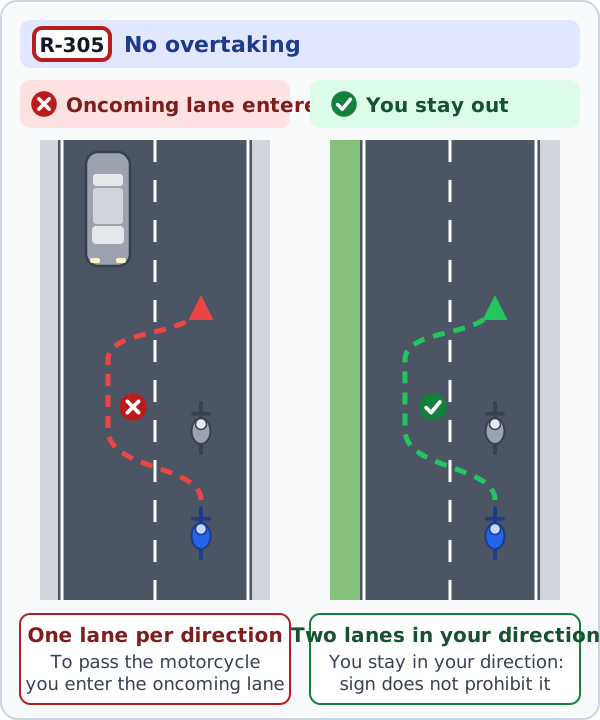
Figure 1. With the R-305 sign, overtaking is prohibited if you enter the opposite direction. With two lanes in your direction, overtaking a motor vehicle, motorcycle included, does not enter the opposite direction and the sign does not prohibit it.
5.2 Speed and distance

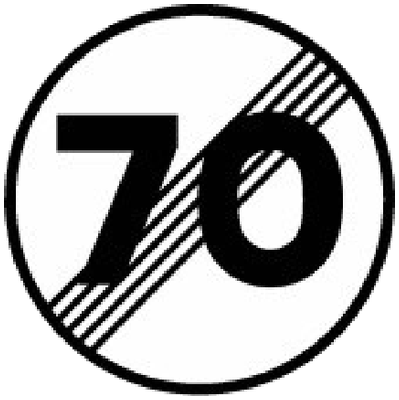
- R-301 prohibits driving faster than the speed shown, from the sign until an end of limit sign (R-501), an end of prohibitions sign (R-500) or another maximum speed sign. You must not exceed that limit in order to overtake.
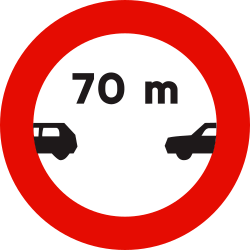
- R-300 (minimum separation) prohibits driving without keeping, from the vehicle ahead of you, the separation it indicates, in meters (for example, 70). Without a figure, it only reminds you that you must keep a safety distance. It does not apply if you are about to overtake.
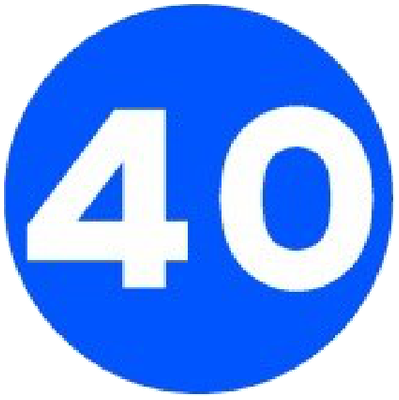
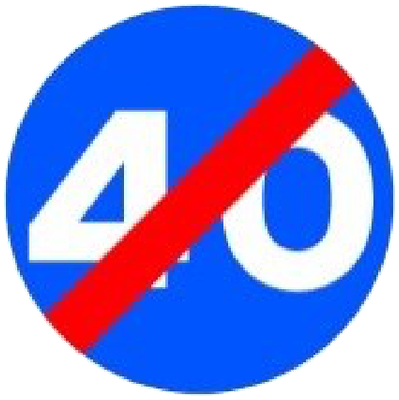
- R-411 (minimum speed): obliges you to travel at least at that speed until an end sign (R-506) or another sign that changes it.
- Speed in general (the limit on each road, minimum of 60 km/h on motorways and dual carriageways) is covered in the topic on speed.
5.3 Stopping and parking
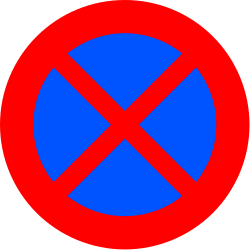
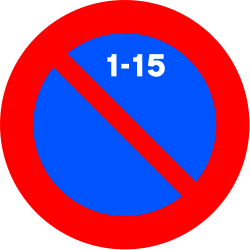
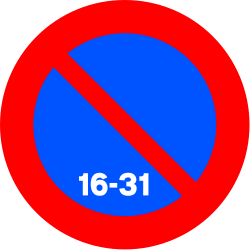
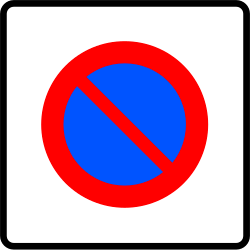
- R-307: you must not stop or park on the side of the roadway where the sign is.
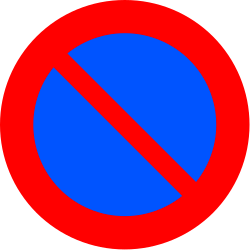
- R-308: you must not park, but you may stop.
- R-308c (1-15) and R-308d (16-31): they prohibit parking, and do not prohibit stopping. The “1-15” one applies from 09:00 on the 1st until 09:00 on the 16th. The “16-31” one, from 09:00 on the 16th until 09:00 on the 1st. With the “16-31” one, on the 30th you do not park but you may stop; on the 1st you may park from 09:00.
- Abolished signs. Those for odd and even days (R-308a and R-308b) were abolished in the 2025 Catalog and had to be removed before 1 July 2026. If one appears in the exam, what is in force is the fortnights.
- R-309: the blue zone. The motorcycle parks under the same rules and hours as other vehicles.
6. Warning and information signs that are asked about
The warning ones are triangular with a red border and warn you that you must slow down and take extreme care.
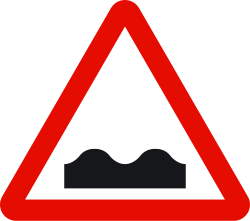
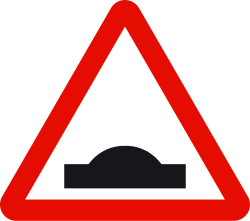
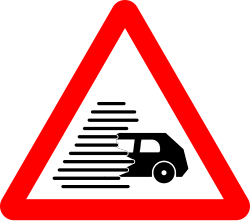
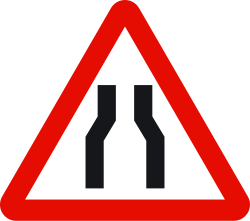
- P-15: uneven road profile, with a hump or dip or with the surface in poor condition. P-15a: speed bump.
- P-33: stretch with reduced visibility due to fog, rain, snow or smoke.
- P-17: road narrowing (since 2025, also if the shoulder narrows).
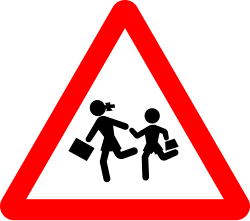
- P-21a: children, near a school or a play area.
The information ones are square or rectangular and blue.
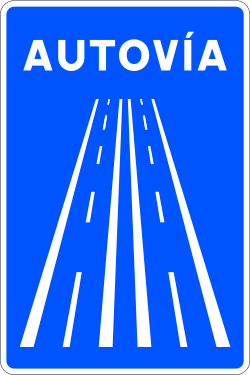
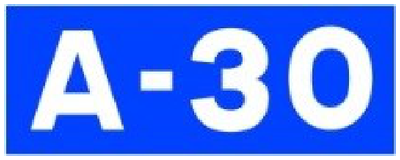
- S-1a marks the start of a dual carriageway; S-1, that of a motorway. S-410 identifies a motorway or dual carriageway by its number.
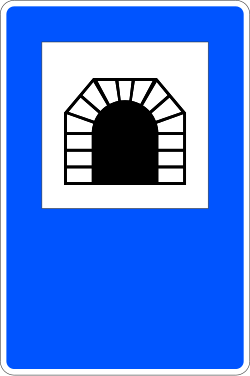
- S-5: tunnel or equivalent underpass. Inside, lights on, no overtaking if there is only one lane per direction and with the safety distance of 100 meters.
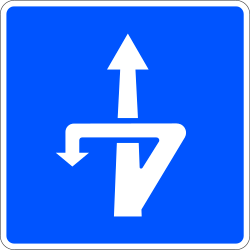
- S-25: an exit by which you can make a U-turn at a different level.
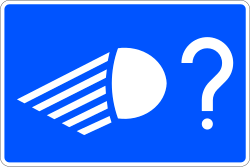
- S-24: end of a stretch where low beam headlights were mandatory. You, with the motorcycle, keep the low beam on, because on the motorcycle it is always mandatory.
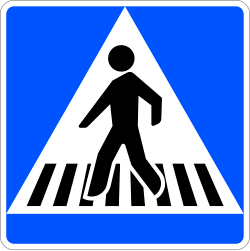
- S-13: where there is a pedestrian crossing. Here you must not make a U-turn, not even pushing your motorcycle on foot: whoever pushes a motorcycle is a driver, not a pedestrian.
Pedestrian priority zones. The S-28 used to be called “residential street” and marked 20 km/h. Since 2025 it is called stay and play zone: it always comes with an R-301 of 10 km/h, pedestrians have priority throughout the zone and there are no pedestrian crossings. In the shared space zone (S-47) the limit is 20 km/h. Outside those zones, on urban roads the limits of the topic on speed apply: 20 km/h on a single platform of roadway and sidewalk, 30 with one lane per direction and 50 with two or more lanes per direction.
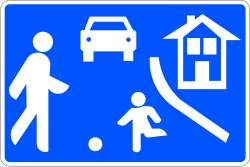
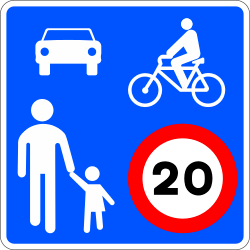
Watch out in the exam: if a question with the S-28 sign gives “20 kilometers per hour” as the answer, it is the old rule. Under the 2025 Catalog the limit of that zone is 10.
Temporary delineation. A temporary directional panel (road works, detours) prohibits passage on the side it closes and indicates where to continue. Amber lights in a row on the ground prohibit you from crossing the line that joins them. Green, orange or red lights on the ground delimit lanes: only the green one may be driven over.
7. Road markings
- Broken line between lanes: you do not drive on it, except when the width of the lanes makes it necessary and it is safe. You cross it to turn or change lanes, yielding to those traveling in the lane you are going to. In the exam, riding on top of the broken markings between two rows of cars, even if the road is saturated, is incorrect.
- Solid line: it is not crossed or driven over. The motorcyclist who advances along the solid line at the left edge between a row of stopped cars and the line is not riding correctly.
- Hatched markings (painted stripes): you do not enter or stop on them.
- Yellow line on the curb: broken, parking prohibited; solid, stopping and parking prohibited. Yellow box junction: do not enter the intersection if you are going to be left stopped inside.
- M-8.4 (guidance markings for motorcyclists): they show, on a dangerous curve, the part of the lane that it is advisable not to ride on. It is not mandatory.
Passing over a road marking or an inscription (an arrow, a pedestrian crossing; figure 2). Paint grips less than asphalt, and even less when wet. For the motorcycle:
- Cross it in a straight line, without leaning the motorcycle and without tracing a curve over it.
- If you can choose, make the angle with the marking as straight as possible (close to 90 degrees).
- Do not accelerate or brake hard on top of it.
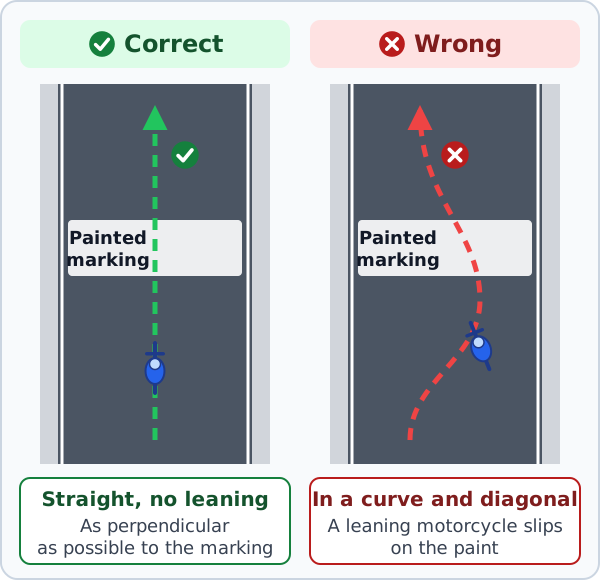
Figure 2. Over a painted marking, the motorcycle goes straight, without leaning and as perpendicular as possible. In a curve and diagonally, the paint can make it slip.
8. Where the motorcycle may go
Roadway, not shoulder. You ride on the roadway, on the right and as close to the edge as possible. With two lanes and two-way traffic, in the one on your right. With three two-way lanes, in the right one and never in the one on your left: the center one is for overtaking or turning left. Outside built-up areas, with more than one lane per direction, normally in the right one, and you may use the others if you do not hinder whoever is behind you. Within built-up areas, with delimited lanes, the one that best suits your destination; with two undelimited lanes for the same direction, the right one.
Roundabouts. The center stays on your left: you go around it counterclockwise.
Motorways and dual carriageways. The motorcycle may ride on them (mopeds, bicycles and vehicles for persons with reduced mobility may not). You may ride in the left lane, although the right one is normal. It is prohibited to:
- Ride on the shoulder, except on stretches enabled for motorcycles in congestion (you see it just below). Outside them, only in the event of a breakdown or emergency and at an abnormally low speed, and then you leave by the first exit. If you do not reach the minimum speed and there is a risk of a rear-end collision, you also turn on the hazard lights.
- Stop outside the enabled areas (rest areas). To rest, neither the shoulder nor the hatched markings are valid. Going at 60 km/h in the right lane is going at the minimum permitted speed.
- Reversing.
Shoulder in congestion (RD 518/2026, since 1 October 2026). On stretches marked with a vertical sign and road markings, motorcycles may use the right shoulder, but only with traffic stopped due to congestion, at 30 km/h at most and in single file. You leave the shoulder if necessary. Apart from that, the shoulder remains prohibited.
Zigzagging between vehicles on a saturated road is prohibited: it is a risk.
HOV lane. Motorcycles may use the high-occupancy lane, complying with the conditions of that stretch.
Contraflow lane. For traffic flow, only motorcycles and passenger cars:
- Speed maximum of 80 km/h and minimum of 60 km/h. Going at 85 or 90 is exceeding it.
- Low beam on, day and night.
- You must not leave it by entering the lane of the normal direction, not even to overtake.
If the lane is enabled because of road works, all vehicles authorized on the road use it.
Bus lane. You must not stop, park or overtake in it.
Sidewalk. You must not ride on it, not even on foot pushing the motorcycle. Whoever pushes a motorcycle is a driver, not a pedestrian (only whoever walks a cycle or a two-wheeled moped is a pedestrian): that is why you must not make a U-turn at a pedestrian crossing pushing it. Parking on the sidewalk is prohibited, unless the city council regulates it by ordinance for two-wheeled vehicles without obstructing pedestrians.
9. Overtaking, changing lanes and signaling
The 1.5 meters, the speed limit and the lanes are covered in the topics on speed and on driving on roads. Here, what is asked:
- You overtake on the left. On the right only if the vehicle ahead signals a left turn or stops on that side, or in built-up areas with at least two delimited lanes for your direction.
- The first thing when changing lanes is to observe and assess the traffic. The mirror is useful and, if in doubt, turn your head slightly to see the blind spot.
- If the overtaking involves a significant lateral movement, even if you do not enter the adjacent lane, you signal it. You turn off the indicator as soon as you are positioned in the new lane.
- Outside built-up areas, if you overtake any vehicle with your motorcycle, you leave at least 1.5 meters. For pedestrians and cyclists, 1.5 meters on any road.
- Do not exceed the road limit to overtake (with 80, you do not go above 80), do not overtake on the shoulder, and do not zigzag around the cones that separate directions.
- On a road with several lanes, after overtaking you return to the right one, unless you chain another overtaking.
- On curves and changes of gradient without visibility you do not overtake, unless the directions are clearly delimited and you do not enter the opposite one.
- Overtaking is prohibited at pedestrian crossings, at intersections with cycle paths and at level crossings, without exceptions since 1 October 2026 (before, it was allowed “at reduced speed” at a pedestrian crossing). At an intersection you may overtake two-wheeled vehicles.
- If you are being overtaken, you keep to the right edge and do not accelerate.
Signaling with your arm (figure 3). If your indicator does not work, you signal with the left arm. The arm overrides any light that contradicts it.
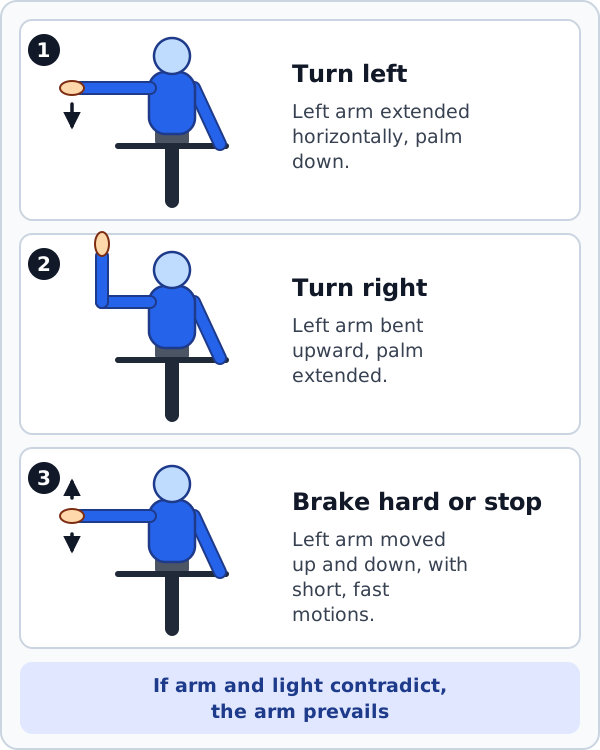
Figure 3. With the left arm: horizontal with the palm down for left, bent upward for right and up and down, with short movements, to brake hard or stop.
The brake light comes on when you operate either of the two brakes. If you are immobilized on a motorway or where visibility is poor, you turn on the hazard lights (if you have them) and the position lights.
Horn. Only to avoid a possible accident (especially on narrow roads with many curves), to warn outside built-up areas that you are going to overtake and to make your presence known in a serious emergency if you are not a priority vehicle. It is not for greeting an acquaintance. In built-up areas, to warn use flashes of the headlights without dazzling.
10. Stopping and parking
- On an interurban road, you stop and park off the roadway, on the right, leaving free the passable part of the shoulder. A group of motorcycles does not rest on the passable shoulder.
- On an urban two-way road, you park on the right; on a one-way road, on the right or left.
- The motorcycle is placed parallel to the edge, unless the road advises otherwise.
- Double parking: parking is prohibited; stopping for a moment to let a passenger off is not, if you do not obstruct or create risk.
- It is prohibited to stop on curves and changes of gradient without visibility, tunnels, level crossings, pedestrian and cyclist crossings, reserved lanes (bus, bike), exclusive-use zones and motorways or dual carriageways outside the enabled areas. And neither stopping nor parking on hatched markings or, if you hinder the turning of others, at an intersection.
- When you move away from the motorcycle, stop the engine, remove the starting system and take precautions so that nobody uses it without permission.
11. Lighting
| Situation | Light you use |
|---|---|
| By day, on any road | Low beam, with the position lights. On the motorcycle it is always mandatory. |
| Night, well-lit urban road | Position and low beam. |
| Night, interurban road insufficiently lit, above 40 km/h | High beam, if you do not dazzle; if you dazzle, low beam. |
| You meet another vehicle | Low beam, until you have passed the one you are meeting. |
| Behind another vehicle that you could dazzle (the questions say: less than 150 meters) | Low beam. |
| Tunnel or underpass (S-5) | Lights on, also by day. |
| Fog or heavy rain, snow, smoke | At least position and low beam. The front fog light may be used alone or with low or high beam. |
| Dense fog, very heavy rain, heavy snowfall or dense clouds of dust or smoke | In addition, the rear fog light, if you have it. |
| Motorcycle immobilized at night on the roadway or shoulder | Position lights. |
- A road is insufficiently lit if, with normal eyesight, you cannot read a license plate at 10 meters or distinguish a dark vehicle at 50.
- The high beam is prohibited with the motorcycle stopped or parked. The questions allow the high beam if you are stopped by traffic (a traffic light) and you do not dazzle.
- The front fog light is only used with reduced visibility or on narrow stretches with many curves (roadway of 6.50 meters or less with a successive curves sign). On the motorcycle it is optional.
- If the lighting breaks down, you slow down until you can stop within the lit area.
- Two low beams are placed symmetrically with respect to the median longitudinal plane of the motorcycle.
- When refueling you stop the engine and turn off the lights, the electrical systems and the mobile phone.
12. Motorcycle equipment
Mandatory on the motorcycle, with or without a sidecar: low beam, high beam, brake light, license plate light, front and rear position light and one non-triangular rear reflector (triangular ones are for trailers; with a sidecar, the exam admits one or two). Two brakes, one on the front wheel and another on the rear.
Indicators. They are mandatory since 1 November 1999 (note to annex X of the General Vehicle Regulations): four, two at the front and two at the rear. The hazard lights are optional on the motorcycle, with or without a sidecar, and mandatory on three-wheeled vehicles and quadricycles.
Optional: front fog light (in the exam, white or yellow; with a sidecar, white), rear fog light and non-triangular side reflectors.
Mirrors. It depends on the maximum speed by construction:
| Maximum speed by construction | Left mirror | Right mirror |
|---|---|---|
| Up to 100 km/h | Mandatory | Optional |
| Over 100 km/h | Mandatory | Mandatory |
If it has only one, it goes on the left.
More obligations: horn (every motor vehicle), silencer in good condition (with a broken silencer or an open exhaust you must not be driven, neither in built-up areas nor outside), rear license plate in a vertical or nearly vertical position and reflective vest: since 1 October 2026 it is part of the motorcycle's equipment and you put it on when you get off and occupy the roadway or shoulder of an interurban road. You do not have to wear it while riding.
Not mandatory: spare wheel (not even with wheels of different sizes), spare bulbs, tools or accessories, one-piece leather suit, glasses (advisable; they should be shatterproof and scratch-resistant) or hazard warning device (V-16 or triangles).
13. Helmet, headphones and attention
- Helmet: mandatory for rider and passenger, approved, properly fastened and on all types of roads. The sidecar passenger's too. With a self-protection structure and seatbelt (if shown on the ITV card) a helmet is not needed, but the seatbelt is.
- Without a helmet, a fall at 25 km/h can cause a skull fracture and brain injuries; it is one of the main causes of death in motorcycle accidents. It protects the rider and the passenger equally.
- Headphones and audio earphones: prohibited. Only certified or approved wireless devices integrated into the helmet are admitted, for intercom or navigation and without reducing safety.
- Mobile phone: only hands-free and without headphones. Screens with internet, television or video: prohibited. GPS, permitted.
- Gloves (interurban road) and closed footwear (all roads): mandatory since 1 October 2026. More in the topic on rider clothing.
14. Breakdown, accident and insurance
Broken-down motorcycle. If it is immobilized and is a danger, you signal it with the hazard lights, if it has them. If you do not reach the minimum speed on a motorway, see section 8. If you need help and can move, you leave the lanes toward the first exit using the right shoulder.
Accident. The order is protect, alert, help (PAS): first signal and protect the area. If you witness an accident without being involved, you must assist or request assistance to attend to the victims, unless it is no longer necessary.
Compulsory insurance. It is taken out by the holder of the motorcycle and you must not ride without it. It covers damage to third parties; it does not cover things carried on the motorcycle or the damage to the responsible driver. If the officer cannot verify that you are insured, you must present the proof; otherwise, the officer will immobilize the motorcycle.
15. Passenger, load and trailer
- Passenger: astride, behind the rider, with feet on the footrests and wearing a helmet; never between the rider and the handlebars. Over 12 years old; between 7 and 12, only with a father, mother, guardian or authorized adult. A child under 7, no.
- Load: nothing at the front, up to 0.25 m at the rear and 0.50 m on each side of the axle. On a vehicle less than 1 meter wide the V-20 plate is not required.
- Trailer: up to 50% of the unladen mass of the motorcycle, by day and with good visibility, at a speed 10% lower and without people. Not at night, even if the urban road is lit; not in fog either.
- Group: in single file or staggered, never one beside the other in the same lane.
- Sidecar: it is ridden with a different technique from a motorcycle without a sidecar.
What has changed in the rules
- 1-7-2025, Catalog of signs (RD 465/2025). R-305 no longer exempts two-wheeled motorcycles: it only counts if you enter the opposite direction. R-103, R-104, R-404 and R-405 name “two-wheeled motorcycles” and equivalent three-wheeled vehicles. S-28 becomes “stay and play zone” (10 km/h). The traffic light with a cycle silhouette does not apply to mopeds. Police with a red light (before, yellow) obliges you to stop. R-308a and R-308b are abolished. The motorcycle advance zone (avanza-motos) and other new markings appear.
- 1-10-2026, vulnerable users (RD 518/2026). Approved helmet, gloves on interurban roads, closed footwear and vest in the motorcycle's equipment. Shoulder for motorcycles with stopped traffic. At pedestrian and level crossings, overtaking is never allowed any more.
Numbers you need to know
| What | Figure | Nuance |
|---|---|---|
| Contraflow lane | 60 km/h minimum, 80 km/h maximum | With low beam, only motorcycles and passenger cars. |
| Shoulder in congestion | 30 km/h | Single file, stopped traffic, marked stretch. |
| Tunnel: distance without overtaking | 100 meters or 4 seconds | Up to 3,500 kg. |
| Overtaking with a motorcycle outside built-up areas | 1.5 meters | Any vehicle. |
| Minimum speed on motorways and dual carriageways | 60 km/h | If you do not reach it, hazard lights and first exit. |
| Insufficiently lit road | You cannot read a license plate at 10 m or a dark vehicle at 50 m | High beam above 40 km/h. |
| Motorcycle trailer | 50% of the unladen mass, speed 10% lower | By day, without people. |
Summary
- The officer is in charge, then temporary signage, the traffic light, the vertical sign and the marking. Between two of the same type, the more restrictive one.
- Police behind with a flashing red light toward the front: you stop on the right, in front of the police vehicle, and stay inside.
- The traffic light with a cycle silhouette is only for cycles. R-102 and R-104 prohibit entry to the motorcycle; R-103, R-105 and R-114, do not.
- R-305 prohibits overtaking only if you enter the opposite direction, motorcycles too.
- R-308 and the fortnight ones prohibit parking, not stopping.
- In a narrow passage without a sign, the first to enter goes through; if in doubt, the one with more preference, and the motorcycle comes last.
- The motorcycle goes on the roadway and on the right. The shoulder, only in a breakdown or, since October 2026, with stopped traffic and a marked stretch.
- HOV lane: yes. Bus lane, sidewalk and zigzagging: no.
- By day, low beam and position lights always on. When refueling, engine, lights and phone off.
- Two brakes; two mirrors only if it exceeds 100 km/h. No spare wheel, tools or V-16; with a vest in the equipment since 2026.
- Broken-down motorcycle: hazard lights if it has them. Accident: protect, alert, help.
Check your understanding
1. You are riding your two-wheeled motorcycle and you find an R-305 sign. A passenger car is ahead and the road has two lanes per direction separated by a median. Are you allowed to overtake it?
Answer
Yes. The R-305 prohibits overtaking motor vehicles only when the maneuver enters the opposite direction. With two lanes in your direction you do not enter it. With a single lane per direction you could not, and since 2025 not a two-wheeled motorcycle either.
2. You reach an intersection with the traffic light green, but an officer raises an arm. What do you do?
Answer
You stop. An officer's orders take precedence over traffic lights and signs. You are only not obliged if you had already entered the intersection.
3. At the entrance of a street there is a sign with a passenger car on top and a motorcycle below separated by a bar. Are you allowed to enter with your motorcycle?
Answer
No. It is the R-102: it prohibits entry to all motor vehicles, and your motorcycle is one. The one that does let you in is the R-103, which shows only the passenger car and exempts two-wheeled motorcycles.
4. Today is the 30th. Next to an R-308d sign (16-31), are you allowed to park? And to stop?
Answer
You must not park, but you may stop: the sign only prohibits parking.
5. If your motorcycle's indicator breaks down, how do you signal that you are going to turn right?
Answer
With the left arm bent upward, palm extended. For left you extend it horizontally with the palm down. If the arm and a light contradict each other, the arm prevails.
6. You are riding on a road at night, insufficiently lit, at 80 km/h. Which lights do you use? And if you meet another vehicle?
Answer
Position and high beam, as long as you do not dazzle. When you meet it you switch to low beam and do not go back to high beam until you have passed the other vehicle.
Do you know it already?