
Lighting and optical signaling
In this topic:
- Which lights a passenger car has, what color each one is and which ones are mandatory.
- Which lights you switch on at night, in a tunnel and during the day, depending on where you drive and how well lit the road is.
- When you use the front and rear fog lights, and how you avoid dazzling others.
- Which lights you leave on when the car is immobilized, stopped or parked.
- How you warn with lights, flashes of the headlights, arm signals and the horn, and what the lights of other vehicles (V-1, V-2, taxi) indicate.
Lights have two jobs: you see the road, and others see you. At night, in fog or inside a tunnel, a car without the right lights is an invisible obstacle, and one with the wrong lights dazzles the driver coming the other way. That is why the General Traffic Regulations say which lighting you use in each situation, and driving without lights when visibility is poor, or dazzling others, is a serious offense. In the exam this topic has many questions, almost all of them of the type "which lights do you use here?".
1. The lights of the car
There are lights to light the road (low beam, high beam, front fog light, reversing light) and lights to signal the vehicle (position, marker, indicators, brake, rear fog light, license plate). The color rule is simple: white at the front, red at the rear and amber on the sides and in the indicators. The exception is the reversing light, which is white and goes at the rear.
| Light | What it is for | Color | On a passenger car |
|---|---|---|---|
| Low beam or short range (2) | Lights the road ahead without dazzling anyone | White | Mandatory |
| High beam or long range (even number) | Lights a long distance ahead | White | Mandatory |
| Position lights, front (2) and rear (2) | Show that the vehicle is there and how wide it is. They do not light the road | White at the front, red at the rear | Mandatory |
| Side position lights | Show the vehicle seen from the side | Amber | Mandatory if it is more than 6 m long (minimum 2, and the maximum depends on the length); optional in the rest |
| Marker lights (2 at the front and 2 at the rear) | Mark the total width; they go at the highest and widest part | White at the front, red at the rear | Mandatory if it is more than 2.10 m wide; optional between 1.80 and 2.10 m |
| Indicators and direction indicators | Warn that you are going to move to one side | Amber | Mandatory |
| Hazard lights | All the indicators at once: the vehicle is a danger | Amber | Mandatory |
| Brake lights (2) | Warn that you are pressing the service brake | Red | Mandatory |
| Third brake light (1) | It is raised, at the center of the rear, and repeats the brake light | Red | Optional |
| Reversing light (1 or 2) | Lights the area behind and warns that you are reversing | White | Mandatory |
| Front fog light (up to 2) | Improves the lighting in fog, snow, rain or dust | White or selective yellow | Optional |
| Rear fog light (1 or 2; if there is one, on the left or in the center) | Makes the car more visible from behind in dense fog | Red | Mandatory |
| License plate light, rear | Lights the rear plate | White | Mandatory |
| Parking light | Marks a parked car in a built-up area; replaces the position lights | White at the front, red at the rear, amber at the side | Optional if it is up to 6 m long and 2 m wide; prohibited in the rest |
Reflectors are not lights: they reflect the light of other vehicles. The rear ones are red and mandatory; the front ones, white and optional; the side ones, amber, mandatory if the car is more than 6 m long and optional in the rest. On a passenger car they are non-triangular: the red triangular one is the one for trailers.
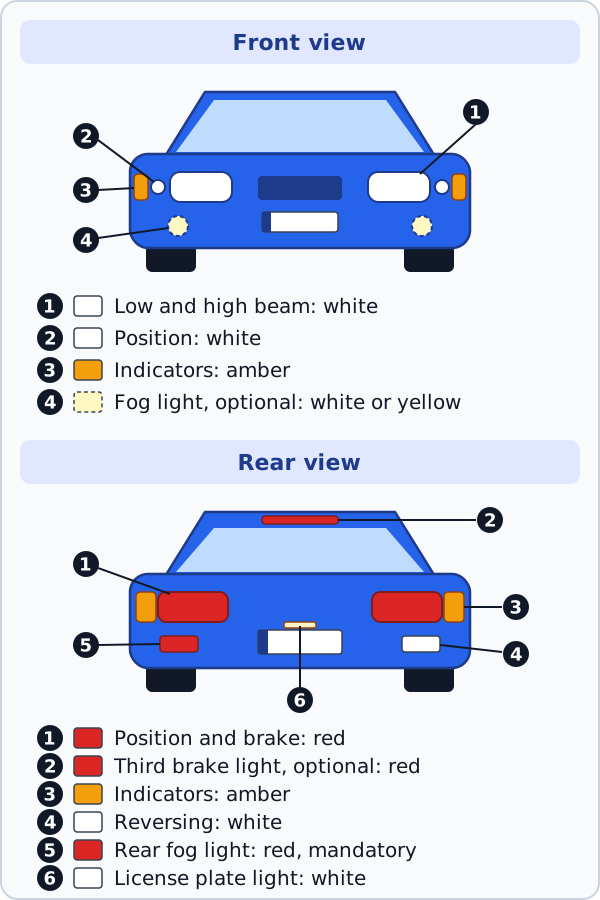
Figure 1. At the front everything is white except the indicators; at the rear everything is red except the indicators, the reversing light and the license plate light.
Other rules on the devices (General Vehicle Regulations):
- Paired lights with the same function have the same color and intensity and are placed symmetrically.
- You must not fit more lights than those authorized, or lights or reflective devices that are not authorized. Additional projectors that reinforce the high beam may only be fitted with authorization and without exceeding the regulatory limit. No light may be flashing or of variable intensity, except those that are so by rule (indicators, hazard lights).
- Lights are switched on together: with the low beam, the high beam or the front fog light, the position lights are always on. The rear fog light may only be switched on if the high beam, the low beam or the front fog light is on.
- Headlight washers are not mandatory as a general rule. They are mandatory, with automatic height adjustment, on gas-discharge (xenon) headlights or on those of more than 2,000 lumens.
Watch out in the exam: the position light does not light the road. It is there so that you are seen, never to drive with it alone. And the fog light that is mandatory to have fitted is the rear one; the front one is optional.
Keeping the lights in good condition
- Dirty headlights: the light scatters and the lighting becomes less effective. Clean them.
- Aim: check the height of the beam periodically, because it goes out of adjustment with knocks, with the load and with time. A beam that is too low shortens what you see; one that is too high dazzles.
- Breakdown on the road: if the lighting fails and you cannot repair it, and you have to continue with a weaker light, reduce your speed until you can stop within the lit area.
2. Which lights you use at night and in tunnels
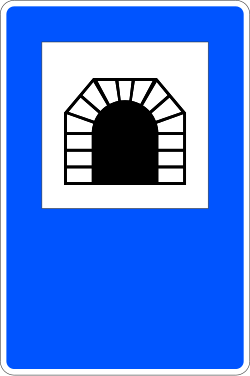
Lighting is mandatory between sunset and sunrise and, at any time of day, in tunnels, underpasses and sections with the tunnel sign (S-5). In all those cases you always use the position lights (and the marker lights if your vehicle is wider than 2.10 meters) and the rear license plate light. What changes is the light that lights the road.
Sufficiently or insufficiently lit road. A road is insufficiently lit when, at any point of its roadway and with normal eyesight, you cannot read a license plate at 10 meters or you cannot distinguish a dark-painted vehicle at 50 meters.
| Where you drive | Which lights you use |
|---|---|
| In a built-up area (urban road or travesía, a road passing through a town), lit or not | Position and low beam |
| Outside a built-up area, sufficiently lit road | Position and low beam |
| Outside a built-up area, insufficiently lit road, at more than 40 km/h | Position and high beam, unless you could dazzle others: then low beam |
| Outside a built-up area, insufficiently lit road, at 40 km/h or less (and without using the high beam) | Position and low beam |
| Tunnel or underpass that is sufficiently lit, at any time | Position and low beam |
| Tunnel that is insufficiently lit outside a built-up area | As on an insufficiently lit road: high beam at more than 40 km/h if you do not dazzle; otherwise, low beam |
The high beam may be used alone or together with the low beam. And if the car has no high beam, you use the low beam. Figure 2 compares how far each light reaches.
In a built-up area the high beam is not used. The Regulations require the low beam in a built-up area even if the street is poorly lit, and in the exam the high beam on urban roads and on roads passing through a town (travesía) is given as prohibited.
When the car is stopped or parked, the high beam is prohibited, on any road.
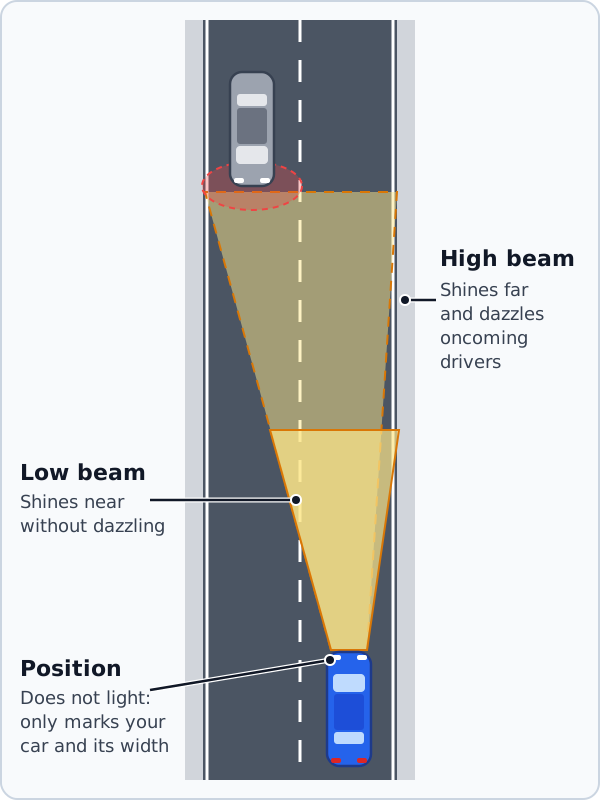
Figure 2. The position light does not light the road; the low beam lights the near area and does not dazzle; the high beam lights far ahead and dazzles whoever is coming the other way. Not to scale.
Watch out in the exam: in a sufficiently lit tunnel you use position and low beam, even during the day, even in a built-up area and even if you can see perfectly. The light in the tunnel does not exempt you.
3. The low beam also during the day
During the day, with good visibility, the passenger car may drive without lights, except in these cases in which you must use at least the low beam:
- In tunnels, underpasses and sections with the S-5 sign, at any time.
- In a reversible lane, a temporary additional lane (the one opened with cones on a two-way road using the shoulders) or a lane opened in contraflow. Also those who drive in the normal lanes next to a lane opened in contraflow. Both by day and by night.
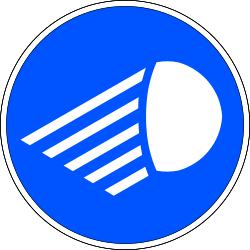
- Where the low beam headlights sign (R-413) indicates it: it requires you to use at least the low beam, whatever the visibility and the lighting, until the end of obligation sign (S-24). After the S-24 you may switch it off, unless you need it because of the time, the visibility or the lighting.
- Motorcycles use the low beam during the day on any road.
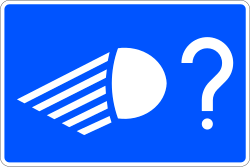
When fog, rain, snow, smoke or dust significantly reduce visibility, you must also use lights during the day: position lights and, to light the road, the low beam, the high beam or the front fog light (section 5). In the exam, dense fog is one of the cases in which the low beam is mandatory at any time.
Many cars have daytime running lights, which switch on by themselves when you start the car. They are there so that you are seen during the day, but they do not replace the low beam: in a tunnel, at night or in fog you must switch on the lighting. If your car does not have them, it is advisable to use the low beam also during the day: you are seen earlier.
4. Glare
To dazzle is to blind another driver for a few seconds. At 90 km/h, in two seconds you travel 50 meters without seeing. That is why the rule is strict: switch from the high beam to the low beam as soon as you could dazzle someone:
- Those coming the other way, even if they do not switch theirs.
- Users of another nearby road (a parallel road, a railway).
- Pedestrians and cyclists on the road.
- Those ahead of you in the same direction, who can be dazzled through the rearview mirror.
When you meet another vehicle, you do not go back to the high beam until you have passed its position (Figure 3).
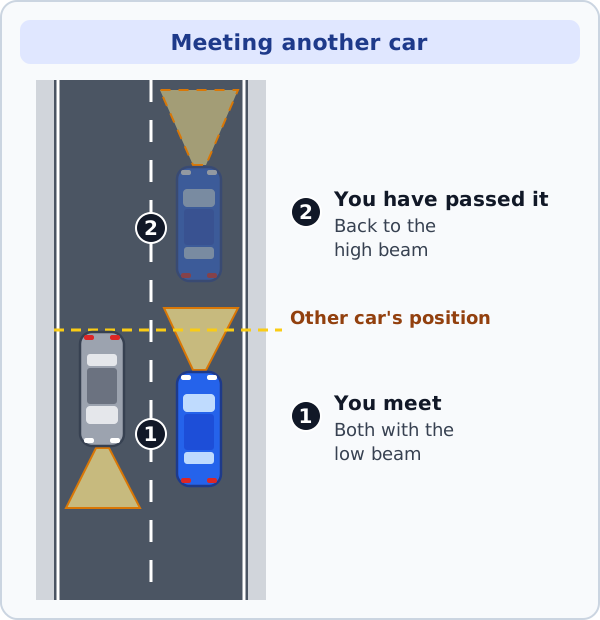
Figure 3. When you meet another vehicle, low beam. You switch back to the high beam once you have passed its position.
When overtaking at night, while you are behind the other vehicle and could dazzle its driver through the mirror, you use the low beam. The driver being overtaken continues with the high beam as long as it does not dazzle the one overtaking.
If you are dazzled, reduce your speed as much as necessary, even to a stop, so as not to run into a vehicle or a pedestrian ahead of you. It is advisable not to look at the headlights, but at the right edge of the roadway, and not to answer with flashes of the headlights.
Watch out in the exam: the light that can dazzle even if it is well aimed is the high beam. The low beam, well aimed, does not dazzle.
5. Fog, rain, snow, smoke or dust
When the weather or the environment significantly reduce visibility (fog, heavy rain, snowfall, clouds of smoke or dust), lighting is mandatory at any time, also during the day. You use the position lights and, to light the road, the front fog light or the low beam or the high beam.
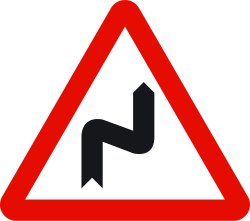
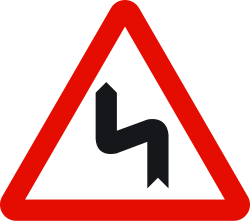
Front fog light. It is optional (if your car has it, you may use it; it is never mandatory). It may be used alone or together with the low beam, and even with the high beam. You may only switch it on in those conditions or on narrow roads with many curves: those with a roadway 6.50 meters wide or less that are signposted with the successive curves sign. With good visibility, even at night, it is not used.
Rear fog light. It is switched on only when conditions are especially unfavorable: dense fog, very heavy rain, heavy snowfall or dense clouds of dust or smoke. In those cases the exam gives it as mandatory. Outside them, do not use it: it is so intense that it dazzles the driver behind and makes it hard for them to distinguish your brake light. With light fog or light snowfall, no rear fog light.
And the high beam? It is allowed in those conditions, but in dense fog or rain the light bounces off the drops and dazzles you: you see less. The low beam is advisable and, if you have it, the front fog light. And if in heavy rain you cannot distinguish a dark vehicle at 50 meters, the road counts as insufficiently lit and you may use the high beam.
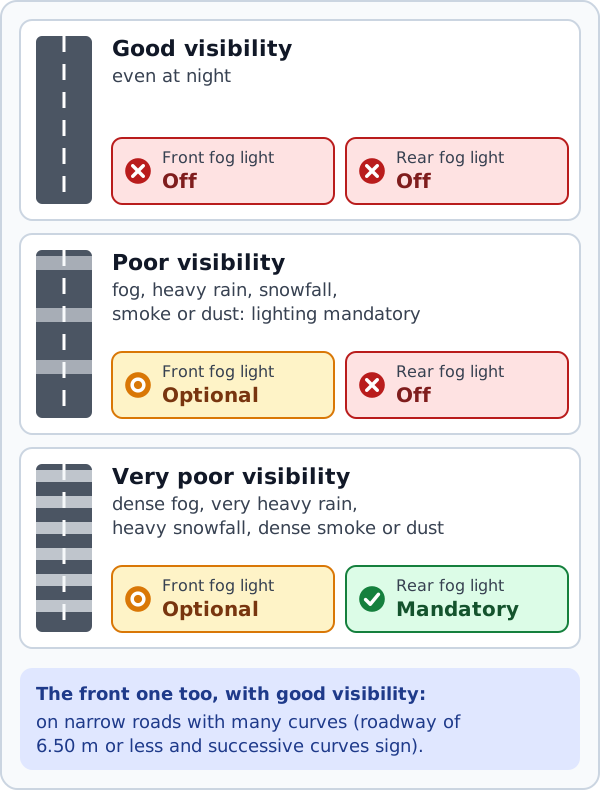
Figure 4. The front fog light is optional and is used when visibility is lacking; the rear one only in dense fog, very heavy rain, heavy snowfall or dense smoke or dust.
Watch out in the exam: in dense fog, "which fog light are you obliged to switch on?": only the rear one. The front one is always optional. And in dense fog on a two-way road, besides the lights, do not overtake: if you cannot see enough, you do not overtake.
6. With the car immobilized, stopped or parked
Immobilized on the roadway or the shoulder (because of a breakdown, an accident or any other cause), between sunset and sunrise or with poor visibility: position lights and, if it has them, marker lights.
Hazard lights. If you are immobilized on a motorway or dual carriageway, or where visibility is poor, switch on the hazard lights (if you have them) and, if necessary, the position lights. In the case of a breakdown or an accident, besides those lights, signal the car with the connected V-16 warning light at the highest point of the vehicle (you have it in the topic on accidents). With that single device you comply: you no longer have to carry two triangles. During the day and with good visibility, on the shoulder, the light you must switch on is the hazard light, if the vehicle has it; the low beam is not necessary.
Stopped or parked at night (Figure 5):
| Where | Which lights |
|---|---|
| Roadway or shoulder of an insufficiently lit travesía | Position. You may replace them with the parking lights or, if you are parked in line, with the two position lights on the roadway side |
| Urban road that is not a travesía, if the lighting lets your car be seen from a sufficient distance | None mandatory |
| Outside a built-up area, on the roadway or the shoulder | Position. The parking light does not replace them: that is only allowed on a travesía |
| Garage or private property | None: it is not a road |
| On any road | Never the high beam |
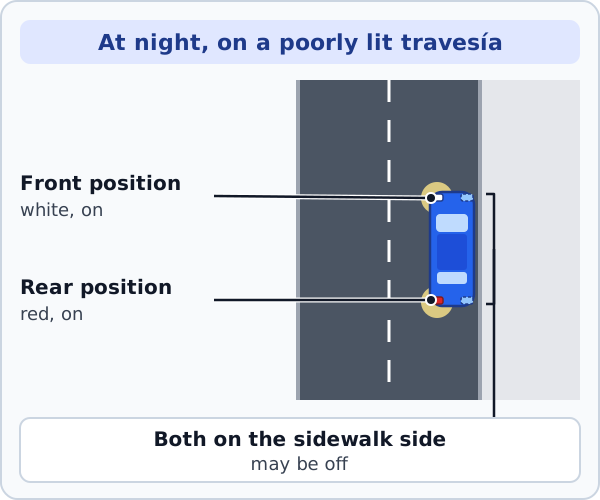
Figure 5. Parked in line on a poorly lit travesía, the two position lights on the roadway side are enough.
In a tunnel. If you are stopped by traffic, do not get out: switch off the engine, leave the position lights on and switch on the hazard lights for a moment to warn those behind. With the car stopped in a tunnel or in an enclosed place, the engine is off; if the wait goes beyond 2 minutes, the Regulations expressly require it, with the position lights on. If you are immobilized because of an emergency: switch off the engine, switch on the hazard lights, leave the position lights on, place and activate the V-16, ask for help from the SOS post and go toward the nearest refuge or exit.
7. Warning with lights and with the arm
Warning of maneuvers is mandatory, and the normal way of doing it is with the vehicle's light signaling or, failing that, with the arm. How they are combined with each maneuver is in the topic on maneuvers; here, what each signal means.
| What you are going to do | With lights | With the arm |
|---|---|---|
| Move or turn left (also to make a U-turn) | Left indicator | Left arm extended horizontally, palm down |
| Move or turn right | Right indicator | Left arm bent upward, palm open |
| Reverse | Reversing light (one or two white lights at the rear) | Left arm extended horizontally, palm to the rear |
| Brake hard or immobilize the vehicle | Brake lights switched on repeatedly (pressing several times) | Arm moved up and down, with short, quick movements |
| Stop or park | Also, the indicator on the side you are moving toward | As when braking |
- Arm signals are valid if others can see them and they are made as the Regulations say. If they contradict the lights, the arm prevails.
- The indicator warns only of the movement: you switch it off as soon as the car has taken its new path.
- Braking hard because of a traffic jam on a motorway is also signaled: with repeated taps of the brake so that the brake lights come on.
Hazard lights. They warn that your vehicle is a temporary danger. They are used:
- When immobilized on a motorway or dual carriageway, with poor visibility, or because of a breakdown or an accident (section 6).
- While driving, when your vehicle cannot reach the minimum speed of the road and there is a danger of being hit from behind (for example, because of a breakdown that forces you to go abnormally slowly).
- If a private vehicle is forced to make an emergency trip (taking a seriously injured person when there is no other means): hazard lights on and the horn sounded intermittently, or waving a handkerchief. Even so, respect the rules, above all at intersections.
They are not a justification for a badly made stop, such as double parking.
Flashes of the headlights. Switching the low beam, the high beam or both alternately on and off, at very short intervals and without dazzling. They serve the same purposes as the horn and to replace it, even in a built-up area: to warn the driver ahead that you are going to overtake or to avoid a possible accident. Using them for anything else is prohibited: you may not flash the headlights to warn that there are traffic officers or a checkpoint ahead.
Watch out in the exam: to warn of an overtaking, flashes of the headlights are valid inside and outside a built-up area; the horn, only outside a built-up area.
8. Warning with the horn
Sound signals are exceptional, with a non-strident sound, and it is prohibited to use them without reason or in an exaggerated way. The device emits a continuous, uniform sound; special tones (sirens) belong only to priority vehicles. A driver who is not driving a priority vehicle may sound the horn only:
- To avoid a possible accident, on any road, and especially on narrow roads with many curves.
- Outside a built-up area, to warn the driver ahead that you are going to overtake.
- To warn of their presence when making an emergency trip without being a priority vehicle, on urban and interurban roads.
The horn is not sounded to say that the traffic light has turned green, to greet or to protest. Drivers communicate with visual warnings (lights and arm) and sound warnings; there are no regulatory "verbal" signals.
9. Lights and signals of other vehicles
| Signal | What it is | What it indicates |
|---|---|---|
| V-1 Priority vehicle | Blue light, visible in all directions at 50 meters | Police, firefighters, civil protection and rescue or medical assistance on an emergency call. With the siren, it has the right of way; it may use only the light if there is no danger without the siren |
| V-2 Vehicle obstructing the road | Amber light (rotating or flashing), visible in all directions from 100 meters | Marks the position of a vehicle that is working on the road or moving slowly. It does not give the right of way |
| V-16 Danger warning light | Amber light at the highest point of the vehicle, connected to the DGT | Vehicle immobilized on the roadway or fallen load |
| V-17 "Free" indicator | Green light at the front, on the right | Free taxi |
| V-18 Taximeter light | Lights the taximeter when the flag is lowered | Only taxis may carry it |
When a priority vehicle warns with light and siren, make way: move to the right or stop if necessary. If a police car positions itself behind you with a flashing or blinking red light facing forward, stop on the right, in front of it, and stay inside.
Who carries the V-2.
- Special vehicles (agricultural tractors, machinery) and special transports, by day and by night, whenever they drive on public roads at 40 km/h or less. If they break down, they use the low beam with the hazard lights.
- Those doing road works, cleaning or maintenance on the road, while they work, if their position could be a danger. On a motorway or dual carriageway, the special road works vehicles carry it from the moment they enter it until the place of work.
- Assistance tow trucks and vehicles towing broken-down or crashed vehicles, when they interrupt or obstruct traffic (only to indicate their position).
Taxis. Besides the "free" indicator, they may carry at the front a lit indicator of multiple fares. Public passenger service vehicles (taxis, buses) and rental vehicles with a driver must have interior lighting of the passenger compartment.
Tractors and other special agricultural vehicles. They have two low beams, as a general rule, and indicators with hazard lights; the high beam is optional and may be of two or four lights. The marker lights go at the highest and widest part, only if the vehicle is wider than 2.10 m. Special vehicles in which arm signals can be made are not obliged to have indicators. Walk-behind tractors (motocultor) that are not authorized to drive at night do not need a low beam. The work light lights the place where the machine is working; it is not a light for driving, and in the exam it is only given as permitted with the machine in operation.
Plates you must recognize (they are not lights, but they appear in this topic):
- V-5 Slow vehicle: red plate at the rear; the vehicle cannot exceed 40 km/h by construction.
- V-6 Long vehicle: yellow plates with a red border at the rear; the vehicle or combination is more than 12 meters long.
- V-7 Spanish nationality: the E on an ellipse, on the license plate or on a separate plate.
- V-10 School transport.
- V-26 Shared use: sticker on the windshield of shared-use vehicles (carsharing).
License plate. At night, in tunnels and with poor visibility, the rear plate must be lit (the front one need not be). It is prohibited to put decorations, signs or advertising on the plates.
Watch out in the exam: the traffic light also appears in this topic. The steady yellow light requires you to stop like the red one, unless you are so close when it comes on that you cannot stop safely. The rest is in the topic on traffic signs.
What has changed in the rules
- 1 January 2026 (Royal Decree 159/2021). An immobilized vehicle is signaled with the connected V-16 warning light, an amber light on the roof that sends its position to the DGT. Triangles are no longer a valid means. If a question asks you to place the triangles, it predates this change.
- The reforms of 1 July 2025 (Catalog of signs) and of 1 October 2026 (vulnerable users) do not change which lights a passenger car has or when it switches them on.
Numbers you need to know
| What | Figure | Nuance |
|---|---|---|
| Insufficiently lit road | License plate at 10 m or dark vehicle at 50 m | If at any point you cannot see it, it is poorly lit |
| High beam mandatory | More than 40 km/h | Outside a built-up area, at night, poorly lit road, and without dazzling |
| Marker light | More than 2.10 m wide | Optional between 1.80 and 2.10 m |
| Side position lights | More than 6 m long | Mandatory |
| Parking light | Up to 6 m long and 2 m wide | Optional; prohibited in the rest |
| Front fog light on curves | Roadway of 6.50 m or less | With the successive curves sign |
| V-1 visible | 50 m | In all directions |
| V-2 visible | 100 m | In all directions |
| V-2 mandatory on special vehicles | 40 km/h or less | By day and by night |
| V-5 | 40 km/h at most | By construction |
| V-6 | More than 12 m | Vehicle or combination |
| Stopped in a tunnel | More than 2 minutes | Engine off, position lights on |
Summary
- White at the front, red at the rear, amber on the sides and in the indicators; the reversing light is white at the rear.
- The position light does not light the road: it always goes with the low beam or the high beam.
- At night, and in tunnels at any time, lighting is mandatory. In a built-up area and on lit roads, position and low beam.
- The high beam is mandatory outside a built-up area, with the road poorly lit and at more than 40 km/h. At 40 km/h or less you may use it if you do not dazzle. Never if you could dazzle or if you are stopped.
- During the day you use the low beam in tunnels, reversible lanes, additional lanes or contraflow lanes, with the R-413 sign and with poor visibility.
- Switch to the low beam as soon as you could dazzle someone, oncoming, ahead or on foot, and switch back to the high beam after passing the one you are meeting.
- Front fog light: optional, in fog, rain, snow, smoke or dust, or on narrow roads with curves. Rear: only in dense fog, very heavy rain or heavy snowfall.
- Immobilized at night: position. On a motorway or with poor visibility, also hazard lights; because of a breakdown or an accident, V-16.
- Parked on a poorly lit travesía: position, parking or the two position lights on the roadway side.
- If the arm contradicts the lights, the arm prevails.
- Flashes of the headlights instead of the horn, also in a built-up area; the horn to overtake, only outside a built-up area. Never flashes to warn of checkpoints.
- V-1 blue (priority vehicle), V-2 amber (obstacle, slow and road works vehicles).
Check your understanding
1. You drive at night on a road without street lights, at 80 km/h, and no one is coming. Which lights do you use? And if you go through a village?
Answer
Position and high beam: outside a built-up area, with the road poorly lit and at more than 40 km/h. When you enter the village (built-up area or travesía) you change to position and low beam: the high beam is not used in a built-up area.
2. It is noon, the sun is shining and you enter a very well-lit tunnel. Do you have to switch on any light?
Answer
Yes: position and low beam. In tunnels lighting is mandatory at any time, even if they are lit.
3. There is light fog. Are you allowed to switch on the rear fog light? And the front one?
Answer
The rear one, no: it is switched on only in dense fog, very heavy rain, heavy snowfall or dense smoke or dust. The front one, yes, if your car has it, alone or with the low beam.
4. You are using the high beam and you see a pedestrian walking on the shoulder toward you. What do you do?
Answer
You switch to the low beam: you must do so as soon as you could dazzle any user, also a pedestrian.
5. You leave the car parked in line, at night, on a poorly lit travesía. Which lights do you leave on?
Answer
The position lights. You may replace them with the parking lights or with the two position lights on the side facing the roadway.
6. Are you allowed to flash the headlights inside a city to warn another driver that you are going to overtake? And to warn of a police checkpoint?
Answer
To warn of the overtaking, yes: flashes of the headlights replace the horn even in a built-up area. To warn of a checkpoint, no: they may only be used for what the Regulations provide.
Frequently asked questions about Lighting and Optical Signaling
Are Headlamp Washers Mandatory on Vehicles?
Actions During an Emergency Stop
Is it mandatory to carry triangles or is the V-16 light enough?
When to Use the Horn?
When is it mandatory to signal a hazard on the road
Signaling an Immobilized Vehicle Due to Breakdown
Use of Hazard Lights at Abnormally Reduced Speed
Repeated Use of Brake Lights
Using Hazard Lights While Moving Due to Breakdown
What Does the Rotating Yellow V-2 Light on Special Vehicles Mean?
Topic test
490 questions available for this topic.