
Speed
In this topic:
- What maximum speed applies to you depending on your vehicle and the road, inside and outside built-up areas, and why you can no longer exceed the limit to overtake.
- When you are considered to be driving too slowly and what to do if you have no choice.
- When you must reduce your speed even if there is no sign, and how much distance you need to stop.
- How to read speed signs and markings, and when they stop applying.
Speed decides how much time you have to react and how hard you hit if you do not make it in time. That is why the General Traffic Regulations set maximum and minimum limits for each vehicle and road, and also require you to drive at a speed you can control at all times. In the exam this is a topic with many questions about numbers: it is advisable to learn them together with their reasons, not as loose facts.
1. Limit, appropriate speed and excess
There are three different ideas, and the exam deliberately mixes them:
| Idea | What it means | Example |
|---|---|---|
| Limit | The cap you must not exceed: the general one for the road or the one shown on a sign. | 90 km/h on a conventional road. |
| Speeding | Driving above the limit. | Driving at 100 km/h where the maximum is 90. |
| Inappropriate speed | Driving too fast for the circumstances, even if you are within the limit. | 90 km/h in dense fog, or even 60 km/h if it is pouring rain and you do not adapt. |
The limit is a cap, not a right. The Regulations (art. 45) require you to respect it and also to take into account your physical and mental condition, the state of the road, the vehicle and the load, the weather and the traffic. The criterion that sums it up: you must be able to stop the vehicle within your field of vision and before any obstacle that appears. That is appropriate speed.
Limits have two purposes: safety and traffic flow. They exempt nobody:
- Nobody is exempt for being a taxi driver or a bus driver. Only priority vehicles (police, fire service, civil protection and rescue, medical assistance) on an emergency call, with the light and the siren on at the same time, may stop complying with them, at their own responsibility and as long as they do not endanger anyone.
- If you have to carry out an emergency service with your car (for example, taking an injured person because there is no other means), you do not become a priority vehicle: you warn others with the hazard lights and by sounding the horn intermittently, and you comply with the traffic rules, including speed (art. 70).
- Novice drivers drive at the same limits as everyone else; they only display the V-13 sign (“L”) during their first year.
- Cyclists may exceed the limit specific to cycles (45 km/h) where the circumstances of the road allow it, for example on a descent.
- Speed competitions on public roads are prohibited, also on motorways and dual carriageways open to traffic, unless the authority closes off the road and authorizes them on an exceptional basis.
Watch out in the exam: if a question asks when someone is driving at “inappropriate speed”, do not rely on the number of the limit. You can drive at 60 km/h on a 90 conventional road and still be going too fast if visibility or grip does not allow it.
2. Limits outside built-up areas
The Regulations (art. 48) divide vehicles into three groups and look at only two types of road: motorway and dual carriageway on one side and conventional road on the other. A road reserved for motor vehicles, for example, has the limits of a conventional road.
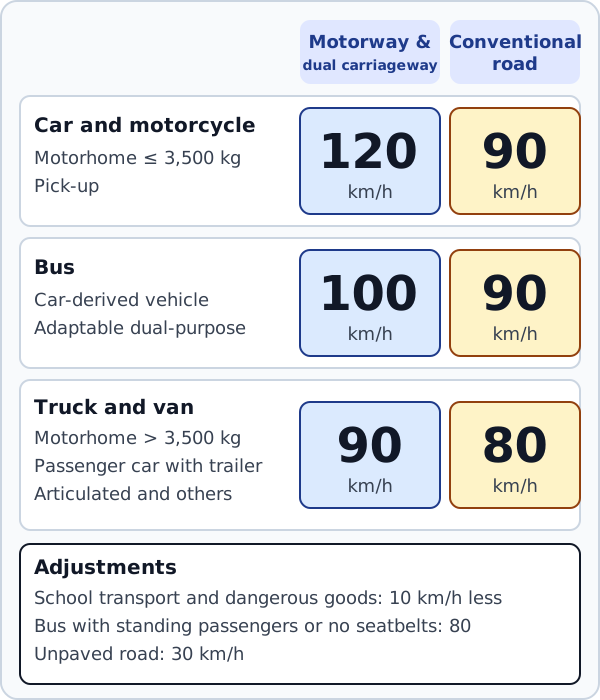
Figure 1. Three groups of vehicles, two types of road. The passenger car with a trailer and the van go with the group of trucks.
What is most often confused:
- Passenger car and motorcycle: 120 km/h on motorways and dual carriageways, 90 km/h on conventional roads. The motorhome up to 3,500 kg and the pick-up (up to 3,500 kg, with seats and a cargo area in separate compartments) go with them.
- Passenger car with a trailer: goes with the trucks, 90 km/h on motorways and dual carriageways and 80 km/h on conventional roads, whether the trailer is light or not.
- Motorhome over 3,500 kg: 90 and 80, like trucks.
- Van: 90 and 80, even if it weighs 3,500 kg or less. It is the opposite of the car-derived vehicle.
- Car-derived vehicle: a motor vehicle intended for services or for carrying goods, which keeps the body of a passenger car and has a single row of seats. It goes with the bus: 100 and 90.
- Adaptable dual-purpose vehicle: one that carries people and goods (up to nine seats including the driver) and can swap the cargo for seats. Also 100 and 90.
- Bus: 100 and 90.
2.1 What does not change the limit
- The shoulder. It makes no difference whether the conventional road has a paved shoulder of 1.50 meters, a narrower one or none: the general limit is the same (90 for the passenger car, 80 for the passenger car with a trailer). The Regulations no longer distinguish by shoulder.
- The number of lanes. A conventional road with more than one lane in some direction is still 90 km/h for a passenger car.
- How long you have held your license. With a license held for six months, on a dual carriageway you drive at 120 like anyone else.
2.2 When the limit is different
- School and minors’ transport, and dangerous goods: 10 km/h less than the limit of their vehicle on that road (art. 48.1.b). A school bus drives at 90 on a motorway and 80 on a conventional road; a nine-seat passenger car doing school transport, at 80 on a conventional road.
- Bus with standing passengers (if authorized) or without seatbelts: 80 km/h on any road outside built-up areas. Since 1 October 2026 it applies on every road; before, only on conventional roads.
- Unpaved road: 30 km/h.
- Conventional road with physical separation between the two directions: the authority responsible for the road may set, with a sign, 100 km/h for passenger cars, motorcycles and motorhomes up to 3,500 kg. Without that sign, the limit is 90.
- Cycles, two- and three-wheeled mopeds and light quadricycles: 45 km/h.
- Three-wheeled vehicles and quadricycles: 70 km/h on any road where they may travel. Three-wheeled vehicles treated as motorcycles follow the motorcycle limits.
- Vehicles with a special permit for tests: they may exceed the limits by 30 km/h, but only on the route set for them and never on urban roads, roads passing through a town (travesías), or where there is a specific speed sign.
- Special vehicles (agricultural and construction machinery):
- 25 km/h if they have no braking signaling, tow a trailer or are walk-behind tractors. A tractor with a trailer outside built-up areas, 25.
- 40 km/h the rest.
- 70 km/h if they can exceed 60 km/h on level ground because of their characteristics and meet the conditions of their regulations.
- Vehicles in special transport: the speed set by their authorization.
Watch out in the exam: “van of 3,500 kg or less on a motorway” is 90, not 120. “Car-derived vehicle on a conventional road” is 90, and on a motorway, 100. And a passenger car with a trailer never goes above 90, not even on a motorway.
3. Overtaking without exceeding the limit
Since 21 March 2022 (Law 18/2021) the exception that allowed exceeding the limit by 20 km/h to overtake on a conventional road no longer exists. Today no vehicle may exceed the maximum speed of the road to overtake, on any road:
- On a conventional road, a passenger car overtakes at 90 km/h at most. A passenger car with a trailer, at 80.
- On a motorway and dual carriageway, at 120 km/h; an adaptable dual-purpose vehicle, at 100.
- In a built-up area and on a travesía, at the urban limit. On a motorway inside a built-up area, at 80.
- You also must not exceed the speed shown on a sign, not even to overtake.
A practical consequence: if the vehicle in front is already driving at the limit of the road, you must not overtake it, because you would have to exceed it.
When you overtake cyclists, mopeds, PMV, pedestrians or animals outside built-up areas, you must also drive at least 20 km/h below the limit of the road before the maneuver and while it lasts, and leave 1.5 meters of separation. On a 90 road, at 70 at most. The same applies when passing an immobilized vehicle in your lane: 1.5 meters and 20 km/h less. The details of these maneuvers are in the topic Maneuvers.
Watch out in the exam: many old questions accepted 110 or 120 km/h to overtake on a conventional road. That was before March 2022. Today the answer is always “no, under no circumstances”.
4. Urban roads and roads passing through a town
Before looking at the numbers, two definitions from the Traffic Law:
- Urban road: a public road located inside a built-up area, except roads passing through a town (travesía).
- Road passing through a town (travesía): a section of road that runs through a built-up area. Urban rules apply, but it is not an urban road.
A built-up area begins where the entrance sign (S-500) is and ends at the exit sign. The S-500 may include the maximum speed of that road from that point on, and it applies to that road: on other streets of the built-up area there may be different limits. The section of road that crosses the built-up area is a travesía (unless there is a bypass you have access to), and its limit is 50 km/h.
4.1 The general urban limit depends on the lanes
Since 11 May 2021 the urban limit is no longer 50 km/h on every street. The Regulations (art. 50) grade it:
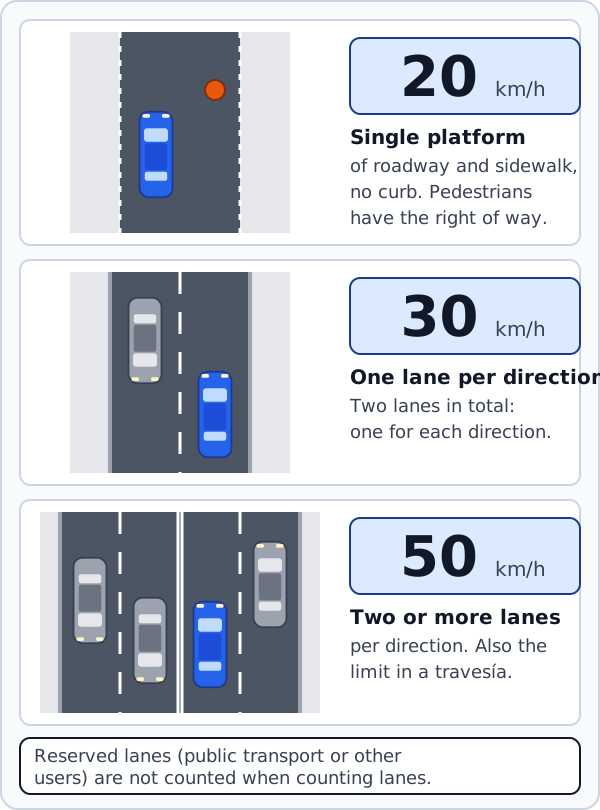
Figure 2. The fewer the lanes and the more the pedestrians, the lower the speed. Lanes reserved for public transport or other users are not counted.
- 20 km/h on roads with a single platform of roadway and sidewalk. The pedestrian has the right of way at any point of the roadway.
- 30 km/h on roads with a single lane in each direction.
- 50 km/h on roads with two or more lanes in each direction.
And the exceptions:
- The city council may lower those limits with specific signs. Exceptionally it may raise a road with a single lane in each direction to 50 km/h, also with a sign.
- Roads passing through a town (travesías): 50 km/h for all types of vehicles. It may be lowered by agreement between the municipal authority and the authority responsible for the road, with a sign; for example, on an especially dangerous travesía.
- Motorways and dual carriageways passing through a built-up area: 80 km/h. The city council and the authority responsible for the road may raise it with a sign, without exceeding the limit that road would have outside built-up areas.
- Dangerous goods: 40 km/h on urban roads with two or more lanes in each direction and on travesías.
- All vehicles: the urban limit is the same for a passenger car as for a passenger car with a trailer (50 on a road with two lanes in each direction).
Zones with their own name. The shared space zone (S-47) is governed by 20 km/h and pedestrians have the right of way throughout the zone. The stay and play zone (S-28) always comes with an R-301 of 10 km/h, and games are permitted in it.
Watch out in the exam: questions from before July 2025 call the S-28 “residential street” and give it 20 km/h. Today that sign is the stay and play zone, at 10 km/h; the 20 km/h belong to the single platform and the shared space zone.
5. Minimum speed
Driving too slowly is also dangerous: it causes sudden braking and rear-end collisions. The Regulations (art. 49) prohibit obstructing the normal movement of another vehicle without justified cause by driving at an abnormally low speed. Speed is considered abnormally low:
- On motorways and dual carriageways: below 60 km/h, for any vehicle, even if no other vehicles are traveling.
- On other roads: below half of the general speed of the vehicle’s category, also even if there are no other vehicles.
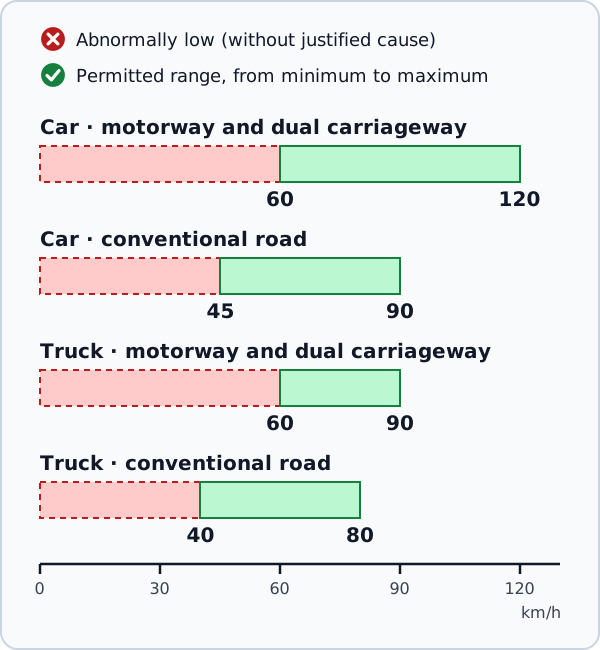
Figure 3. The minimum on motorways and dual carriageways is 60 for everyone. On conventional roads it is half of the general speed of your vehicle.
| Vehicle | Conventional road: maximum | Conventional road: minimum |
|---|---|---|
| Passenger car, motorcycle | 90 | 45 |
| Bus, car-derived vehicle, adaptable dual-purpose vehicle | 90 | 45 |
| Truck, van, passenger car with a trailer | 80 | 40 |
The minimum comes from the general speed, not from the one a sign sets.
5.1 When you may drive below it
You may drive below the minimum in these cases:
- Special vehicles and vehicles in special transport.
- When the circumstances of the traffic, the vehicle or the road make it impossible to keep the minimum without risk: a traffic jam, a breakdown, ice, snow or dense fog.
- When protecting or escorting other vehicles, adapting the speed to that of the escorted vehicle. Escort vehicles display the V-21 or V-22 sign on top.
- Cycles and animal-drawn vehicles (Traffic Law).
If you cannot reach the minimum and there is a danger of being run into, use the hazard lights (art. 49.3). If an emergency forces you to drive at an abnormally low speed on a motorway or dual carriageway, you must leave it by the first exit (art. 38.2); in the meantime, if you seriously obstruct traffic, drive on the shoulder on the right.
5.2 Minimum speed signs and lanes by speed
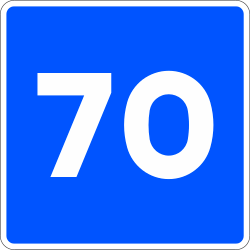
- R-411 “Minimum speed”: requires you to drive at least at the speed on the sign, until another different minimum speed sign, the end of minimum speed sign (R-506) or a maximum speed sign of equal or lower value.
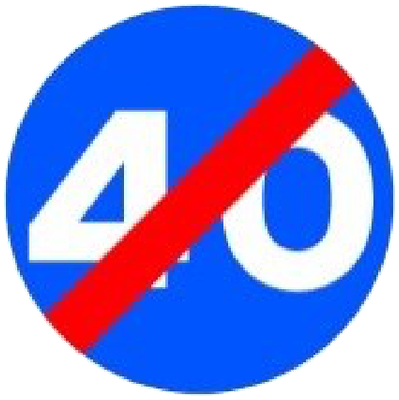
- R-506 “End of minimum speed”: the obligation ceases. The typical question is what “has ended the obligation to drive at least at 70”.
- S-50 “Lanes reserved according to the signed speed”: in the lane where a speed is shown, only vehicles traveling at that speed or more may drive. If circumstances allow, the normal thing is to use the one on the right.
5.3 Temporary additional lane and contraflow lane
There are two cases with their own speed:
- Temporary additional lane (the authority uses the width of the platform and the two shoulders to have two lanes in one direction): on that lane and on the shoulders you drive at 80 km/h at most and 60 at least, or less if the sign says so, with low beam headlights on by day and by night.
- Lane opened for driving in the opposite direction to the usual (with more than one lane in each direction): motorcycles and passenger cars may use it, not passenger cars with a trailer. Speed of 80 at most and 60 at least, low beam headlights on and without entering the lanes of the normal direction, not even to overtake. Those driving in the adjacent lane, if only one is left in their direction, have the same 80 and 60.
Watch out in the exam: if the question is “minimum on a motorway?”, the answer is 60. If it is “minimum on a 90 conventional road?”, it is 45. The 50 comes from half of 100, and 100 is not the general limit of the passenger car on a conventional road.
6. Adapting your speed: when to reduce it
Besides respecting the limit, the Regulations (art. 46) require you to drive at a moderate speed and, if necessary, stop the vehicle when the circumstances require it. These are cases that come up again and again in the exam:
| Situation | What you do |
|---|---|
| Pedestrians on the part of the road you use, or who may burst onto it (especially children, elderly people, blind people or other people with disabilities) | You slow down and, if necessary, stop. |
| Cycles traveling; intersections; the vicinity of cycle paths and of pedestrian crossings not regulated by a traffic light or an officer; markets, schools or places with children | You slow down. |
| Animals on the road or that may enter it | You slow down. |
| Sections with buildings with immediate access to the roadway | You slow down. |
| Approaching a stopped bus, especially a school bus | You slow down: passengers or children may get off. |
| Outside built-up areas: immobilized vehicles on the roadway, assistance vehicles on duty and cycles traveling on the roadway or the shoulder | You slow down. |
| Slippery road surface, or if you may splash or throw up water, gravel or other material | You slow down. |
| Level crossings, movable bridges, roundabouts and intersections where you do not have priority, places of reduced visibility and narrowings | You slow down. |
| Meeting another vehicle if the road, the weather or the vehicles do not allow it to be done safely | You slow down. |
| Glare | You slow down. |
| Dense fog, heavy rain, snowfall, clouds of dust or smoke | You slow down. |
At a properly signed intersection with practically zero visibility, you must not exceed 50 km/h.
Other common-sense rules the exam asks about:
- Curves: slow down before entering, with the car straight, not inside. The speed you bring into the curve decides whether you keep your grip.
- Slowing down suddenly: except in case of imminent danger, you must make sure you can slow down without risk to those behind, warn them beforehand, with repeated flashes of the brake lights or with your arm, and not do it abruptly (art. 53).
- Speed and consumption: the faster you go, the more air resistance has to be overcome, and you use considerably more fuel.
- Speed and signs: the faster you go, the worse you perceive signs, and the less time you have to react.
What happens when you drive fast. The energy of the impact grows greatly with speed: the higher the speed, the more serious the injuries, and being hit at more than 50 km/h in a built-up area can be fatal for a pedestrian. That is why in cities the general limit does not exceed 50 and drops to 30 or 20 where there are more pedestrians. Driving at an inappropriate speed also increases the likelihood of losing control in the face of the unexpected.
Prohibited devices. It is prohibited to install or carry radar jammers and any mechanism to evade checks, and also to carry radar detectors. Devices that warn you where the checks are located are allowed.
7. Safety distance and stopping distance
Safety distance. The driver who follows another must leave a space that allows stopping if the vehicle in front brakes suddenly, taking into account the speed and the grip and braking conditions (art. 54.1). That is why the safety distance increases with speed, and also with rain, snow or ice. Groups of cyclists may travel without keeping that separation, being extremely attentive.
Stopping distance. It is the distance you travel from the moment you see the danger until you stop, and it has two parts (the topic Adherence, Tires and Brakes explains the second):
- Reaction distance: what you travel while you react, with the car at the same speed. It is speed times time: it depends on your speed and your condition (fatigue, alcohol, distractions). If you react in 1 second, at 50 km/h you travel about 14 meters; at 90, 25 meters; at 120, about 33.
- Braking distance: what you travel from when you press the brake. When you double the speed, it is multiplied by about four: from 60 to 120 km/h it does not double, it grows much more.
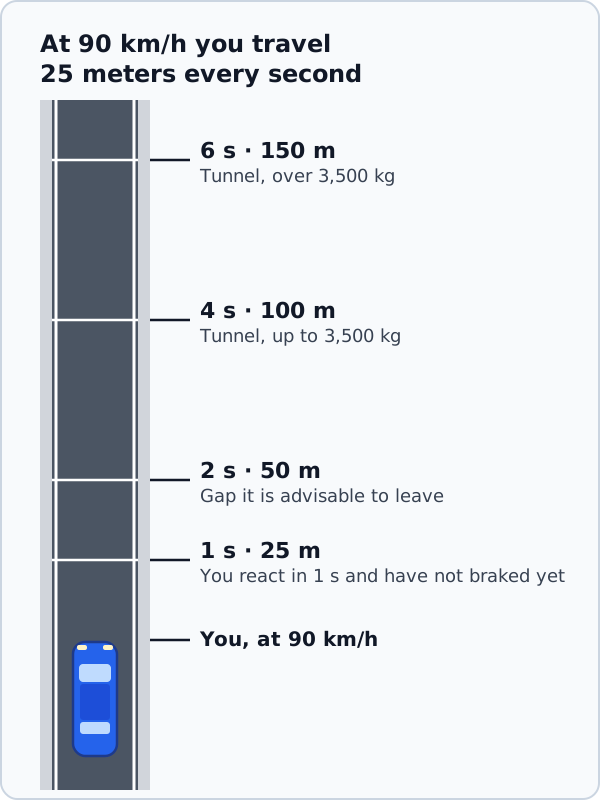
Figure 4. At 90 km/h that is 25 meters per second. It helps you convert seconds to meters: the tunnel requires 100 meters or 4 seconds, and 150 meters or 6 seconds if you exceed 3,500 kg.
How much distance to leave
- DGT rule of thumb: at least 2 seconds from a fixed point on the road; 3 or more in rain, snow or ice. It is advice, not a number set by the Regulations. At 90 km/h, 2 seconds are 50 meters.
- In a tunnel and without intending to overtake: 100 meters or 4 seconds up to 3,500 kg, and 150 meters or 6 seconds above.
- If you are being followed and you do not signal that you are going to overtake (art. 54.2): leave a space that allows the vehicle behind you to overtake safely. Vehicles of more than 3,500 kg and vehicles or combinations of more than 10 meters must leave at least 50 meters; this is not required in built-up areas, where overtaking is prohibited, with more than one lane in your direction or with traffic so congested that it does not allow overtaking.
Watch out in the exam: the reaction distance does not depend on how hard the wheels brake. It depends on your speed and your condition. If the speed goes up, the reaction distance goes up, because in the same time you travel farther.
8. Speed signs and markings


- R-301 “Maximum speed”: prohibits driving at a higher speed than the one indicated, in km/h. It applies even if you want to overtake.
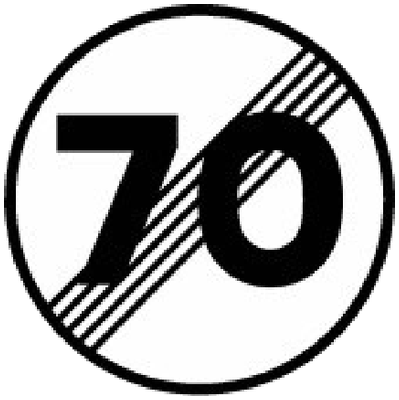
- R-501 “End of speed limit”: cancels a previous R-301.
- R-411 “Minimum speed” and R-506 “End of minimum speed”: see section 5.2.
- S-7 “Recommended maximum speed”: a recommendation, not a prohibition: the speed it is advised not to exceed even if the weather and environmental conditions are favorable. With snow, rain or ice you may (and must) drive more slowly. S-8 marks its end. S-9 is a recommended speed range and S-10 its end.
- S-500 “Entrance to a built-up area”: from there, built-up area rules apply.
- S-53 “Increase from one to two lanes with the maximum speed of each” (and the S-53c, from two to three): each lane has its own maximum.
- S-940 “Speed limits in Spain”: reminds you of the general limits: 30 and 50 in built-up areas, 90 on conventional roads and 120 on motorways and dual carriageways.
- Enforcement signs (S-991): warn that there is speed enforcement (radar, section control or aerial means such as a helicopter or drone). The S-892 indicates surveillance by automatic means. They do not change the limit.
An R-301 that repeats the limit of the road (for example, 120 on a motorway) only reminds you of the prohibition to exceed it.
8.1 How far a maximum speed sign applies
An R-301 is binding from where it is placed until:
- An “End of speed limit” (R-501) sign, an “End of prohibitions” (R-500) sign or another maximum speed sign.
- If it is on the same post or panel as a danger warning sign, until the danger ends: the curve, the intersection, the section with traffic lights. After the intersection that the triangle warns about, you may go faster again (if there is no other sign).
- If it is on a road without priority, it ceases to be valid when you leave an intersection with a priority road.
- An R-301 inside a built-up area applies to that road, not to the whole built-up area.
- A supplementary panel may limit it: for example, an R-301 with the panel that says so applies only on the exit ramp of the motorway. Under a vertical sign, the S-890 (“snow”, “rain” or “fog”) says it applies only when that circumstance occurs.
8.2 Road markings and road works signs
- Speed limit road marking (M-6.6 and M-6.7): indicates the maximum speed painted on the roadway. If it is in a lane bounded by lines, it applies only to vehicles in that lane. It applies until an end of limit sign or another maximum speed sign.
- Dragon’s teeth (M-8.1): warn that you are approaching a road passing through a town or an urban road and that you must reduce your speed noticeably. The checkerboard (M-8.3) and the broken edge lines (M-8.2, before a pedestrian or cyclist crossing) also ask you to slow down and be extremely attentive.
- Road works: a speed limit for road works always applies, whether or not workers are in sight. At road works the signs have a yellow background; temporary signage for other causes is orange.
8.3 What prevails when they contradict each other
The Regulations (art. 52) order that the speeds set prevail over the general speeds:
- With signs.
- For certain drivers because of their personal circumstances.
- For novice drivers (today they have no limits of their own).
- For certain vehicles or combinations because of their characteristics or the nature of their load.
Some of these vehicles carry at the rear the V-4 speed limit sign, with the figure they must not exceed. It is mandatory for certain drivers because of their personal circumstances, for special vehicles and combinations of vehicles (even if only one of them is special) and for vehicles that need a special authorization to travel. The V-5 “slow vehicle” indicates that the vehicle, by construction, does not exceed 40 km/h, and it is optional if the vehicle already carries the V-4.
What has changed in the rules
- 1 October 2026 (Royal Decree 518/2026). Bus with standing passengers or without seatbelts: 80 km/h on any road outside built-up areas (before, only on conventional roads). Overtaking cyclists, mopeds, PMV, pedestrians and animals outside built-up areas, and passing an immobilized vehicle: 20 km/h below the limit and 1.5 meters of separation.
- 1 July 2025 (Royal Decree 465/2025). New Catalog of signs. The S-28 changes from “residential street” (20 km/h) to stay and play zone (10 km/h), with R-301. The S-940 no longer has the 100 km/h row.
- 21 March 2022 (Law 18/2021). You may no longer exceed the limit to overtake (art. 51 of the Regulations, which allowed 20 km/h more on conventional roads, was repealed).
- 11 May 2021 (Royal Decree 970/2020). Urban limit of 20, 30 and 50 km/h depending on the road (before, 50 in general).
- 29 January 2019 (Royal Decree 1514/2018). General limit of 90 km/h on conventional roads (before, 100 on some); with physical separation of directions, the authority responsible for the road may set 100 with a sign.
If a question accepts any of the old rules, it predates these changes.
Numbers you need to know
| What | Number | Nuance |
|---|---|---|
| Passenger car, motorcycle, motorhome ≤ 3,500 kg, pick-up | 120 km/h on motorways and dual carriageways; 90 km/h on conventional roads | Without a sign, that is the limit |
| Passenger car with a trailer, van, truck, motorhome > 3,500 kg | 90 km/h on motorways and dual carriageways; 80 km/h on conventional roads | The van, even if it weighs 3,500 kg or less |
| Bus, car-derived vehicle, adaptable dual-purpose vehicle | 100 km/h on motorways and dual carriageways; 90 km/h on conventional roads | |
| School transport and dangerous goods | 10 km/h less | In built-up areas, dangerous goods: 40 km/h |
| Bus with standing passengers or without seatbelts | 80 km/h | On any road outside built-up areas |
| Unpaved road | 30 km/h | |
| Three-wheeled vehicles and quadricycles | 70 km/h | Mopeds and light quadricycles, 45 km/h |
| Special vehicles | 25, 40 or 70 km/h | Depending on braking, trailer and speed on level ground |
| Urban: single platform | 20 km/h | Pedestrian right of way |
| Urban: one lane in each direction | 30 km/h | The city council may raise it to 50 with a sign |
| Urban: two or more lanes in each direction | 50 km/h | Reserved lanes do not count |
| Road passing through a town (travesía) | 50 km/h | May be lowered by agreement with the authority responsible for the road |
| Motorway or dual carriageway in a built-up area | 80 km/h | May be raised with a sign without exceeding the limit outside built-up areas |
| Minimum on motorways and dual carriageways | 60 km/h | Even if there is no other traffic |
| Minimum on conventional roads | Half of the general speed | Passenger car, 45; truck or passenger car with a trailer, 40 |
| Temporary additional lane or contraflow lane | Maximum 80, minimum 60 | With low beam headlights by day and by night |
| Overtaking cyclists, PMV, mopeds, pedestrians | 20 km/h less than the limit | Outside built-up areas; plus 1.5 meters |
| Exceeding the limit to overtake | Not allowed | Since 21 March 2022 |
| Distance in a tunnel | 100 m or 4 s (up to 3,500 kg); 150 m or 6 s (more) | Without intending to overtake |
| Separation if you drive a vehicle of more than 3,500 kg or more than 10 m | 50 meters | Without intending to overtake. Not in built-up areas, where overtaking is not allowed, with more than one lane in your direction or with congested traffic |
Summary
- The limit is a cap. You must also drive at a speed that lets you stop within your field of vision.
- Passenger car and motorcycle: 120 on motorways and dual carriageways, 90 on conventional roads. With a trailer, van or truck: 90 and 80. Bus, car-derived vehicle and adaptable dual-purpose vehicle: 100 and 90.
- The shoulder and the number of lanes do not change the general limit of a conventional road.
- School transport and dangerous goods: 10 km/h less. Bus with standing passengers or without seatbelts: 80 outside built-up areas.
- In cities, 20 on a single platform, 30 with one lane in each direction and 50 with two or more. Road passing through a town (travesía), 50. Motorway in a built-up area, 80.
- You must not exceed the limit to overtake, on any road. Outside built-up areas, overtaking cyclists, PMV, mopeds and pedestrians also requires 20 km/h less than the limit.
- Minimum: 60 on motorways and dual carriageways; on other roads, half of the general speed of your vehicle (45 for the passenger car on a conventional road). You may drive below it with justified cause.
- If you cannot reach the minimum, hazard lights; if it is an emergency on a motorway or dual carriageway, leave by the first exit.
- Slow down for pedestrians, cycles, children, animals, intersections, stopped buses, level crossings, curves, slippery road surface and lack of visibility.
- The safety distance grows with speed and with poor grip. The reaction distance is speed times time. In a tunnel, 100 m or 4 s (150 m or 6 s above 3,500 kg).
- An R-301 sign applies until its end, until the danger of its panel or its post ends, or until you leave an intersection with a priority road. A road marking applies only to its lane.
- Road works signs and the V-4 prevail over the general limits.
Check your understanding
1. You are driving a passenger car with a light trailer on a dual carriageway. What is the maximum speed, and what is it on a conventional road?
Answer
90 km/h on the dual carriageway and 80 km/h on the conventional road. The passenger car with a trailer goes with the group of trucks.
2. On a conventional road with no other signs, a passenger car traveling at 90 km/h blocks your way. May you overtake it by exceeding 90?
Answer
No. Since March 2022 no vehicle may exceed the limit of the road to overtake. If the vehicle in front is already driving at the limit, you must not overtake it.
3. You enter a street with a single lane in each direction, with no speed sign. How fast may you go? And if it has a single platform of roadway and sidewalk?
Answer
At 30 km/h if it has one lane in each direction, and at 20 km/h if it is a single platform. With two or more lanes in each direction it would be 50.
4. Below what speed are you driving “abnormally low” with a passenger car on a motorway, and on a conventional road? When may you drive below it?
Answer
Below 60 km/h on motorways and dual carriageways, and below 45 km/h on conventional roads (half of 90). You may drive below it if there is justified cause: a traffic jam, a breakdown, ice, snow, dense fog or other circumstances of the traffic, the vehicle or the road.
5. An R-301 of 60 is on the same post as an “intersection with priority” triangle. When are you no longer required to drive at 60?
Answer
When the danger ends that the triangle warns about, that is, when you pass the intersection, as long as there is no other speed sign.
6. How many meters do you travel in one second at 90 km/h, and how much distance do you leave in a tunnel with a passenger car if you are not going to overtake?
Answer
25 meters every second. In the tunnel, 100 meters or 4 seconds, which at 90 km/h come to the same thing.
Frequently asked questions about Speed
Prohibition of Radar Detectors and Jammers in Vehicles
Driving in Rain on Wet Roads
What is the Speed Limit on Urban Roads with Two Lanes?
Benefits of Appropriate Speed and Anticipation while Driving
Minimum Speed for Cars on Conventional Roads
Are Any Drivers Exempt From Speed Limits?
Max Speed Dangerous Goods Urban Area
When to Slow Down
Maximum speed for a van on a motorway
Definition of Driving with Excess Speed
Topic test
502 questions available for this topic.