
The driving license and documents
In this topic:
- What each class of license authorizes, with its ages, and everything you may drive with the B.
- When you need code 96 or the B+E to tow a trailer.
- How long the license lasts, how it is renewed, and what a novice driver is.
- How the points-based license works: balance, loss, recovery, and what happens if you lose all your points.
- Which documents you carry with you, who the holder of the vehicle is, and what the insurance covers.
Driving takes more than knowing how to handle the car. You need a valid license, the vehicle must be registered and insured, and you must be able to prove it when an officer asks. If you do not comply, you are fined and, in some cases, your vehicle is immobilized. In the exam, this topic is asked with very specific figures: masses, years, points, and deadlines.
1. The driving license
The license certifies that you have the knowledge, the skill, and the psychophysical fitness to drive. All the classes you hold are recorded on a single document.
As a driver, you are required to:
- Carry it with you and show it to officers when they ask. It must be valid.
- Respect its conditions. If the license shows codes (glasses, automatic transmission, speed limit...), you comply with them.
- Notify the Provincial Traffic Office of any change of data, including your address, within 15 days.
- Request a duplicate if you lose it, it is stolen, or it gets damaged. If you find the original, you return it to the Office.
A license whose validity has expired does not authorize you to drive. If you use it, officers seize it. If it has expired, you may apply for renewal (section 4).
There is also the driving permit (licencia de conducción), which exists only for special agricultural vehicles and for reduced-mobility vehicles. It is not the same as the license.
Watch out in the exam: the Regulations only allow replacing the original with a certified photocopy for the vehicle documents (section 8). For the driving license, they require you to carry the license itself. One question in the bank accepts a certified photocopy of the driving license: if you see it, it is the answer the exam expects, but it is not the general rule.
2. Classes of license and ages
Each class has its minimum age, in completed years:
| License | Age | What it authorizes (summary) |
|---|---|---|
| AM | 15 | Two- or three-wheeled mopeds and light quadricycles. |
| A1 | 16 | Motorcycles up to 125 cm³, 11 kW, and 0.1 kW/kg; motor tricycles up to 15 kW. |
| A2 | 18 | Motorcycles up to 35 kW and 0.2 kW/kg, not derived from another with more than twice the power. |
| A | 20 | Motorcycles and motor tricycles with no power limit (motor tricycles over 15 kW, from age 21). |
| B | 18 | Automobiles up to 3,500 kg and 9 seats, and more (section 3). |
| B+E | 18 | B-class car with a trailer of up to 3,500 kg. |
| C1, C, D1, D | 18, 21, 21, and 24 | Truck and bus, with lower ages if you hold the CAP. These are other licenses and other syllabi. |
Rules that link some classes to others:
- The A requires the A2 held for at least two years, and specific training. The A2 license includes the A1, and the A1 includes the AM.
- C1, C, D1, and D are only issued to someone who already holds a valid B. Licenses with trailer (B+E, C+E...) require the base license.
- The B does not give you other licenses. You may hold the B and the C at the same time.
3. What the B license authorizes
This is the license you are preparing for. With the B you may drive:
- Automobiles of up to 3,500 kg of maximum authorized mass (MAM) and no more than eight passengers besides the driver, that is, 9 seats counting yours. It does not matter whether it is a passenger car, a van, an ambulance, or a small truck: what counts is the MAM, not the type of vehicle.
- Mopeds with two, three, and four wheels, light quadricycles, and also motor tricycles and motor quadricycles. Until age 21, the B does not authorize motor tricycles of more than 15 kW.
- Vehicles for persons with reduced mobility.
- Trailers, under the rules in the next section.
- A1 motorcycles and alternative-fuel vans, under the conditions in sections 3.2 and 3.3.
- Special agricultural vehicles and other special vehicles, in section 3.4.
Watch out in the exam: the MAM is the maximum weight the vehicle can carry when loaded and authorized, not what it weighs empty (the tare). A vehicle of exactly 3,500 kg is driven with the B. With one more kilo, it is not. If it has 9 seats including the driver's and more than 3,500 kg, the B is not enough.
3.1 Trailers
A light trailer is one of up to 750 kg of MAM. With it there is no condition other than that of the car. What changes with the weight of the trailer is the class of license:
| Trailer | Combination (car + trailer) | License |
|---|---|---|
| Up to 750 kg | Whatever results (car of up to 3,500 kg) | B |
| More than 750 kg | Up to 3,500 kg of MAM | B |
| More than 750 kg | More than 3,500 kg and up to 4,250 kg | B with code 96 |
| Up to 3,500 kg, no limit for the combination | May exceed 4,250 kg | B+E |
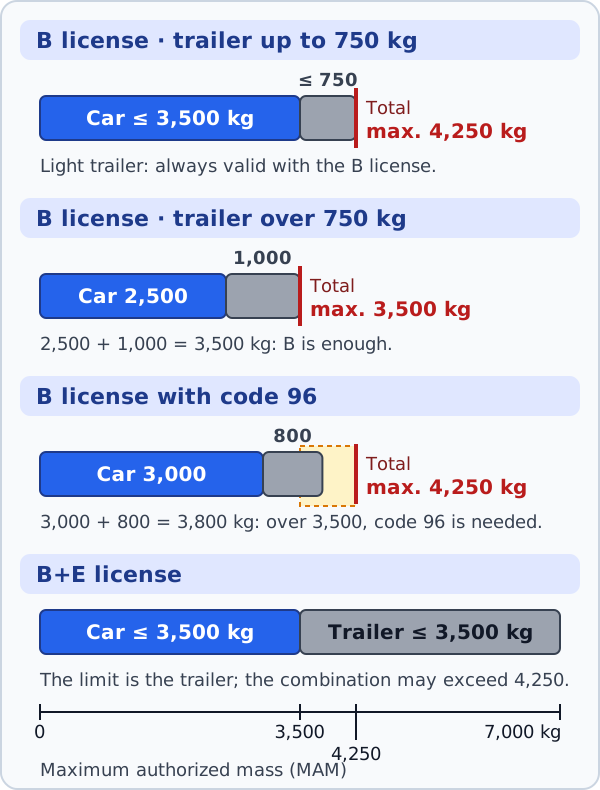
Figure 1. With a trailer of up to 750 kg, the B is enough. With one of more than 750 kg, the MAM of the combination counts: up to 3,500 kg, the B; between 3,500 and 4,250 kg, code 96; and above that, the B+E.
- Code 96. It is an authorization recorded on your B license. To drive a combination of more than 3,500 kg with a trailer of more than 750 kg, you must pass a skills and behavior test on a closed course and on open roads (or the training set by an order of the Ministry of the Interior). The combination must not exceed 4,250 kg.
- B+E. It is a different license. It authorizes a B-class car with a trailer of up to 3,500 kg of MAM. Here the limit is set by the trailer; the combination may exceed 4,250 kg.
- Your car may only tow what its technical characteristics allow: that is what the Regulations say (without prejudice to the type-approval rules).
Watch out in the exam: a question with a combination of a 3,000 kg car and an 800 kg trailer (3,800 kg) asks for code 96 (“supplementary authorization”). Another, about a trailer of more than 750 kg, accepts the answer “only if the combination does not exceed 3,500 kg” without mentioning code 96. An older question adds that the trailer must not weigh more than the empty car: that is an earlier rule that the current Regulations no longer include. If code 96 is not mentioned, the key is that the combination does not exceed 3,500 kg. And if the exam gives you a caravan with a combination of 4,000 kg and the options C1+E, B+E, and C+E, the answer is B+E.
3.2 Motorcycles with the B: the A1 rule
With a B held for more than 3 years you may drive the motorcycles that the A1 authorizes: up to 125 cm³, 11 kW, and 0.1 kW/kg. It is only valid in Spain and only with those of the A1 (also with a sidecar, if the motorcycle meets the limits). It is not a motorcycle license, and the B on its own, without that seniority, does not authorize any motorcycle (mopeds are authorized, as you have seen).
For a motorcycle of more than 125 cm³ you need the A2 (or the A).
3.3 Alternative-fuel vans
With a B held for more than 2 years you may drive, only in Spain and without a trailer, alternative-fuel automobiles for goods of more than 3,500 and up to 4,250 kg of MAM. This is valid when the weight above 3,500 kg comes only from the excess of the propulsion system (for example, the batteries) compared with an identical vehicle with a conventional engine, and provided that it does not increase the load capacity.
3.4 Special vehicles
- Non-agricultural special vehicles (or their combinations) of up to 40 km/h and 3,500 kg: the B is enough. If they exceed either of the two limits, you need the license that corresponds to their MAM.
- Non-agricultural special vehicles that carry people: B if they do not exceed 9 people counting the driver; D1 if they carry 10 to 17; D if they exceed 17.
- Self-propelled special agricultural vehicles and their combinations: you may drive them with the B. If their mass or dimensions do not exceed the limits of ordinary vehicles, the agricultural driving permit is also enough. If they exceed them, or if by construction they go over 45 km/h, the B license is required in all cases.
Watch out in the exam: the B is valid for an agricultural vehicle even if it exceeds the mass or dimensions (a tractor of more than 3,500 kg is driven with the B). The questions also accept class B for an agricultural vehicle with people on board (up to nine seats, the figure the Regulations set for non-agricultural special vehicles).
4. Validity and renewal
The B license (and the A1, A2, A, and AM, and the B+E) lasts 10 years, and 5 years from age 65. The C1, C, D1, D, and the licenses with trailer of those classes last 5 years, and 3 from age 65.
- It can be shorter. If, when you are issued the license or it is renewed, an illness or deficiency is found that does not currently prevent you from driving but may get worse, you are given it for a shorter time.
- Requirements to keep it. Validity depends on you maintaining the requirements under which it was issued, and on you not losing all your points.
- Renewal. You apply for it at the Provincial Traffic Office, and you must prove that you keep your psychophysical fitness: an authorized medical test center assesses it. You may submit it up to three months in advance; the new period counts from the expiry date. If the license has already expired, you may also apply for it.
- Speed limit due to illness. If an illness or physical deficiency makes it advisable, your license may carry a restriction (code 64, “driving with a speed limit of... km/h”). You must display the V-4 sign with that figure at the back.
5. The novice driver
You are a novice driver during the first year from when you obtain your first license. It is not the same as holding a license for less than a year: if you already held another license (national or foreign, civil or military) with effective possession of at least one year, you are not a novice.
- V-13 sign. It is a rectangular green plate with a white L, 15 cm wide and 19.5 cm high (on motorcycles, reduced-mobility vehicles, three-wheeled vehicles, and quadricycles, 10 cm wide and 13 high). It is made of reflective sheeting and is removable: you take it off when the year ends.
- Where. On the rear left of the vehicle, in a visible place. On motorcycles, reduced-mobility vehicles, and three-wheeled vehicles, a visible place at the rear is enough.
- How long. One year. It is suspended while the license has lost its validity, has been seized, or is subject to deprivation of the right to drive. If you obtain another license within that year, you carry it only for the time you have left.
- It does not replace the V-4 speed limit sign: if you must carry both, you carry both.
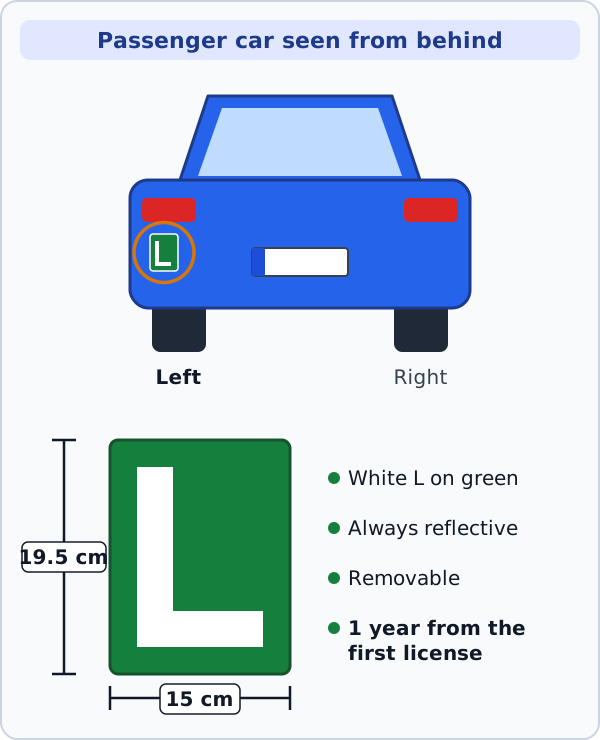
Figure 2. The V-13 goes at the back on the left, is green with a white L, reflective and removable, and is carried for one year from the first license.
In addition to the plate:
- Alcohol. During the first two years from the first license, your maximum level is 0.15 mg/l in exhaled air (0.3 g/l in blood), the same as that of a professional. The general level is 0.25 mg/l (0.5 g/l). For minors, the level is 0.
- Points. You start with 8 (section 6).
Watch out in the exam: do not mix up the deadlines. The L plate, one year. The reduced alcohol levels, two years. To reach 12 points, two years without penalties.
6. The points-based license
Each license is born with a points balance that you lose when you receive a final penalty for certain offenses. The balance is single: you have it even if you hold several classes of license, and the loss or the recovery affects all of them.
6.1 Initial balance
- 12 points as a general rule.
- 8 points if your license has a seniority of no more than 3 years, unless you already held another license with more than 3 years of seniority: then you are not assigned 8 for newly obtaining the B.
- 8 points also if you have used up the balance and obtain the license again.
- Obtaining another class does not reset the balance. Since it is single, obtaining the B after another license does not send you back to 8 or to 12: if you had already moved up to 12 for going two years without final penalties that deduct points, you keep that balance.
- Maximum: 15. The initial 12 points can increase with the bonus and with courses.
Bonus. If you keep all your points, without being given a final penalty for offenses that deduct points, the law gives you two points for the first three years and one for the next three, up to a maximum of 15.
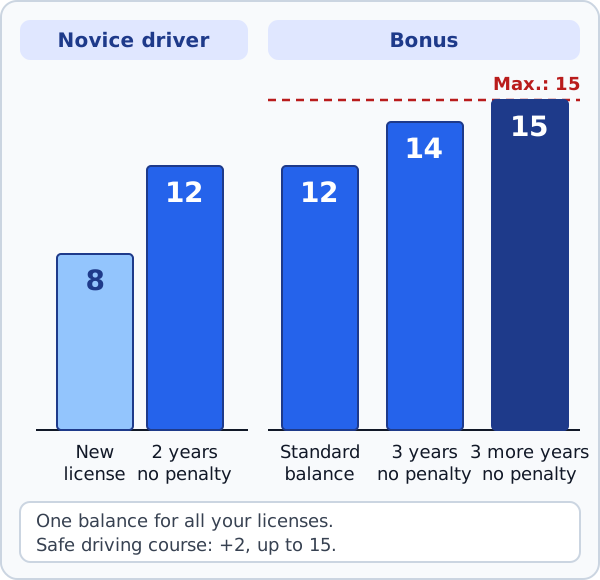
Figure 3. The novice driver starts with 8 and reaches 12 after 2 years without penalties. With a full balance, the bonus raises it up to a maximum of 15.
Watch out in the exam: if a question gives you a driver with a license from three years ago and no offenses, the exam's answer is 12 points.
6.2 When you lose points
You only lose points through a penalty that is final through the administrative channel for a serious or very serious offense that carries the loss of points. Not every offense takes points from you, nor every fine. The resolution tells you how many are deducted, and they are deducted when it is entered in the register.
In addition:
- You only lose points if you commit the offense while driving a vehicle for which a license or permit is required. On a bicycle or an electric scooter you do not lose points.
- As a general rule you cannot lose more than 8 points in a single day. Excluded are very serious offenses for speeding, alcohol or drugs, refusing alcohol and drug tests, reckless driving, driving the wrong way, unauthorized races, radar jammers, or exceeding driving times by more than 50%: in those cases you lose all the points that apply.
Points that some offenses take away:
| Points | Offenses |
|---|---|
| 6 | Alcohol above 0.50 mg/l (novice and professional drivers, more than 0.30). Drugs. Refusing the tests. Reckless driving, driving the wrong way, or races. Radar jammers. Holding the mobile phone in your hand. Throwing onto the road objects that could cause fires or accidents. Overtaking cyclists endangering them or without leaving 1.5 meters. |
| 4 | Alcohol between 0.25 and 0.50 mg/l (novice and professional drivers, between 0.15 and 0.30). Running a stop sign, a yield sign, a red light, or not respecting the right of way. Not keeping a safe distance. Not respecting signs or officers. Overtaking dangerously or with reduced visibility. Not using the seatbelt, the child restraint system, or the helmet. Driving with a license that does not authorize you. Reversing on a motorway or dual carriageway. |
| 3 | Making a U-turn in breach of the rules. Driving with headphones or handling the navigation system. Carrying a radar detector, even if you do not use it. |
Speeding loses points according to the excess over the limit (table in the law); you do not need to memorize it.
Watch out in the exam: “Do you always lose points with an offense?” No, only with certain ones. And keep in mind the numbers that come up most: 6 for the mobile phone, 4 for the safety distance and for the seatbelt, 3 for the radar detector.
Reckless driving is a very serious offense, and negligent driving, a serious offense. Unauthorized races or competitions on the road are prohibited, are very serious, and take away points.
6.3 How you recover points
- By time. If you go 2 years without receiving a final penalty for offenses that deduct points, you recover the initial balance of 12 points. It works even if the loss came from a very serious offense. Those with 8 points move up to 12 with that same period.
- Road safety awareness and re-education course. If you have lost points, the course gives you back 4 points, never more than you have lost, only once every 2 years (professional drivers, once a year). It lasts at least 10 hours (Order INT/914/2024). The Traffic Law sets the ceiling: the course cannot give back more than 6 points or last more than 15 hours.
- Safe and efficient driving course (since Order INT/209/2025). It gives you 2 more points, without going over 15, as long as you have a positive balance. You may take one course of each type every two years. There are two types: for passenger cars and for motorcycles and mopeds. It lasts at least 6 teaching hours of effective training, theoretical and practical.
Note the difference: the awareness course restores lost points, 4. The safe driving course adds 2 additional points up to the cap of 15.
Watch out in the exam: awareness course, 4 points and at least 10 hours; the law allows at most 6 points and 15 hours. Safe driving course, 2 points and at least 6 hours. If you are asked how many points are recovered at most with the course, it is 4: the 6 is the ceiling of the law, not what the course gives back today.
6.4 If you lose all your points
Losing all your points is not enough by itself: the Central Traffic Headquarters declares the loss of validity of the license and notifies you (within 15 days from when it is established). From the moment they notify you, you must not drive.
To drive again:
- Wait 6 months from the notification (3 months if you are a professional driver). If you lose it again within the 3 years after obtaining the new license, the wait is 12 months (6 if you are a professional).
- You take a road safety awareness and re-education course (of at least 20 hours and never more than 30) and then you pass the knowledge control test, that is, the theory test.
- You obtain a license of the same class and with the same seniority as the previous one, with 8 points.
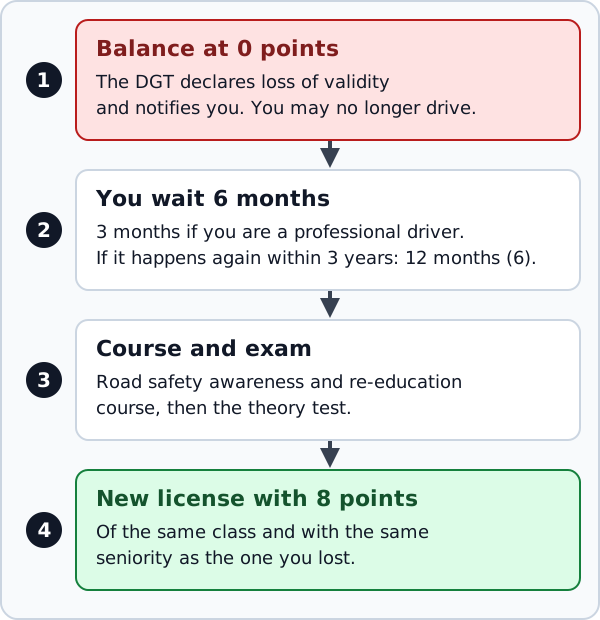
Figure 4. Without points, the license loses its validity. To get it back you wait, take the course, and pass the theory test, and you start again with 8 points.
Professional driver, for these purposes, is someone whose main work activity is driving motor vehicles for the transport of goods or people. It is proven with a certificate from the company and Social Security contributions (the self-employed, with a declaration). This concept is only used in the points-based license.
7. Who the driver is and who is responsible
- Driver is the person who handles the steering mechanism or is in command of the vehicle. In a driving school vehicle during practice, it is the person in command of the additional controls (the instructor), not the student.
- As a general rule, the offender is responsible: the driver. There are exceptions: parents or guardians are jointly liable for the fine of a minor under 18; and the holder is responsible for offenses regarding documentation, periodic inspections, and state of repair of the vehicle when they affect safety.
- If the vehicle is not stopped, responsibility falls on the regular driver, if there is one (unless it is proven that it was someone else or that it was stolen), or on the driver identified by the holder. That is why the holder must identify the driver if asked; not doing so is a very serious offense.
- The holder must also prevent the vehicle from being driven by anyone who has never obtained the corresponding license.
8. The vehicle documents
To drive you must carry with you, and show to officers, these documents:
- The driving license (section 1).
- The vehicle registration certificate. It is the document that certifies the registration of the vehicle and authorizes it to be driven on public roads. It identifies the vehicle and its holder, and it records the date of first registration. On a moped it is the registration certificate (licencia de circulación).
- The roadworthiness test (ITV) card. It records the technical characteristics and the inspections of the vehicle.
- If you tow a trailer of up to 750 kg, the ITV card of the trailer. The car's card must show a coupling system compatible with that of the trailer.
- The insurance documents (section 9).
The vehicle documents must be originals, although they may be replaced by duly certified photocopies.
Watch out in the exam: the Regulations list the vehicle registration certificate and the ITV card (and the ITV of the small trailer). The road tax, the health card, and the permit to transport heavy loads are not documents you must carry to drive normally.
8.1 Registration, holder, and sale
- Registration. You apply for it at the Provincial Traffic Office (the one for your legal address). Trailers of more than 750 kg have their own license plate and vehicle registration certificate; those of up to 750 kg carry the license plate of the towing vehicle. On the blue band of European Union license plates, Spain is E.
- Holder is the person in whose name the vehicle is entered in the register. For the purposes of compulsory insurance, whoever appears in the register is presumed to be the owner. A regular driver is the person reported to the Register as the one who drives it most often, with that person's consent.
- Changes. If your data or your address change, you have 15 days to notify the Traffic Office.
- Sale. The seller must notify the Office within 10 days, with the data of the new holder. If they do not, they remain the holder for traffic purposes. The buyer requests the renewal of the vehicle registration certificate within 30 days, and may not drive the vehicle without it. The vehicle registration certificate is renewed whenever the holder changes.
8.2 Immobilization
Officers may immobilize the vehicle, among other reasons, if:
- it is driven without administrative authorization or breaches its conditions,
- it has deficiencies that are an especially serious risk,
- it exceeds the permitted levels of noise, gases, or smoke,
- it is driven without the compulsory insurance,
- the driver tests positive or refuses the alcohol or drug tests,
- the driver or a passenger does not wear the helmet or the child restraint system when it is mandatory (this does not apply to cyclists),
- there is an occupancy that exceeds the authorized seats by 50%, or an excess of more than 50% in driving times.
The immobilization is lifted as soon as the cause disappears; there is no minimum number of days. The costs are borne by the driver who committed the offense; failing that, by the regular driver or the lessee and, failing them, by the holder. They are paid before the measure is lifted.
Watch out in the exam: one question in the bank accepts the answer “the holder of the vehicle” for the costs of the immobilization. The law puts first the driver who committed the offense.
9. Compulsory insurance
Every owner of a motor vehicle (and mopeds; since 2026, also electric scooters and other personal mobility vehicles) must have valid third-party liability insurance.
- It covers the damage you cause to other people and their property.
- It does not cover injuries to the driver who causes the accident, nor the material damage to your own vehicle or to what you carry in it.
- It is proven: officers check the insured vehicles file. If they cannot, the proof of payment of the premium for the current period is valid, showing the insurer, the license plate, and the coverage. The document that proves it is that receipt, not the policy.
- Who insures. The person obliged is the owner, who is presumed to be the holder entered in the register. If your vehicle is immobilized for not having insurance, the holder is liable.
- Without insurance, the vehicle must not be driven. You are fined (from 601 to 3,005 euros) and the vehicle is placed in the pound or sealed, with costs borne by the owner, until insurance is taken out (as a precaution, one month; three months if you repeat the offense).
Compulsory insurance is the minimum. Extended insurance (comprehensive, for example) covers more, but it is not compulsory.
10. Before starting off: seat, hands, and mirrors
These questions also come up in this topic. More detail in Driver's Physical State.
- Seat and backrest. You reach the pedals and press them fully with your legs slightly bent, without leaning or moving your body forward. You easily reach the top of the steering wheel with your arms slightly bent, never extended or at a right angle.
- Hands. Both, on the upper half of the steering wheel, like the 9 and 3 o'clock positions on a clock (“quarter to three,” says the exam).
- Rear-view mirrors. A passenger car must have, at a minimum, two: the interior one and the left exterior one. The right exterior one is optional. Adjust the interior mirror with the vehicle immobilized, on flat and level ground, never while moving.
What has changed in the rules
- March 2025 (Order INT/209/2025). The safe and efficient driving courses come into operation: they add 2 points to the balance, up to 15, with one course of each type every two years. Before, the way to recover points was the awareness course.
- 4 November 2024 (Order INT/914/2024). The awareness course to recover part of the points lasts at least 10 hours (before, 12) and the one to recover the license, at least 20 (before, 24). It still gives back 4 points, as since 2005 (Order INT/2596/2005).
- 1 July 2025 (Order INT/210/2025). To obtain the A license from the A2, a course is required (at least 9 teaching hours).
- 2 January 2026. Compulsory insurance reaches personal mobility vehicles (Law 5/2025).
- 21 March 2022 (Law 18/2021). Points go up for holding the mobile phone in your hand (6) and for not wearing the seatbelt, helmet, or restraint system (4). The period to recover the 12 points by time becomes 2 years also after a very serious offense.
Numbers you need to know
| What | Figure | Note |
|---|---|---|
| Age for the B | 18 years | AM 15, A1 16, A2 18, A 20 |
| MAM of the B | 3,500 kg | 9 seats including the driver's |
| Light trailer | Up to 750 kg | Goes with the B |
| Combination with a trailer of more than 750 kg | Up to 3,500 kg with B; from 3,500 to 4,250 kg with code 96 | More, with the B+E |
| B+E | Trailer of up to 3,500 kg | The combination has no limit of its own |
| Motorcycles with the B | Those of the A1, with more than 3 years of B | Only in Spain |
| Alternative-fuel vans | Up to 4,250 kg with more than 2 years of B | Only in Spain and without a trailer |
| Validity of the B | 10 years, 5 from age 65 | Renewal, up to 3 months before |
| Novice driver | V-13 plate one year; alcohol 0.15 mg/l two years | The plate goes at the back on the left |
| V-13 | 15 × 19.5 cm | Reflective and removable |
| Points balance | 12 (8 for novice drivers); maximum 15 | You recover 12 with 2 years without a penalty |
| Points | Mobile phone 6; safety distance 4; seatbelt 4; radar detector 3 | Maximum 8 per day, with exceptions |
| Courses | Awareness: 4 points, minimum 10 hours (the law: up to 6 and 15 hours); safe driving: 2 points, minimum 6 hours | Once every 2 years |
| Loss of validity | Wait 6 months (3 professional); second time, 12 (6) | New license with 8 points |
| Change of data or address | 15 days | Driving license and vehicle |
| Sale of the vehicle | Notice within 10 days; the buyer renews within 30 | The vehicle registration certificate is renewed when the holder changes |
Summary
- The driving license certifies your skills, is on a single document, and you must carry it with you and keep it valid.
- The B authorizes automobiles of up to 3,500 kg of MAM and 9 seats, as well as mopeds, quadricycles, and motor tricycles.
- With a trailer of more than 750 kg, the B is valid up to 3,500 kg for the combination; up to 4,250 kg you need code 96; beyond that, the B+E.
- With more than 3 years of B you drive the A1 motorcycles in Spain, and with more than 2 years, alternative-fuel vans up to 4,250 kg.
- The B license lasts 10 years (5 from age 65). Renewal is requested at the Provincial Traffic Office, with psychophysical fitness.
- You are a novice for one year from your first license: V-13 plate at the back on the left. Alcohol drops to 0.15 mg/l for two years.
- The points balance is single: 12 (8 for novice drivers), up to 15 with the bonus and the courses.
- You lose points with a final penalty for certain offenses, at most 8 per day except for very serious ones.
- You recover the 12 points with 2 years without a penalty, or with courses: 4 (awareness) or 2 (safe driving).
- Without points, the license loses its validity: you wait 6 months, take the course, pass the theory test, and get the license back with 8 points.
- The holder is the person entered in the register. You sell within 10 days, you change your data within 15.
- Compulsory insurance covers third parties, not the driver who causes the accident or your vehicle.
Check your understanding
1. You hold the B license, a car of 2,700 kg of MAM, and a trailer of 1,000 kg. Are you allowed to drive that combination?
Answer
The combination weighs 3,700 kg, more than 3,500 and less than 4,250. With the B, you may only do so if you have code 96.
2. You obtained your first license 10 months ago. Which plate do you carry, where, and for how long?
Answer
The V-13 (white L on a green background, reflective), on the rear left of the vehicle, in a visible place. You carry it for one year from your first license.
3. You lost 4 points two years ago and have not been penalized since. How many points do you have?
Answer
You have 12. After 2 years without penalties that deduct points, you recover the initial balance.
4. You have lost 5 points. How many can you recover with a road safety awareness and re-education course, and how often?
Answer
4 points, once every 2 years: the course gives back 4, even though you lost 5. If you were a professional driver, once a year.
5. Your balance reaches 0 points. How do you get the license back and with how many points?
Answer
The DGT declares the loss of validity. You wait 6 months from the notification, take the road safety awareness and re-education course, and pass the theory test. You get back a license of the same class and seniority, with 8 points.
6. You sell your car today. What must you do and within what period? And if you move?
Answer
Notify the sale to the Provincial Traffic Office within 10 days, with the data of the new holder. If you change your address, you notify it within 15 days.