
Car maintenance
In this topic:
- When a passenger car takes the roadworthiness test (ITV), what each result means and what you may do with the car in each case.
- What the rules prohibit regarding the exhaust, noise and fumes.
- What each system of the car does (engine, oil, cooling, electrical, transmission, steering, suspension and brakes) and what warns you that something is failing.
- What each dashboard warning lamp tells you according to its color.
- What your car must carry and what you check before a trip.
A poorly maintained car does not just break down: it brakes worse, grips worse in curves and pollutes more. Most mechanical failures that end in an accident can be avoided with good maintenance. In the exam, this topic mixes two things that are best kept apart: what the rules require (the ITV, the exhaust, the mandatory equipment) and what technical practice advises (when to change the oil, how to look after the battery).
1. What the law requires and what the manufacturer advises
| It is a rule (mandatory) | It is technical advice (advisable) |
|---|---|
| Take the ITV within the deadlines | Change the oil, filters and timing belt when the manufacturer indicates |
| Exhaust with an effective silencer; no resonator pipes | Check the fluid levels often |
| Do not exceed the limits for noise, gases and fumes | Grease the battery terminals |
| Do not drive with an unauthorized major modification | Replace the wiper blades when they deteriorate |
| Refuel with the engine off and the electrical devices switched off | Check the pressure of the spare wheel before a trip |
| Carry the mandatory equipment: V-16, vest and spare wheel or alternative system | Carry a set of spare bulbs |
The intervals for changes (how often the oil, the filters, the timing belt or the brake fluid are changed) are set by the manufacturer in the maintenance booklet. The law gives no figure, and this topic does not invent one. When a figure appears here, it is because the exam gives it as a guideline, and your car's manual always prevails.
Watch out in the exam: to ensure good maintenance, the answer is to follow the manufacturer's recommendations and take the ITV. And yes: with proper maintenance you reduce the probability of having an accident because of the condition of the vehicle.
2. The ITV
2.1 What it is and who takes it
The roadworthiness test (ITV) checks, at an authorized station, that your car is still safe and that it does not pollute or make more noise than it should. It is regulated by Royal Decree 920/2017. To be driven on public roads, the car must have passed the inspection within the deadlines set by that rule.
The obligation to present the car lies with the holder (or the long-term lessee), not with the regular driver or the insurer. Before it can be inspected, you must prove that it has the compulsory insurance.
The ITV checks, among other things: brakes, steering, visibility, lighting and electrical system, axles, wheels, tires and suspension, chassis and bodywork, seatbelts, horn, speedometer and emissions (gases, noise and electromagnetic interference). A comfort item, such as heated seats, is not checked.
2.2 How often a passenger car takes it
The frequency depends on the type of vehicle and its age. The age is counted from the first registration, not from when you bought the car. For a passenger car for private use:
| Age | Frequency |
|---|---|
| Up to 4 years | Exempt: no ITV |
| More than 4 years | Every 2 years (biennial) |
| More than 10 years | Every year (annual) |
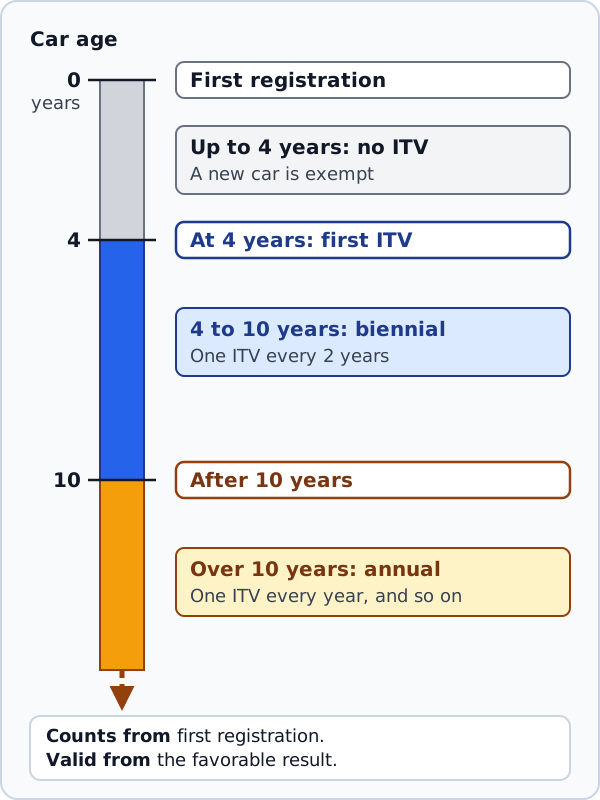
Figure 1. A passenger car's first ITV comes 4 years after registration; after that, every 2 years, and over 10 years, every year.
So a new passenger car for private use takes its first ITV 4 years after registration and, if the result is favorable, the next one is 2 years later. At 6 years old, it takes it every two years; at 11, every year.
When the validity starts to count. The period is counted from the date on which the result is favorable. If you take the ITV within the 30 calendar days before the expiry date, the new validity is counted from the date on which the previous one expired: you do not lose time by going early. You may choose any ITV station you like, including to repeat the inspection after repairs.
Other vehicles you may be asked about:
| Vehicle | Frequency |
|---|---|
| Van or light goods truck (up to 3.5 t MAM) | Up to 2 years, exempt. From 2 to 6 years, every 2. From 6 to 10, every year. Over 10, every 6 months (semiannual) |
| Dual-purpose vehicle | The same as for goods vehicles. A dual-purpose vehicle of 2,000 kg MAM that is 7 years old takes it every year |
| Taxi, ambulance and school transport or transport of minors (passenger cars) | Up to 5 years, every year. Over 5, every 6 months |
| Driving school passenger car | Up to 2 years, exempt. From 2 to 5, every year. Over 5, every 6 months |
The frequency for trucks, buses and trailers is covered in the topics for those licenses.
Watch out in the exam: the deadlines look alike and get confused. The passenger car starts its ITV at 4 years; the goods van, at 2. And to know when it is due, look at the date of first registration, which appears on the vehicle registration certificate. The roadworthiness test (ITV) card is also the document where you can check the inspections the car has already passed.
2.3 The three results
Every defect the ITV finds is rated according to its seriousness:
- Minor: it does not significantly affect safety or the environment.
- Serious: it reduces the safety of the vehicle, puts other users at risk or can damage the environment.
- Very serious: it is a direct and immediate risk to road safety, or it has an impact on the environment.
The worst defect decides the result:
| Result | When it applies | What you may do |
|---|---|---|
| Favorable | No defects or only minor ones | Drive normally. Minor defects are repaired within a maximum of 2 months and do not require a new inspection |
| Unfavorable | Some serious defect | Drive only to take the car to the workshop and return to the ITV, within a maximum of 2 months from the first unfavorable inspection |
| Failed | Some very serious defect | You must not drive the car. The car goes to the workshop by means other than its own (for example, on a tow truck). You have 2 months from the first failed inspection to repair it and come back |
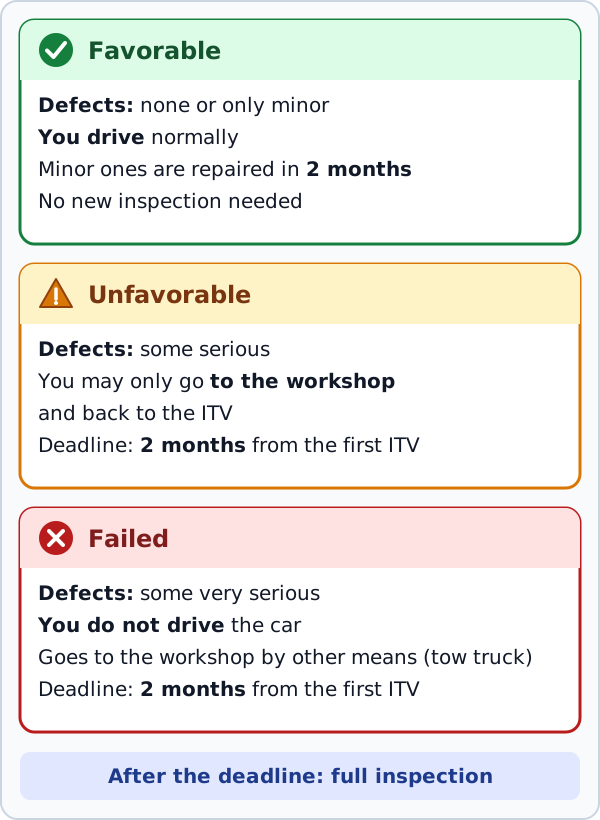
Figure 2. Favorable: you keep driving. Unfavorable: only to the workshop and back to the ITV. Failed: not even that, the car does not move under its own power.
When you return, the defective items are inspected; if others appear, they also count toward the result. If you show up after the deadline, the inspection is a full one again. Every car that must not be driven because of the ITV result is recorded in the Vehicle Register.
2.4 The sticker, the card and the register
- V-19 sticker. It is the sticker you are given at the station when you pass the ITV and it is proof of the inspection. It shows that you have passed and the date of the next one. If the car has a windshield, it goes in the upper right corner, on the inside; if it does not, in a clearly visible place. Its color and figures depend on the year in which the inspection expires. It is not valid to stick it anywhere on the glass.
- ITV card. It records the car's technical specifications, modifications and the result of inspections. It is the document that proves that the vehicle meets the technical conditions to be driven, and you must carry it.
- DGT Vehicle Register. The station reports the result the same day. Law enforcement officers check in it that your ITV is valid; if they cannot, they look at the inspection report or the ITV card.
2.5 Without an ITV, with an expired ITV or with a modification
Driving with an expired ITV is a serious offense, with a fine of 200 euros. Officers give you a period of 10 days to take it; if you do not prove that you have presented the car, the Provincial Traffic Office starts its ex officio deregistration.
In the exam questions, besides fining you, the officer can seize the vehicle registration certificate and can immobilize the vehicle, especially if it is being driven with a failed result.
A major modification is a change that alters the car's technical specifications (power, steering, brakes, bodywork...). You must not drive with an unauthorized major modification: it must be approved, pass a technical inspection and be recorded on the ITV card. A modification that improves performance does not make it legal, and neither does passing the ordinary ITV.
An inspection can be required before the deadline expires in these cases: after an accident with significant damage to the steering, suspension, transmission, brakes or structure; after a modification or a change to safety or environmental components; if an authority has well-founded suspicion that the car is dangerous; and if its use or service changes and a stricter frequency applies to it.
3. Exhaust, noise and fumes: what the rules prohibit
Article 7 of the General Traffic Regulations prohibits driving a vehicle that:
- Exceeds the noise limits or emits gases or fumes above the limits. Noise counts even if no polluting gases come out.
- Emits electromagnetic disturbances (electrical systems, such as the ignition and the lighting, can produce them if they are not in good condition).
- Has undergone an unauthorized major modification.
In addition, on urban and interurban roads the open exhaust is prohibited. Every motor vehicle carries an effective exhaust silencer, which reduces the noise of the engine's explosions. You must not drive with a silencer that is incomplete, unsuitable or deteriorated, or with resonator pipes (even to give a sportier feel). If the exhaust pipe breaks, the first thing you notice is that the car makes more noise.
Internal combustion engines must also carry a device that prevents unburned fuel from falling to the ground, and they must not emit fumes that hinder the vision of other drivers or that are harmful.
Officers can immobilize a vehicle that exceeds the permitted levels of gases, fumes or noise. The immobilization is lifted when a workshop certifies that it no longer exceeds them.
Watch out in the exam: “open exhaust”, a broken silencer and resonator pipes always have the same answer: it is prohibited, on any type of road.
4. Under the hood: engine and systems
The fundamental systems of an automobile are the engine and its circuits (lubrication, cooling, fuel supply and exhaust, electrical), the transmission, the steering, the suspension and the brakes. “Electromagnetic equipment” is not one of them.
Figure 3 shows what the driver looks at most often. The oil and coolant levels are checked with the engine cold and the car on level ground.
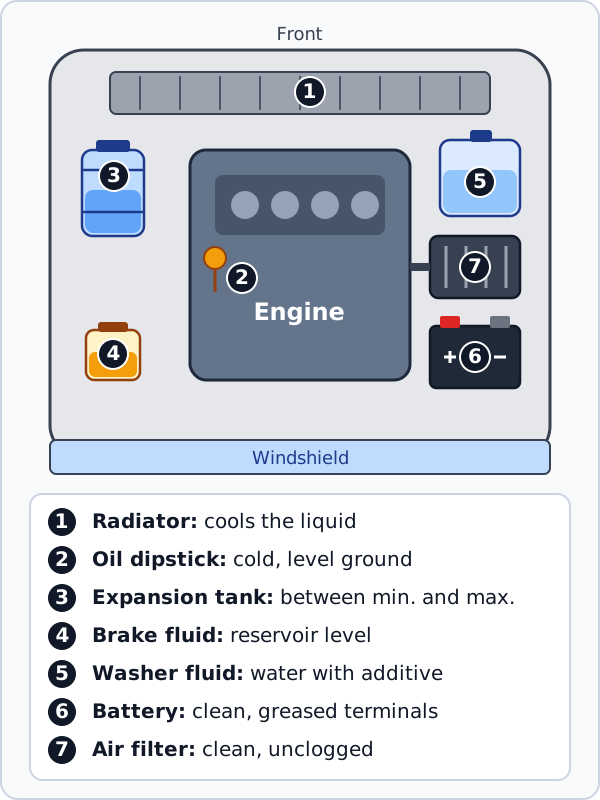
Figure 3. What you check under the hood: oil, coolant, brake and washer fluid levels, the battery and the air filter.
4.1 The engine
The engine generates the force that moves the car. The two types you are asked about:
| Engine | Fuel | How the mixture is ignited |
|---|---|---|
| Explosion | Gasoline | A spark that jumps at the spark plug. It is produced by the ignition circuit |
| Combustion | Diesel | The air is compressed and heated so much that the diesel ignites by itself, without a spark plug |
Warming up the engine. Do not rev it hard to warm it up: you use more fuel and you can damage the cylinders, whose walls still have little oil.
4.2 Lubrication: the oil
The oil forms a film between the metal parts that rub together, prevents them from seizing and reduces wear and overheating. It is kept in the sump, a pump sends it under pressure and a filter cleans it.
- Level: check the dipstick with the engine cold and the car in a horizontal position. The mark must fall between the minimum and the maximum.
- Change: besides watching the level, you must change all the oil periodically, because it loses its properties, and also the filter, which gets clogged with use. How often is set by the manufacturer.
- Red oil warning lamp: it warns of a lack of oil pressure. It is a serious warning (see section 8).
4.3 Cooling
It keeps the engine at its working temperature. It can be air-cooled (the engine has fins that dissipate the heat) or liquid-cooled, which is the usual system in current passenger cars.
In liquid cooling:
- The radiator is where the liquid is cooled.
- The hoses are the pipes that carry the liquid from the engine to the radiator.
- The water pump makes it circulate and is driven by a belt: before a trip, check its condition and tension.
- The thermostat regulates the temperature of the liquid and the fan moves air through the radiator when needed.
- The expansion tank lets you see the level: it must be between the minimum and maximum marks.
- The liquid is a mixture of water and antifreeze. You must take into account its freezing point according to the climate of the area you are going to drive through.
Technical tip: do not open the cap with the engine hot. The liquid is under pressure and can burn you.
The timing belt synchronizes the internal movements of the engine. If it breaks, the engine stops and can suffer serious damage. When it is changed is set by the manufacturer (by time or by kilometers): it is a typical case of technical advice with no figure in the law.
4.4 Fuel supply and exhaust
Air filter. It cleans the air that mixes with the fuel. If it is dirty, less air gets in, the mixture becomes too rich and the car uses more fuel, gives off more smoke and jerks at high revs. It is in the intake, where the air enters (in older engines, above the carburetor).
Injection. The injectors spray the fuel. In indirect injection, they are in the intake manifold. Cold starting is now automatic: the electronic control unit manages it.
Care that saves fuel and pollutes less:
- A too-high idle increases consumption, because the engine turns faster than necessary.
- Avoid hard revving and sudden starts at high revs: this produces less carbon monoxide.
- Use the fuel the manufacturer asks for. Refueling with gasoline of a lower octane rating than the one indicated in order to save money damages the engine.
The exhaust, from the inside out:
- The exhaust manifold collects the gases from each cylinder.
- The lambda sensor measures the oxygen in the gases, before the catalytic converter, so that the electronic control unit adjusts the mixture.
- The catalytic converter reduces the polluting gases through chemical reactions. It needs heat: it starts working well at about 250 degrees, which is why very short trips pollute more.
- The silencer reduces the noise.
In diesel engines, the particulate filter traps the particles in the smoke and from time to time burns them to clean itself. If its warning lamp comes on, consult the car's manual.
The exhaust smoke tells you about the condition of the engine:
| Smoke | What it indicates |
|---|---|
| Clear | Correct combustion |
| White | With a cold engine, water vapor: it is normal and goes away as the engine warms up. Dense and persistent with a hot engine: coolant could be getting into the cylinders |
| Black | Poor combustion, from too much fuel or too little air (for example, a dirty filter). Have it checked |
| Bluish | The engine is burning oil |
A vehicle that emits more smoke than permitted must not be driven.
4.5 The filters
| Filter | What it does | What you should know |
|---|---|---|
| Oil | Cleans the engine oil | It gets clogged with use: it is changed at the same time as the oil |
| Air | Cleans the air going to the engine | When dirty, it increases consumption and causes jerking |
| Cabin (pollen) | Cleans the air you breathe inside | It is replaced, especially at the start of spring: its filtering capacity is limited |
4.6 Electrical system
The battery stores the energy. In a conventional passenger car it supplies 12 volts. The alternator is the generator: with the engine running it charges the battery (it is the charging circuit, which prevents it from running down). The starter motor is what turns the combustion engine to start it; the exam gives about 70 revolutions per minute.
Battery care:
- Keep the terminals clean, on any type of battery. If they are sulfated (with a whitish layer), clean them with distilled water, not with mineral water or alcohol.
- Grease the connections before a trip: the grease protects them from moisture.
- If the battery requires maintenance, watch the electrolyte level and, if it is low, add only distilled water. Sulfuric acid does not evaporate, so it does not need to be topped up.
Each electrical function has its own circuit:
| Circuit | What it is for |
|---|---|
| Charging | Keeps the battery charged (alternator) |
| Starting | Activates the starter motor when you turn the ignition key |
| Ignition | In a gasoline engine, generates the spark at the spark plugs at the right moment |
| Lighting | Carries the energy from the battery to the lights and other accessories |
If the battery warning lamp comes on with the engine running, the battery is not being charged. The fuses protect each circuit: if one blows, it is advisable to replace it with another of the same amperage, never with a higher one.
The lights are part of maintenance. Check periodically that they all work. Carrying a set of spare bulbs is not mandatory.
5. Transmission: from the engine to the wheels
The transmission carries the engine's force to the drive wheels. There is no fixed rule about which they are: they can be the front ones, the rear ones or all four, depending on the car. The steered wheels, the ones that turn the car, are as a general rule the front ones.
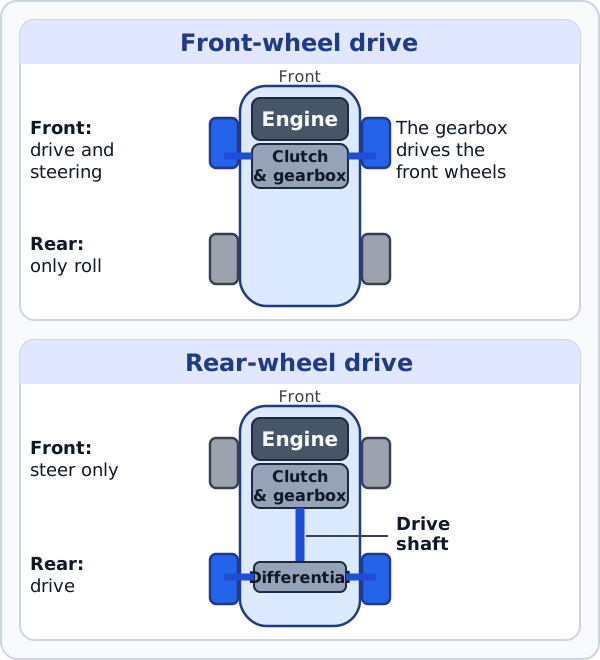
Figure 4. The force goes from the engine to the clutch, the gearbox and the drive wheels (in blue). The path changes depending on the car, not the order of the parts.
- Clutch. It connects and disconnects the engine from the gearbox. It transmits the engine's rotation to the rest of the transmission while it is engaged. Before selecting a gear, you must depress it fully to disengage the engine. Two disc-shaped elements interact: one attached to the engine (the flywheel) and another attached to the gearbox (the clutch disc). The friction point is the moment in the pedal's travel at which the engine starts to transmit force to the wheels. The discs wear out with use.
- Gearbox. It chooses how much force or how much speed reaches the wheels. The low gears (1st, 2nd) give a lot of force and little speed; the high gears (5th, 6th), little force and a lot of speed. With a gear engaged, the gearbox passes the movement to the driveshaft.
- Wheels. They are fixed to the hub with bolts or nuts.
The clutch, the brake and the accelerator are operated with the foot; the gear lever, with the hand.
6. Steering, suspension, brakes and wheels
6.1 Steering
It turns the steered wheels. Almost all cars have power steering (assisted steering), which reduces the effort. In progressive steering, at low speed (maneuvers, city) the assistance is greater and the steering wheel is handled with less effort. There are cars with four-wheel steering.
Have the steering checked if the car drifts when you let go of the steering wheel. If the assistance is hydraulic, watch the fluid level. Changing the steering wheel for a smaller one affects handling and requires prior approval.
6.2 Suspension and shock absorbers
The suspension keeps the wheels in contact with the ground and absorbs irregularities. With it, the tires and the brakes work well and grip improves. In independent suspension, each wheel works separately, and that gives more comfort and more grip.
The shock absorbers prevent the spring from bouncing uncontrollably. If they are in poor condition:
- The wheels bounce excessively over bumps.
- The car leans too much in curves.
- The braking distance increases, and the car becomes unstable and more tiring to drive.
6.3 Brakes
How they work and how they are used is covered in the topic Adherence, Tires and Brakes. Here, what concerns maintenance:
- The brake fluid reservoir is under the hood. Check its level and replace the fluid when the manufacturer indicates. As a general guideline, the exam gives every 2 or 3 years.
- Worn pads warn you with abnormal noises when braking.
- If the car pulls to one side when braking, have the brakes checked: they could be out of adjustment.
- The parking brake (handbrake) is used to immobilize the car when parking or stopping, and it is left applied when you leave the driver's seat.
6.4 Wheels and tires
The minimum tread depth, the pressure, the puncture and the spare wheel are covered in Adherence, Tires and Brakes. Here this is enough:
- The tires are what is most advisable to check frequently in order to avoid accidents.
- The rim must be free of cracks and deformations. A blow that dents it unbalances the wheel and causes vibrations.
- The balancing of the wheels is done by a mechanic with the right machine, not by the driver.
7. Windshield wipers and washers
The windshield wiper is mandatory when you can only see the road ahead through the windshield. For it to do its job:
- Wiper blades: replace them when the rubbers are deteriorated. To clean them, use paper dampened in water; never bleach, alcohol or solvents.
- Reservoir: check that it has water. In cold weather or when there is a risk of frost, add an antifreeze windshield washer fluid, so that it does not freeze and the system does not break down.
- Cleaning: a neutral detergent or a specific fluid helps to remove grease and insects. Products with bleach or other corrosives damage the rubbers and the pipes.
8. The dashboard warning lamps
The instrument cluster must be readable while driving without taking your attention off the driving. Manufacturers draw the symbols in their own way, but the color tells you how urgent it is.
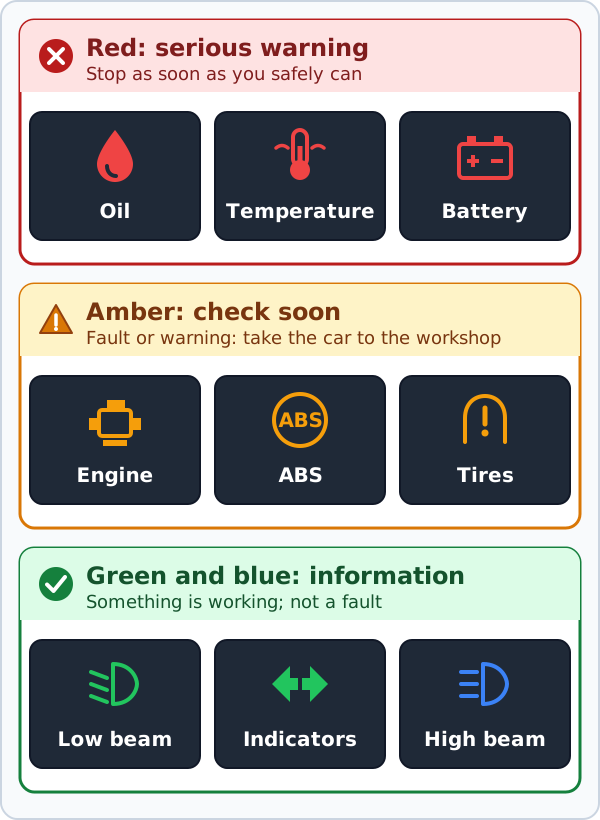
Figure 5. Red: stop safely. Amber: to the workshop soon. Green and blue: they tell you that something is working. They are simple pictograms, not the official ones from your car.
| Color | What it means | What you do | Examples |
|---|---|---|---|
| Red | Danger or serious fault | Stop the car as soon as you can do so safely and do not keep driving until you find out the cause | Oil pressure, excessive coolant temperature, battery charging, brakes or parking brake applied |
| Amber (orange or yellow) | Fault or warning that is not immediate | Check the car soon and take it to the workshop | Engine (injection), ABS, tire pressure, particulate filter |
| Green or blue | Information: something is working | Nothing, except checking that what it turns on is what you wanted | Low beam and indicators (green), high beam (blue) |
Tire pressure monitoring (TPMS) has been mandatory in new passenger cars since 1 November 2014, and in new vans (category N1) since 7 July 2024. It does not have to be installed in earlier vehicles. Its warning lamp tells you if a wheel is losing pressure.
Watch out in the exam: the alternator or battery warning lamp, on with the engine running, means that the battery is not being charged. The oil warning lamp warns of a lack of pressure, not only a lack of quantity.
9. Mandatory equipment
Annex XII of the General Vehicle Regulations sets what the car must carry:
| Vehicle | Equipment |
|---|---|
| Passenger car and dual-purpose vehicle or goods van up to 3,500 kg MAM | The connected V-16 warning light. A high-visibility reflective vest. A complete spare wheel, or a temporary-use one with the tools to change it, or an alternative system (for example, a puncture repair kit) that gives guarantees of mobility |
| Bus, dual-purpose or goods vehicle over 3,500 kg, and non-special combined vehicles | The above (V-16 and vest) and also an approved fire extinguisher |
- With the puncture repair kit, it is not mandatory to carry a spare wheel, but you drive within the limitations of that alternative. A temporary-use wheel is also valid, with its speed and distance limitations (you will see them in Adherence, Tires and Brakes).
- The tools you must carry are those for changing a wheel (jack and wrench). A pump or a compressor is not essential.
- A passenger car is not required to carry a fire extinguisher. A combined vehicle (passenger car with a trailer) is, and it does not need a specific spare wheel for the trailer.
- The vest the rules require is the driver's. It is not mandatory to carry one for each passenger, although it is recommended. A vest exposed to sunlight for a long time loses its reflective capacity.
- You no longer have to carry a set of spare bulbs with the tools to change them.
- Mirrors: a passenger car carries at least two, the interior one and the left exterior one. The right exterior one is optional, unless the interior one does not let you see 60 meters behind in a width of 20 meters: then it is mandatory.
Watch out in the exam: if you are asked how many triangles a passenger car must carry today, the answer is none: the mandatory device is the connected V-16.
10. What to check before a trip
| What | How |
|---|---|
| Tires (the spare too) | Pressure and tread condition |
| Levels | Oil (dipstick, cold engine and level ground), coolant (expansion tank), brake fluid and washer water |
| Brakes | That they respond well and without noises; that there are no leaks |
| Lights | All of them: low beam, high beam, position, brake and indicators |
| Windshield wipers | Blades in good condition and reservoir with fluid. If you expect rain, pay special attention to tires and windshield wipers |
| Battery | Terminals clean, tight and greased |
| Water pump belt | Condition and tension |
| Mirrors | Adjust the exterior one every time you get in. The interior one is adjusted with the car stopped and on level ground, not while moving |
| Seatbelts | Check the anchorages and the buckles from time to time |
| Equipment | V-16, vest and spare wheel or kit |
After a beach vacation, it is advisable to clean the car thoroughly: salt causes corrosion.
11. Refueling safely
When refueling you must stop the engine and switch off the lights, the electrical systems (such as the radio) and the devices that emit electromagnetic radiation, such as the mobile phone. It is mandatory, and it applies equally whether you refuel yourself or an employee does, who must not serve you fuel if you do not comply (article 115 of the General Traffic Regulations).
What has changed in the rules
- 1 January 2026 (Royal Decree 159/2021). The connected V-16 is the only valid hazard warning device and is part of the mandatory equipment of the passenger car. Triangles are no longer a valid means. If an old question treats two triangles as mandatory, it predates that date.
Numbers you need to know
| What | Figure | Nuance |
|---|---|---|
| First ITV of a passenger car | 4 years | From the date of first registration |
| Next ITV | Every 2 years; every year over 10 | If the result is favorable |
| First ITV of a van (up to 3.5 t) | 2 years | Every 2 years from 2 to 6, every year from 6 to 10, every 6 months over 10 |
| Taxi, ambulance, school transport | Every year up to 5 years; every 6 months after that | Passenger cars |
| Validity of the ITV | From the favorable result | If you take it within the 30 days before expiry, from the expiry date |
| Minor defects | 2 months to repair them | No new inspection |
| Unfavorable or failed | 2 months to return to the ITV | From the first inspection. Failed: no driving |
| Officers' deadline | 10 days | After that, ex officio deregistration |
| Fine for an expired ITV | 200 euros | Serious offense |
| Battery of a passenger car | 12 volts | Top up only with distilled water |
| Catalytic converter | About 250 degrees | Exam figure |
| Brake fluid | Every 2 or 3 years | Exam guideline; the manufacturer prevails |
Summary
- Taking the ITV is the holder's obligation. A passenger car takes it for the first time 4 years after first registration, then every 2 years and, over 10, every year.
- The ITV period is counted from the favorable result; if you go 30 days early, from the expiry date.
- With an unfavorable result you go only to the workshop and back to the ITV; with a failed one, the car is not driven.
- The V-19 is stuck on the upper right corner of the windshield, on the inside.
- The open exhaust, a deteriorated silencer, resonator pipes and exceeding the limits for noise, gases and fumes are prohibited.
- Oil: level with the dipstick, cold engine and car on level ground; all the oil and the filter are changed when the manufacturer says.
- Coolant: mixture of water and antifreeze, level between minimum and maximum in the expansion tank.
- Battery: terminals clean and greased; if it requires maintenance, only distilled water.
- Clutch: depress it fully before changing gear. The drive wheels can be the front, the rear or all of them.
- Red, stop as soon as you can safely; amber, workshop soon; green and blue, information.
- Mandatory equipment of the passenger car: V-16, vest and spare wheel or alternative system. Fire extinguisher, no.
- When refueling: engine off, lights, radio and mobile phone off.
Check your understanding
1. You bought a new passenger car for private use 3 years ago. When does it take its first ITV and when the next one, if the result is favorable?
Answer
The first one, 4 years after first registration, that is, in a year's time. The next one, 2 years later. Over 10 years old, it will take the ITV every year.
2. At the ITV you are given an “unfavorable” result. Are you allowed to keep using the car?
Answer
Only to take it to the workshop and return to the ITV, within a maximum of 2 months from the first inspection. With a “failed” result not even that: the car goes by other means, such as a tow truck.
3. When you start with the engine already hot, black smoke comes out of the exhaust. What does it indicate and what do you do?
Answer
Poor combustion, from too much fuel or too little air (for example, a dirty air filter). The car must be taken to be checked. Bluish smoke would indicate that it is burning oil.
4. You want to check the oil. How do you leave the car?
Answer
With the engine cold and the car in a horizontal position. You read the dipstick: the mark must fall between the minimum and the maximum.
5. A red oil warning lamp comes on while you are driving. What do you do and what does it indicate?
Answer
You stop the car as soon as you can do so safely. The red oil warning lamp warns of a lack of oil pressure: continuing to drive can damage the engine.
6. What mandatory equipment does a passenger car carry and what not?
Answer
It carries the connected V-16, a reflective vest and a spare wheel (complete or temporary-use) or an alternative system, such as a puncture repair kit. It is not mandatory to carry triangles, a fire extinguisher or spare bulbs.
Frequently asked questions about Car Maintenance
Driving with Unauthorized Major Vehicle Modifications
Can you drive without an exhaust silencer?
Is the Exhaust Silencer Device Mandatory?
Mandatory Devices in Internal Combustion Engines
Mandatory Car Accessories in Spain
Mandatory Safety Measures When Refueling a Vehicle
Vehicle Noise and Emission Limits
When to Replace the Cabin or Pollen Filter in a Vehicle
Prohibition of Driving with Open Exhaust
Is driving with excessive noise allowed?
Topic test
444 questions available for this topic.